
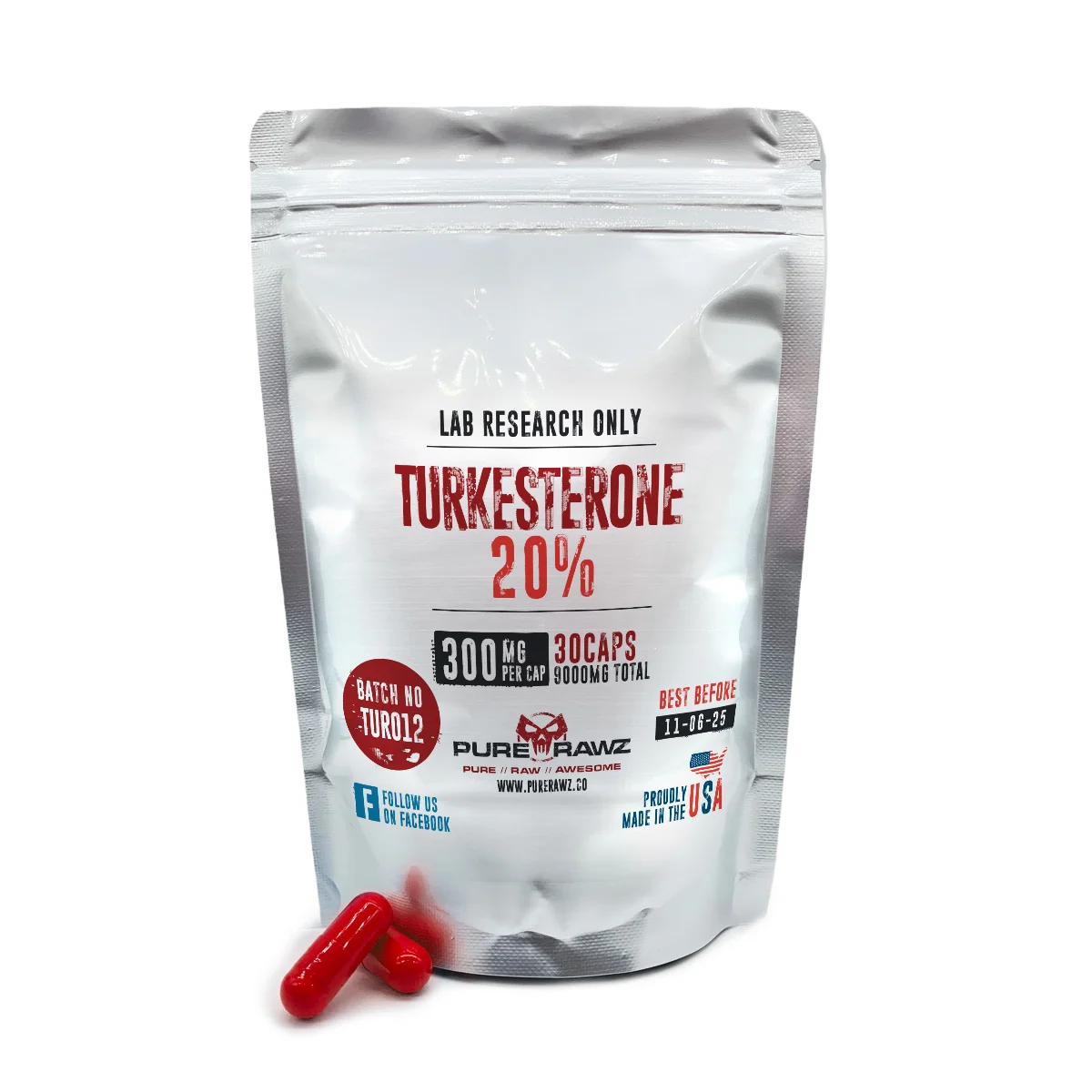
Turkesterone
Price range: $37.71 through $45.33
Earn 38 - 45 points upon purchasing this product.
Check Out Alternative Here!
Looking for something with similar applications? Check out our Test Drol (Turkesterone 20% + Ecdysterone 99% + 5a-Hydroxy Laxogenin). A great alternative with comparable research applications!

Test Drol (Turkesterone 20% + Ecdysterone 99% + 5a-Hydroxy Laxogenin)
✅ 99% Purity – Third-Party Tested
🚚 Free U.S. Shipping on Orders $100+
 Proudly Made in the USA
⚡ Fast & Reliable Shipping
🔒 Secure Checkout Guaranteed
Enjoy 24/7 customer support, 1st & 3rd party verified 99% purity, and free shipping on orders over $100!
Description
Overview
Turkesterone is a naturally occurring ecdysteroid compound. It is isolated from several plant species. This includes Ajuga turkestanica. Ecdysteroids are steroid-like molecules that share structural similarities with insect molting hormones. All of them are commonly studied in biochemical and phytochemical research environments.
In experimental research, Turkesterone is investigated as a phytoecdysteroid molecule. This is the one that is capable of interacting with ecdysteroid receptor systems and related signaling pathways in controlled laboratory models. Studies of this compound often focus on:
- receptor interactions
- molecular signaling, and
- structure-activity relationships (in steroid-like natural products)
Turkesterone is supplied strictly as a research material intended for laboratory investigation.
Turkesterone
| Property | Description |
| Compound Name | Turkesterone |
| CAS Number | 41451-87-0 |
| Molecular Formula | C27H44O8 |
| Molecular Weight | 496.63 g/mol |
| Chemical Class | Phytoecdysteroid |
| Research Category | Natural steroid-like research compound |
| PubChem CID | 14376672 |
| Source | Plant-derived ecdysteroid (e.g., Ajuga turkestanica) |
Mechanism of Action
Ecdysteroid Receptor Interaction
Turkesterone has been investigated in experimental assays. This is done for its ability to interact with ecdysteroid receptor complexes (ECR). In vitro studies have shown that the compound may bind to receptor complexes. These are the ones involved in steroid-like signaling pathways within certain biological systems.
Steroid-Like Molecular Signaling
As a phytoecdysteroid, Turkesterone possesses a cyclopentaphenanthrene steroid-like ring structure. It also has multiple hydroxyl groups that may participate in hydrogen-bond interactions with receptor sites in biochemical assays.
Researchers analyze these structural characteristics to study how ecdysteroid molecules affect:
- ligand-receptor binding dynamics
- transcriptional signaling pathways, and
- molecular regulatory mechanisms (in controlled laboratory models)
Structure-Activity Relationship Research
Because of its steroid-like scaffold and multiple functional groups, Turkesterone is frequently examined in structure-activity relationship (SAR) investigations. These studies evaluate how modifications to ecdysteroid molecules influence receptor interaction, molecular stability, and ligand binding behavior.
Research Applications
Within controlled laboratory environments, Turkesterone may be utilized for investigations involving:
- phytoecdysteroid receptor interaction studies
- molecular signaling pathway analysis involving steroid-like compounds
- structure-activity relationship research of ecdysteroid molecules
- analytical and phytochemical characterization of plant-derived steroids
- receptor-binding and ligand interaction assays
All applications are limited strictly to analytical and experimental research environments.
Why Choose Purerawz?
Buy Turkesterone for laboratory research use from our online shop. At Purerawz, we provide high-quality reference materials. Each compound is supplied with an independent third-party Certificate of Analysis verifying identity, purity, and concentration.
Note: Turkesterone is an investigational compound currently undergoing scientific evaluation and has not been established as safe or effective for any therapeutic application.
Disclaimer
This information is for educational purposes only and does not constitute medical advice.
THE PRODUCTS DESCRIBED HEREIN ARE FOR LABORATORY AND RESEARCH USE ONLY. All clinical research must be conducted with oversight from the appropriate Institutional Review Board (IRB). All preclinical research must be conducted with oversight from the Institutional Animal Care and Use Committee (IACUC) in accordance with the guidelines of the Animal Welfare Act (AWA).
Our content is intended to be used for informational purposes only. It is important to conduct independent analysis and review research from trusted sources before making any purchase decision.
By completing and paying for your order, you agree to our Terms and Conditions. Customer satisfaction is our priority. If you are not fully satisfied with the product you received, please contact support@staging.purerawz.co.
ATTENTION: All products are for LABORATORY AND RESEARCH PURPOSES ONLY, not for veterinary or human use.
References
Todorova, V., Ivanova, S., Chakarov, D., Kraev, K., & Ivanov, K. (2024). Ecdysterone and Turkesterone—Compounds with Prominent Potential in Sport and Healthy Nutrition. Nutrients, 16(9), 1382. https://doi.org/10.3390/nu16091382
Guibout, L., Mamadalieva, N., Balducci, C., Girault, J., & Lafont, R. (2015). The minor ecdysteroids from Ajuga turkestanica. Phytochemical Analysis, 26(5), 293-300. https://doi.org/10.1002/pca.2563/

Dr. Helma Wennemers
Dr. Helma Wennemers is a globally recognized chemist shaping modern peptide science and molecular design through highly original research in applied biosciences.
Her work explores how precise molecular architecture can be engineered to create new functional systems in chemistry and life sciences. Her contributions continue to redefine contemporary chemical research through creativity, depth, and structural innovation.
Please click here to access instructions on how to make a payment.
How to PayRelated products
-

TUDCA
Price range: $37.76 through $67.49 Select options This product has multiple variants. The options may be chosen on the product page -
BHB Keto Salts
$18.35 Select options This product has multiple variants. The options may be chosen on the product page -
Palmitoylethanolamide (PEA) – With Levagen Capsules
$43.60 Select options This product has multiple variants. The options may be chosen on the product page -
Agmatine Sulfate
$19.66 Select options This product has multiple variants. The options may be chosen on the product page


