
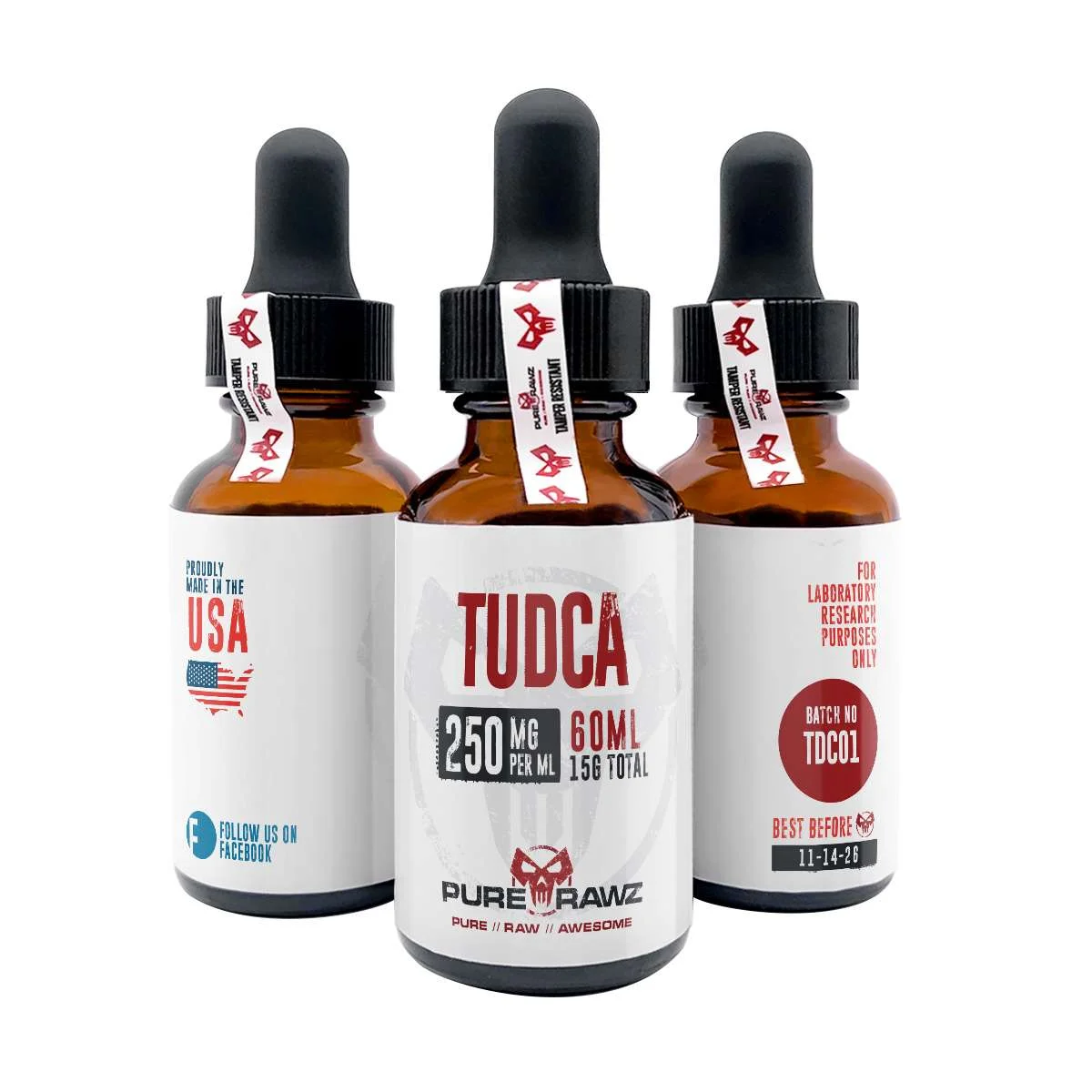
TUDCA
Price range: $37.76 through $67.49
Earn 38 - 67 points upon purchasing this product.
✅ 99% Purity – Third-Party Tested
🚚 Free U.S. Shipping on Orders $100+
 Proudly Made in the USA
⚡ Fast & Reliable Shipping
🔒 Secure Checkout Guaranteed
Enjoy 24/7 customer support, 1st & 3rd party verified 99% purity, and free shipping on orders over $100!
Description
TUDCA (Tauroursodeoxycholic Acid)
Product Overview
Tauroursodeoxycholic acid (TUDCA) is a taurine-conjugated bile acid derivative that has been widely investigated in biochemical and cellular research. It is formed by the conjugation of ursodeoxycholic acid (UDCA) with the amino acid taurine and is naturally present in small amounts in bile acid pools in certain mammals.
TUDCA has drawn interest in experimental research looking at cell survival pathways, mitochondrial function, and bile acid signaling systems since bile acids are crucial regulators of lipid metabolism, cellular stress signaling, and digestive functions.
PureRawz supplies TUDCA strictly for laboratory and scientific research purposes. This is not FDA-approved and should not be used as a dietary supplement.
| Property | Description |
| Compound Name | Tauroursodeoxycholic Acid (TUDCA) |
| Chemical Class | Taurine-conjugated bile acid |
| Molecular Formula | C26H45NO6S |
| Molecular Weight | 499.7 g/mol |
| CAS Number | 14605-22-2 |
| Appearance | White to off-white powder |
| Solubility | Soluble in water and polar solvents |
| IUPAC | 2-[[(4R)-4-[(3R,5S,7S,8R,9S,10S,13R,14S,17R)-3,7-dihydroxy-10,13-dimethyl-2,3,4,5,6,7,8,9,11,12,14,15,16,17-tetradecahydro-1H-cyclopenta[a]phenanthren-17-yl]pentanoyl]amino]ethanesulfonic acid |
Mechanism of Action
Research suggests that TUDCA may interact with several cellular pathways involved in stress regulation and metabolic homeostasis.
In experimental systems, investigators have examined how TUDCA may influence endoplasmic reticulum (ER) stress responses, a cellular process associated with protein folding and quality control. Disruptions in ER function can lead to activation of apoptosis signaling pathways.
Additionally, because TUDCA is a bile acid derivative, researchers study its role in bile acid metabolism and transport systems, which are important for lipid digestion and hepatic physiology.
Research Applications
TUDCA has been studied by researchers in many clinical settings, such as:
- Research on the signaling mechanisms involved in endoplasmic reticulum stress
- Studies on oxidative stress reactions and mitochondrial stability
- Experimental models assessing cellular survival and apoptotic regulation
- Studies of liver physiology and bile acid metabolism
- Laboratory studies looking at models of neurodegenerative diseases
- Research on cellular adaptability and metabolic signaling pathways
Why Buy TUDCA from PureRawz?
PureRawz provides research-grade compounds tested for identity and purity. Each batch of TUDCA is accompanied by a Certificate of Analysis (COA) for verification. Orders of $100 or more qualify for free shipping, and PureRawz periodically offers promotional discounts for research supply purchases.
Research Disclaimer
The information presented here is intended for educational and research reference purposes only.
All products sold by PureRawz are supplied strictly for laboratory and scientific research use and are not intended for human or veterinary consumption.
Research involving this compound should be conducted only by qualified professionals and must comply with applicable regulatory guidelines, including Institutional Review Board (IRB) or Institutional Animal Care and Use Committee (IACUC) oversight where appropriate.
For product information, support, or order inquiries: support@staging.purerawz.co.
References
Amaral, J. D., Viana, R. J., Ramalho, R. M., Steer, C. J., & Rodrigues, C. M. P. (2009). Bile acids: Regulation of apoptosis by ursodeoxycholic acid. Journal of Lipid Research, 50(9), 1721 1734. https://doi.org/10.1194/jlr.R900011-JLR200
Keene, C. D., Rodrigues, C. M., Eich, T., et al. (2002). Tauroursodeoxycholic acid, a bile acid, is neuroprotective in a transgenic mouse model of Huntington’s disease. Proceedings of the National Academy of Sciences, 99(16), 10671 10676.
Vang, S., Longley, K., Steer, C. J., & Low, W. C. (2014). The unexpected uses of urso- and tauroursodeoxycholic acid in the treatment of non-liver diseases. Global Advances in Health and Medicine, 3(3), 58 69.

Dr. Helma Wennemers
Dr. Helma Wennemers is a globally recognized chemist shaping modern peptide science and molecular design through highly original research in applied biosciences.
Her work explores how precise molecular architecture can be engineered to create new functional systems in chemistry and life sciences. Her contributions continue to redefine contemporary chemical research through creativity, depth, and structural innovation.
Please click here to access instructions on how to make a payment.
How to PayRelated products
-

Any Cycle Capsules
$26.10 Select options This product has multiple variants. The options may be chosen on the product page -
ZMA Pure
$26.76 Select options This product has multiple variants. The options may be chosen on the product page -
Slin
$30.59 Select options This product has multiple variants. The options may be chosen on the product page -
Super Omega
$19.89 Select options This product has multiple variants. The options may be chosen on the product page


