
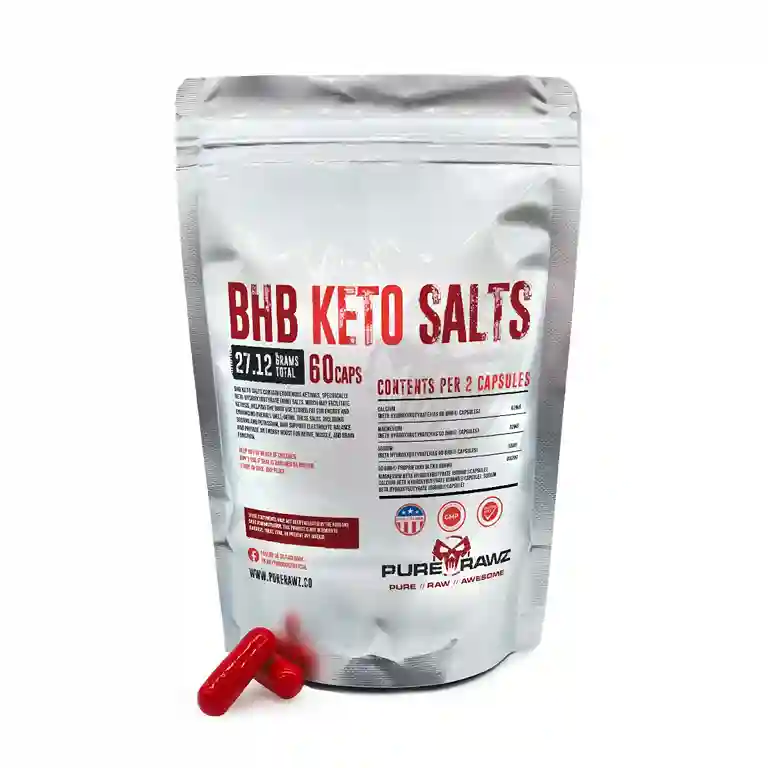
BHB Keto Salts
$18.35
Earn 18 points upon purchasing this product.
✅ 99% Purity – Third-Party Tested
🚚 Free U.S. Shipping on Orders $100+
 Proudly Made in the USA
⚡ Fast & Reliable Shipping
🔒 Secure Checkout Guaranteed
Enjoy 24/7 customer support, 1st & 3rd party verified 99% purity, and free shipping on orders over $100!
Description
BHB Keto Salts - Overview
BHB Keto Salts are a class of research compounds containing the ketone body β-hydroxybutyrate (BHB) combined with specific mineral salts (e.g., sodium, calcium, and magnesium).
BHB is a naturally occurring ketone body produced during states of low carbohydrate availability. In research settings, BHB keto salts are being investigated for their potential role in energy metabolism, cellular signaling, and metabolic applications.
Mechanism of Action of BHB Keto Salts
The mechanism of action of BHB Keto Salts can be described in two main dimensions: energetic metabolism and molecular signaling.
Energetic Metabolism
- Alternative Fuel Source: In metabolic research, BHB is observed to enter the cell via monocarboxylate transporters (MCTs). Once inside, it is converted into acetoacetate, which will become acetyl-CoA. The latter participates in the citric acid cycle to generate ATP.
- Tissue Utilization: Certain studies suggest that heart, skeletal muscle, and brain cells may readily oxidize BHB. This may occur under the conditions of limited glucose availability.
- Electrolyte Role: The accompanying mineral salts could support ion balance. This could influence hydration and nerve signaling in experimental models.
Molecular & Signaling Pathways
- Epigenetic Regulation: BHB has been shown to inhibit class I histone deacetylases (HDACs). This action enables BHB to influence gene expression and possibly alter stress-response pathways.
- Inflammation & Oxidative Stress: Research suggests that BHB may interact with the NLRP3 inflammasome, potentially modulating inflammatory responses.
- Neuroprotection: BHB is studied as a signaling molecule in neuronal cells. In this action, the research compound may affect neurotransmitter balance, mitochondrial efficiency, and resistance to oxidative stress.
- Metabolic Signaling: Some studies classify BHB as a ligand for receptors, such as HCAR2 (hydroxycarboxylic acid receptor 2). The latter has been linked to lipid metabolism within research settings.
What are the potential research benefits of BHB Keto Salts?
BHB in metabolic research models
Elevated blood glucose is a known key driver of oxidative stress and inflammation in metabolic disorders. Research indicates that exogenous ketones, BHB included, may help lower blood glucose levels in rodent models. The effect was observed with or without underlying pathology.
BHB in cardiovascular metabolism studies
Clinical and experimental studies have shown that ketone salts have led to increased blood ketone levels. This effect appeared to be safe for short-term administration. BHB Keto Salts administration was linked to reductions in systolic and diastolic blood pressure. It was also believed to improve insulin sensitivity and better lipid profiles.
BHB Keto Salts for Neurological Models
Cell culture studies suggest ketone bodies, such as BHB, may protect neurons from mitochondrial dysfunction. Some findings indicate potential neuroprotective effects that may be relevant to Alzheimer's and Parkinson's disease models. However, current evidence is limited to cell and animal studies.
BHB Keto Salts for Oxidation and Inflammation
Both in vivo and in vitro models have shown that BHB may help lower levels of oxidative stress. This is achieved by lowering reactive oxygen species (ROS) production. BHB has also shown promise in modulating the NLRP3 inflammasome. The latter is a key driver of inflammation.
Note: BHB salts are used as ingredients in dietary supplements, especially those related to ketogenic nutrition. This product is supplied for dietary and nutrition research purposes only.
Current Research On BHB Keto Salts
- A 90-day study compared exogenous BHB salts with a placebo. Afterward, blood markers, bone density, blood pressure, and psychological measures were all monitored. Results showed no significant adverse effects, indicating that BHB salts were well-tolerated under the study conditions.
- A randomized, triple-blind, placebo-controlled study measured the effects of ketone salts (KS) among research models. Results showed that KS significantly increased plasma acetoacetate (AcAc) compared to placebo. Utilizing a specific analysis approach, the study suggested that KS promotes ketone body interconversion, supporting their role in energy metabolism research.
- One review explores the role of ketone bodies in cardiac metabolism. Evidence indicates that during heart failure (HF), ketone metabolism becomes an adaptive fuel source. This is believed to help sustain cardiac function and limit disease progression.
What is the best place to buy BHB Keto Salts?
PurRawz provides high-quality BHB Keto Salts for research purposes only. All products have been tested for purity and authenticity. This practice supports reliable laboratory results. Customers may directly order BHB Keto Salts and other related investigational compounds through PureRawz's website.
Disclaimer
This information is for educational purposes only and not medical advice. Products are for research use only. Research must follow IRB or IACUC guidelines. Verify information independently before purchasing. By ordering, you agree to our Terms and Conditions. If you are not 100% satisfied with the product you received, please contact us at support@staging.purerawz.co
ATTENTION: All our products are for LABORATORY AND RESEARCH PURPOSES ONLY, not for veterinary or human use
Reference Links
Garcia, C., Banerjee, A., Montgomery, C., Adcock, L., Maezawa, I., Ramsey, J., Grodzki, A. C. G., Kim, K., & Cortopassi, G. (2025). Beta-hydroxybutyrate (BHB) elicits concentration-dependent anti-inflammatory effects on microglial cells, which are reversible by blocking its monocarboxylate (MCT) importer. Frontiers in Aging, 6.https://doi.org/10.3389/fragi.2025.1628835
Pali, D. V., Kim, S., Mantik, K. E. K., Lee, J.-B., So, C.-Y., Moon, S., Park, D.-H., Kwak, H.-B., & Kang, J.-H. (2025). Unraveling the Translational Relevance of β-Hydroxybutyrate as an Intermediate Metabolite and Signaling Molecule. International Journal of Molecular Sciences, 26(15), 7362.https://doi.org/10.3390/ijms26157362
Shimazu, T., Hirschey, M. D., Newman, J., He, W., Shirakawa, K., Le Moan, N., Grueter, C. A., Lim, H., Saunders, L. R., Stevens, R. D., Newgard, C. B., Farese, R. V., de Cabo, R., Ulrich, S., Akassoglou, K., & Verdin, E. (2012). Suppression of Oxidative Stress by - Hydroxybutyrate, an Endogenous Histone Deacetylase Inhibitor. Science, 339(6116), 211–214.https://doi.org/10.1126/science.1227166
Jang, J., Su Rim Kim, Jo Eun Lee, Seo Yeon Lee, Hyeong Jig Son, Choe, W., Yoon, K., Sung Soo Kim, Yeo, E., & Kang, I. (2023). Molecular Mechanisms of Neuroprotection by Ketone Bodies and Ketogenic Diet in Cerebral Ischemia and Neurodegenerative Diseases. International Journal of Molecular Sciences, 25(1), 124-124.https://doi.org/10.3390/ijms25010124
Ari, Murdun, Koutnik, Goldhagen, Rogers, Park, Bharwani, Diamond, Kindy, D'Agostino, & Kovacs. (2019). Exogenous Ketones Lower Blood Glucose Level in Rested and Exercised Rodent Models. Nutrients, 11(10), 2330.https://doi.org/10.3390/nu11102330
Holland, A. M., Qazi, A. S., Beasley, K. N., & Bennett, H. R. (2019). Blood and cardiovascular health parameters after supplementing with ketone salts for six weeks. Journal of Insulin Resistance, 4(1).https://doi.org/10.4102/jir.v4i1.47
Kashiwaya, Y., Takeshima, T., Mori, N., Nakashima, K., Clarke, K., & Veech, R. L. (2000). D-beta-Hydroxybutyrate protects neurons in models of Alzheimer's and Parkinson's disease. Proceedings of the National Academy of Sciences, 97(10), 5440-5444. https://doi.org/10.1073/pnas.97.10.5440
Wang, L., Chen, P., & Xiao, W. (2021). β-hydroxybutyrate as an Anti-Aging Metabolite. Nutrients, 13(10), 3420. https://doi.org/10.3390/nu13103420
Stefan, M., Sharp, M., Gheith, R., Lowery, R., & Wilson, J. (2021). The Effect of Exogenous Beta-Hydroxybutyrate Salt Supplementation on Metrics of Safety and Health in Adolescents. Nutrients, 13(3), 854.https://doi.org/10.3390/nu13030854
Holland-Winkler, A., Moore, A., & Bederman, I. (2025). Effectiveness of Exogenous Ketone Salts in Enhancing Circulating Acetoacetate Levels-A Pilot Study in Healthy Adults. Nutrients, 17(10), 1665.https://doi.org/10.3390/nu17101665
Matsuura, T. R., Puchalska, P., Crawford, P. A., & Kelly, D. P. (2023). Ketones and the Heart: Metabolic Principles and Therapeutic Implications. Circulation Research, 132(7), 882-898.https://doi.org/10.1161/circresaha.123.321872

Dr. Helma Wennemers
Dr. Helma Wennemers is a globally recognized chemist shaping modern peptide science and molecular design through highly original research in applied biosciences.
Her work explores how precise molecular architecture can be engineered to create new functional systems in chemistry and life sciences. Her contributions continue to redefine contemporary chemical research through creativity, depth, and structural innovation.
Please click here to access instructions on how to make a payment.
How to PayRelated products
-

Attention Capsules
$32.49 Select options This product has multiple variants. The options may be chosen on the product page -
Adreno
$19.89 Select options This product has multiple variants. The options may be chosen on the product page -
BAM15
Price range: $187.94 through $514.93 Select options This product has multiple variants. The options may be chosen on the product page -
Lean Shed
$36.33 Select options This product has multiple variants. The options may be chosen on the product page


