
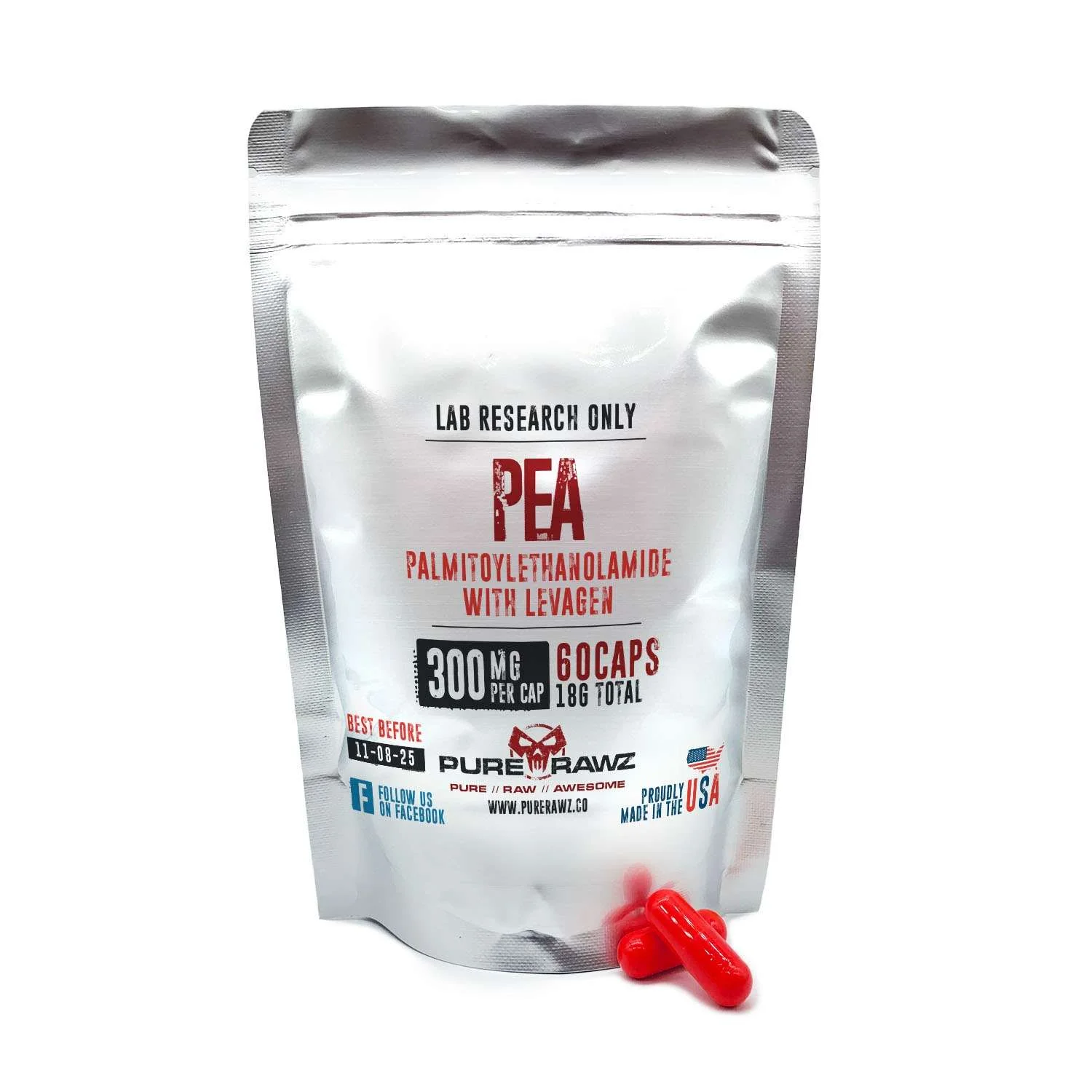
Palmitoylethanolamide (PEA) – With Levagen Capsules
$43.60
Earn 44 points upon purchasing this product.
✅ 99% Purity – Third-Party Tested
🚚 Free U.S. Shipping on Orders $100+
 Proudly Made in the USA
⚡ Fast & Reliable Shipping
🔒 Secure Checkout Guaranteed
Enjoy 24/7 customer support, 1st & 3rd party verified 99% purity, and free shipping on orders over $100!
Description
Palmitoylethanolamide (PEA)-Product Information
Overview of Palmitoylethanolamide
Palmitoylethanolamide (PEA) is an endogenous fatty acid amide belonging to the N‑acylethanolamine (NAE) class of lipid signaling molecules. It is biosynthesized from membrane phospholipids and has been identified in multiple mammalian tissues. In investigational research, PEA is examined for its interactions with lipid‑responsive signaling networks and cellular regulatory mechanisms. This compound is supplied strictly for laboratory research use and has not been approved by the U.S. Food and Drug Administration (FDA) for any therapeutic or diagnostic application. It is not intended for human or animal consumption.
Chemical and Molecular Properties
| Palmitoylethanolamide | |
| PubChem CID | 4671 |
| Molecular Formula | C18H37NO2 |
| Molecular Weight | 299.5 g/mol |
| Synonyms | Palmidrol
N-(2-Hydroxyethyl)hexadecanamide Palmitoyl ethanolamide |
| IUPAC | N-(2-hydroxyethyl)hexadecanamide |
| CAS | 544-31-0 |
| Labeling | Research Use Only (RUO), not for human or animal consumption. |
| Chemical Structure Depiction | |
| Purity | ≥98% |
| Classification | Endogenous Fatty Acid Amide |
| Storage Temperature | Store capsules in a cool, dry place, away from light and moisture; refrigeration recommended at 2–8 °C for long-term stability |
| Solubility | Soluble in ethanol and DMSO (research‑grade solvents); limited solubility in water |
| Safety | Handle with gloves, a lab coat, eye protection; use a fume hood if dust/aerosol is possible |
Mechanism of Palmitoylethanolamide
Interaction with Nuclear Receptors and Lipid‑Responsive Transcription Factors
Palmitoylethanolamide is examined for its ability to interact with nuclear receptors, particularly peroxisome proliferator‑activated receptor alpha (PPAR‑α). PPAR‑α is a ligand‑activated transcription factor involved in coordinating lipid metabolism and signaling pathways associated with inflammation. Activation of PPAR‑α by PEA in investigational systems promotes receptor dimerization with the retinoid X receptor (RXR) and recruitment to response elements on DNA, influencing transcriptional programs linked to lipid‑responsive and inflammatory signaling networks. These receptor-mediated pathways are central to mechanistic studies examining transcriptional regulation of lipid metabolism and immune signaling molecules.
Modulation of Non‑Neuronal Cell Signaling
PEA has been studied for its effects on non‑neuronal cell signaling, including influences on mast cells and glial cell pathways. These cell types contribute to local signaling cascades in response to cellular stress and inflammatory cues. Experimental results indicate that PEA can modify mast cell activation pathways and glial cell responses, affecting the release of signaling mediators in cellular systems.
Influence on Endocannabinoid‑Related Signaling Networks
While PEA does not bind directly to classical cannabinoid receptors (CB1 or CB2), it is structurally related to endocannabinoids and has been investigated for its ability to modulate the dynamics of related lipid signaling molecules. Some investigational studies suggest that PEA can affect the levels of other fatty acid‑derived mediators by influencing catabolic enzyme activity, such as fatty acid amide hyd
Why Choose Purerawz for Palmitoylethanolamide (PEA)?
Buy Palmitoylethanolamide (PEA) for laboratory research use from our online shop. At Purerawz, we provide high-quality reference materials. Each research compound comes with a Certificate of Analysis for verification of purity and concentration.
Note:
Palmitoylethanolamide is an investigational compound currently undergoing clinical evaluation and has not been established as safe or effective for any therapeutic use
Disclaimer
This information is for educational purposes only and not medical advice. Products are for research use only. Research must follow IRB or IACUC guidelines. Verify information independently before purchasing. By ordering, you agree to our Terms and Conditions. If you are not 100% satisfied with the product you received, please contact us at support@staging.purerawz.co
ATTENTION: All our products are for LABORATORY AND RESEARCH PURPOSES ONLY, not for veterinary or human use
Reference Links
PubChem. (n.d.). Palmitoylethanolamide (CID 4671). PubChem Compound Database. U.S. National Library of Medicine.
https://pubchem.ncbi.nlm.nih.gov/compound/4671
Lambert, D. M., & Di Marzo, V. (1999). The palmitoylethanolamide and oleamide enigmas: are these two fatty acid amides cannabimimetic? Current Medicinal Chemistry, 6(8), 757 773. https://www.sciencedirect.com/science/article/abs/pii/S221343441300176X
Palmitoylethanolamide: A Nutritional Approach to Keep Neuroinflammation within Physiological Boundaries—A Systematic Review. (2020). International Journal of Molecular Sciences, 21(24), 9526. https://pmc.ncbi.nlm.nih.gov/articles/PMC7765232/
Di Marzo, V., Melck, D., Orlando, P., Bisogno, T., Zagoory, O., Bifulco, M., et al. (2001). Palmitoylethanolamide inhibits the expression of fatty acid amide hydrolase and enhances the anti-proliferative effect of anandamide in human breast cancer cells. Biochemical Journal, 358(Pt 1), 249-255. https://pmc.ncbi.nlm.nih.gov/articles/PMC7765232/

Dr. Helma Wennemers
Dr. Helma Wennemers is a globally recognized chemist shaping modern peptide science and molecular design through highly original research in applied biosciences.
Her work explores how precise molecular architecture can be engineered to create new functional systems in chemistry and life sciences. Her contributions continue to redefine contemporary chemical research through creativity, depth, and structural innovation.
Please click here to access instructions on how to make a payment.
How to PayRelated products
-

1-Andro
Price range: $34.41 through $132.80 Select options This product has multiple variants. The options may be chosen on the product page -
AC-262
Price range: $38.44 through $152.06 Select options This product has multiple variants. The options may be chosen on the product page -
19-NOR-ANDRO Blend
Price range: $57.37 through $219.71 Select options This product has multiple variants. The options may be chosen on the product page -
Amino Tadalafil
Price range: $31.13 through $78.15 Select options This product has multiple variants. The options may be chosen on the product page


