
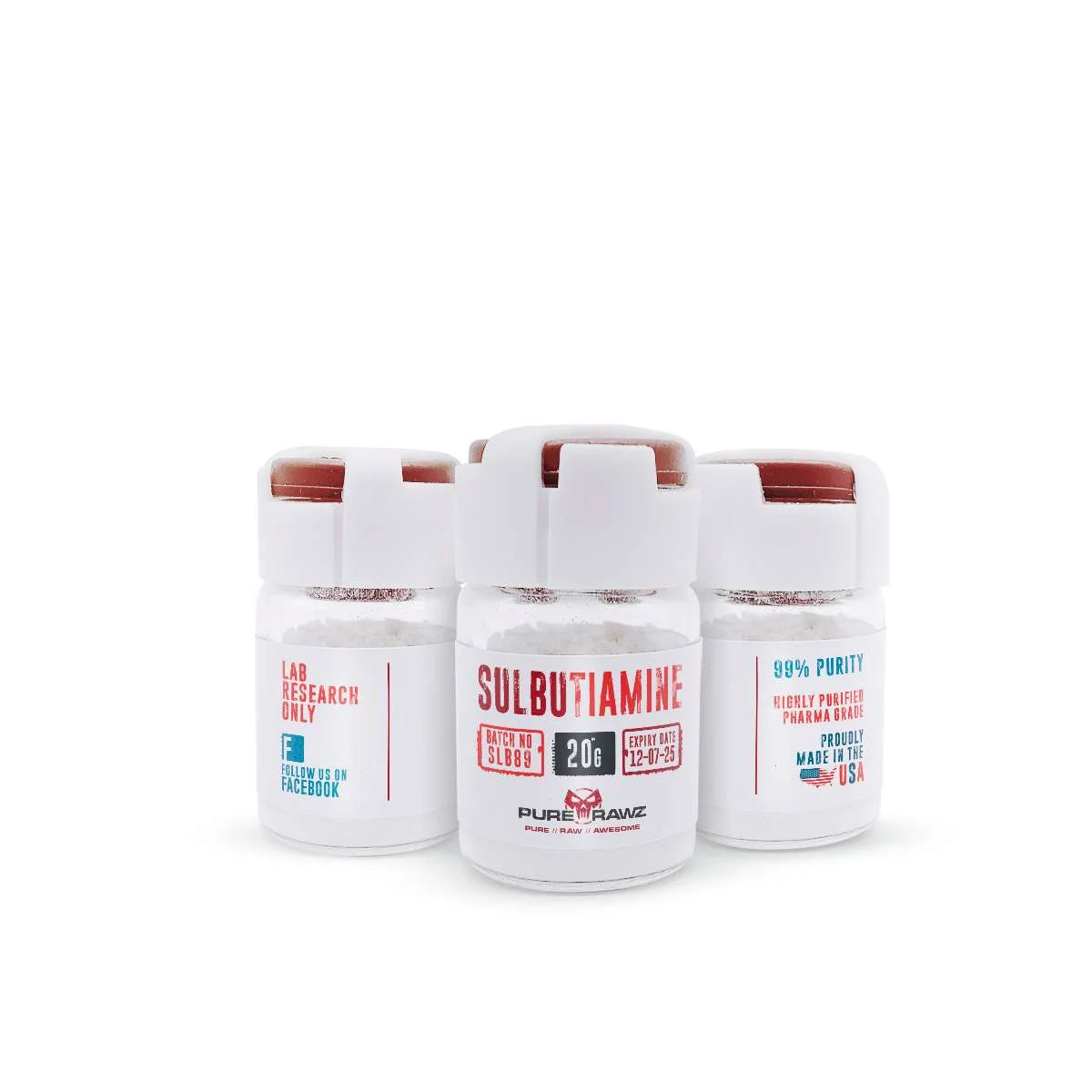
Sulbutiamine
Price range: $17.47 through $61.76
Earn 17 - 62 points upon purchasing this product.
✅ 99% Purity – Third-Party Tested
🚚 Free U.S. Shipping on Orders $100+
 Proudly Made in the USA
⚡ Fast & Reliable Shipping
🔒 Secure Checkout Guaranteed
Enjoy 24/7 customer support, 1st & 3rd party verified 99% purity, and free shipping on orders over $100!
Description
Sulbutiamine Overview
Sulbutiamine is a synthetic derivative of thiamine (vitamin B1) developed through structural modification of the parent vitamin. The compound consists of two modified thiamine molecules connected through a disulfide bridge, which increases lipophilicity compared with native thiamine. This structural feature facilitates membrane permeability. Researchers have suggested that the structural feature may enable the molecule to cross lipid barriers more efficiently than water-soluble thiamine derivatives in preclinical research models.
It is frequently examined as a biochemical tool for studying thiamine metabolism in preclinical research models.
Preclinical studies have suggested that Sulbutiamine may also contribute to intracellular thiamine phosphate formation and neuronal energy pathways. Experimental work focuses on its ability to influence intracellular thiamine derivatives and enzymatic systems that depend on thiamine cofactors.
Note: The product is strictly for research purposes. All the analytical studies are conducted under a strict laboratory environment.
Chemical and Molecular Properties
| Chemical Name | Sulbutiamine |
| CAS Number | 3286-46-2 |
| Molecular Formula | C32H46N8O6S2 |
| Molecular Weight | 702.89 g/mol |
| Structural Class | Thiamine disulfide derivative |
| Physical Appearance | White or off-white crystalline powder |
| Solubility | Soluble in ethanol; slightly soluble in water |
| Key Structural Feature | Two thiamine units connected by a disulfide bridge |
Proposed Working Mechanism of Sulbutiamine
A few experimental studies regarding Sulbutiamine demonstrate increased lipophilicity relative to thiamine. It may facilitate passive diffusion through lipid bilayers in experimental models. This property allows the compound to cross cellular membranes and reach intracellular compartments where enzymatic conversion occurs in research models.
Following cellular entry, reductive cleavage of the disulfide bond may generate thiamine-related intermediates.
These intermediates undergo further enzymatic processing that leads to the formation of phosphorylated thiamine derivatives. The derivatives include thiamine monophosphate (ThMP), thiamine diphosphate (ThDP), and thiamine triphosphate (ThTP).
Note: The product is strictly for research purposes. All the analytical studies are conducted under a strict laboratory environment.
Why Choose Purerawz for Sulbutiamine?
Buy Sulbutiamine for laboratory research use from our online shop. At Purerawz, we provide high-quality reference materials. Each research compound comes with a Certificate of Analysis for verification of purity and concentration.
Disclaimer
This information is for educational purposes only and not medical advice. Products are for research use only. Research must follow IRB or IACUC guidelines. Verify information independently before purchasing. By ordering, you agree to our Terms and Conditions. If you are not 100% satisfied with the product you received, please contact us at support@staging.purerawz.co
Reference Links
Starling-Soares, B., Carrera-Bastos, P., & Bettendorff, L. (2020). Role of the synthetic B1 vitamin sulbutiamine on health. Journal of Nutrition and Metabolism, 2020, 1-9. https://doi.org/10.1155/2020/9349063
Farid, N. F., & Abdelwahab, N. S. (2016). Stability-Indicating HPTLC Method for studying stress degradation behavior of sulbutiamine HCL. Journal of Chromatographic Science, 54(4), 609-617. https://doi.org/10.1093/chromsci/bmv226
Nagae, M., Parniske, M., Kawaguchi, M., & Takeda, N. (2016). The relationship between thiamine and two symbioses: Root nodule symbiosis and arbuscular mycorrhiza. Plant Signaling & Behavior, 11(12), e1265723. https://doi.org/10.1080/15592324.2016.1265723

Dr. Helma Wennemers
Dr. Helma Wennemers is a globally recognized chemist shaping modern peptide science and molecular design through highly original research in applied biosciences.
Her work explores how precise molecular architecture can be engineered to create new functional systems in chemistry and life sciences. Her contributions continue to redefine contemporary chemical research through creativity, depth, and structural innovation.
Please click here to access instructions on how to make a payment.
How to PayRelated products
-

Methylene Blue
Price range: $14.91 through $178.19 Select options This product has multiple variants. The options may be chosen on the product page -
Centrophenoxine
$17.47 Select options This product has multiple variants. The options may be chosen on the product page -
Emoxypine Succinate
$22.93 Select options This product has multiple variants. The options may be chosen on the product page -
Aniracetam
Price range: $60.24 through $130.25 Select options This product has multiple variants. The options may be chosen on the product page


