
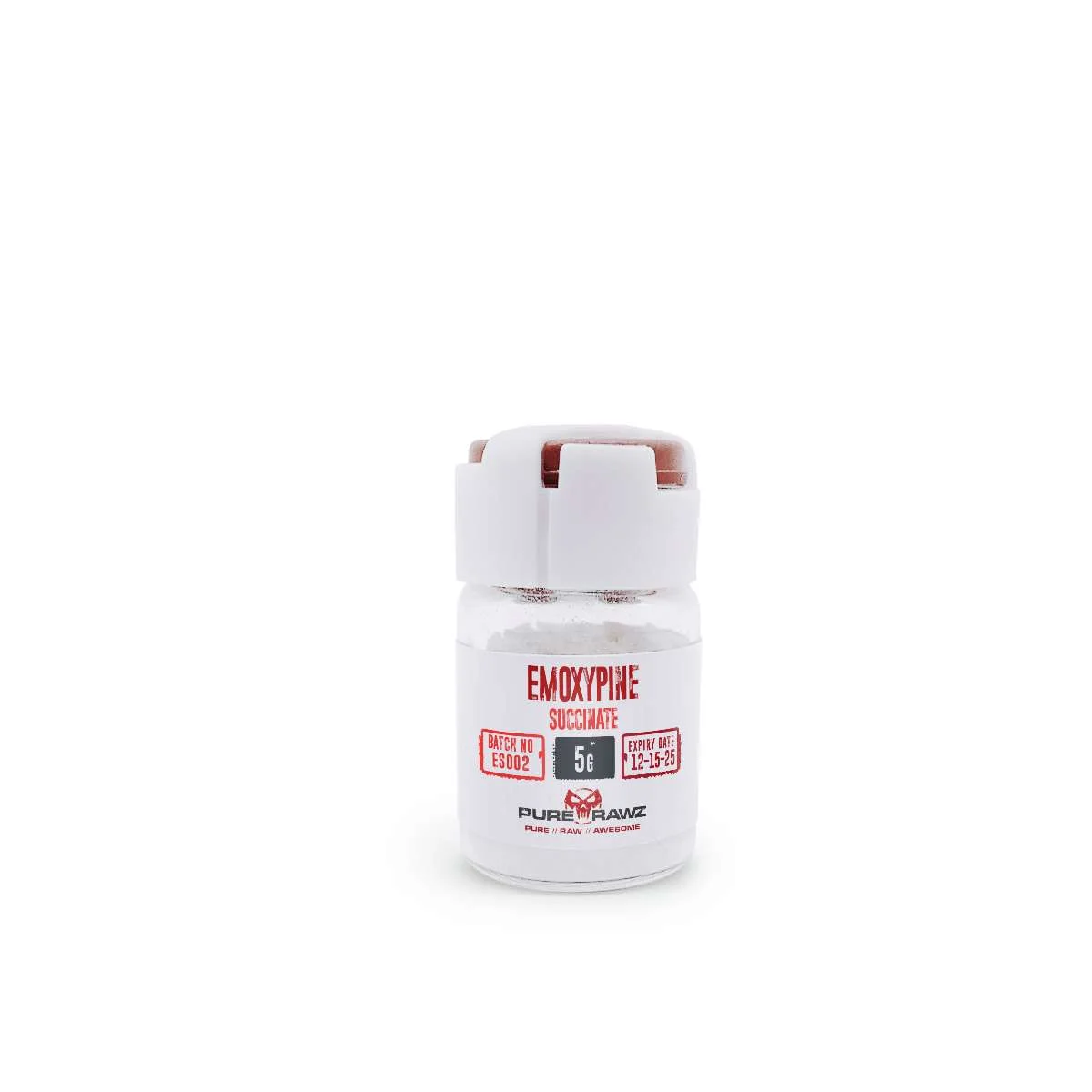
Emoxypine Succinate
$22.93
Earn 23 points upon purchasing this product.
✅ 99% Purity – Third-Party Tested
🚚 Free U.S. Shipping on Orders $100+
 Proudly Made in the USA
⚡ Fast & Reliable Shipping
🔒 Secure Checkout Guaranteed
Enjoy 24/7 customer support, 1st & 3rd party verified 99% purity, and free shipping on orders over $100!
Description
Overview of Emoxypine Succinate
Emoxypine Succinate (2–ethyl–6–methyl–3–hydroxypyridine succinate) is a synthetic compound investigated in experimental and preclinical research for its biochemical and cellular properties. Structurally, it is derived from a 3–hydroxypyridine core and a succinate moiety, which together form a stable salt investigated for mechanisms including redox modulation, membrane interactions, and metabolic signaling in laboratory systems. Emoxypine Succinate is classified as an investigational research compound and is supplied exclusively for research use in controlled experimental settings.
Chemical and Molecular Properties.
| Emoxypine Succinate | |
| PubChem CID | 122298 |
| Molecular Formula | C12H17NO5 |
| Molecular Weight | 255.27 g/mol |
| Synonyms | 127464-43-1
mexidol methylethylpiridinol succinate 2R985002CT |
| IUPAC | butanedioic acid;2-ethyl-6-methylpyridin-3-ol |
| CAS | 127464-43-1 |
| Labeling | Research Use Only (RUO), not for human or animal consumption. |
| Chemical Structure Depiction | 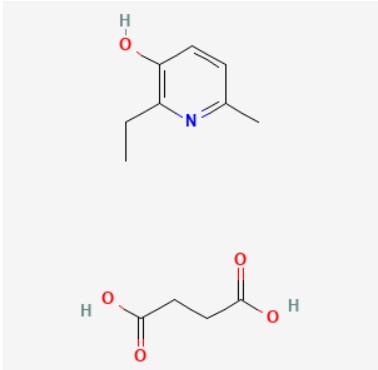 |
| Purity | ≥98% |
| Classification | Investigational research compound |
| Storage Temperature | Store lyophilized at −20 °C, protected from moisture and light |
| Solubility | Soluble in water and research‑grade solvents (e.g., DMSO) once reconstituted |
| Safety | Handle with gloves, a lab coat, eye protection; use a fume hood if dust/aerosol is possible |
Various Mechanisms of Emoxypine Succinate
Antioxidant Activity in Experimental Systems
Emoxypine Succinate exhibits direct antioxidant activity characterized by free radical neutralization and modulation of oxidative stress markers. A mechanistic evaluation showed that the chemical activates endogenous redox pathways by inactivating free radicals and increasing glutathione peroxidase and superoxide dismutase activity in experimental systems under oxidative challenge. Additionally, increased expression of the transcription factor Nrf2 under ischemic conditions has been associated with enhanced cellular resistance to oxidative stress.
Mitochondrial Metabolic Modulation
Preclinical research on succinate-containing derivatives like Emoxypine Succinate suggests involvement in mitochondrial bioenergetic pathways. In isolated tissue models, oxidation of the succinate component within the mitochondrial respiratory chain was highlighted as a compensatory mechanism under limited oxygen availability, supporting cellular resistance to hypoxic stress via enhanced succinate oxidase pathway activity.
Membrane Interaction and Metabolic Signaling
Emoxypine Succinate interacts with cellular membranes, impacting lipid peroxidation rates and stability of phospholipid structures in laboratory models of ischemia-induced damage. Such interactions are studied to understand how structural perturbations affect membrane behavior and related signaling processes.
Research Applications of Emoxypine Succinate
Emoxypine Succinate is utilized in experimental and preclinical research to investigate a range of mechanistic phenomena, including but not limited to:
- Oxidative Stress and Antioxidant Defense Pathways
- Hypoxia–Related Metabolic Pathways
- Gene Expression and Transcriptional Regulation
Why Choose Purerawz for Emoxypine Succinate?
Buy Emoxypine Succinate for laboratory research use from our online shop. At Purerawz, we provide high-quality reference materials. Each research compound comes with a Certificate of Analysis for verification of purity and concentration.
Note:
Emoxypine Succinate is an investigational compound currently undergoing clinical evaluation and has not been established as safe or effective for any therapeutic use
Disclaimer
This information is for educational purposes only and not medical advice. Products are for research use only. Research must follow IRB or IACUC guidelines. Verify information independently before purchasing. By ordering, you agree to our Terms and Conditions. If you are not 100% satisfied with the product you received, please contact us at support@staging.purerawz.co
ATTENTION: All our products are for LABORATORY AND RESEARCH PURPOSES ONLY, not for veterinary or human use
Reference Links
Shchulkin AV. A modern concept of antihypoxic and antioxidant effects of mexidol. Zh Nevrol Psikhiatr Im S S Korsakova. 2018;118(12):87–93. https://pubmed.ncbi.nlm.nih.gov/30830123/
Luk’ianova LD, Atabaeva RE, Shepeleva SIu. Bioenergetic mechanisms of the antihypoxic action of mexidol, the succinate‑containing derivative of 3–hydroxypyridine. Biull Eksp Biol Med. 1993;115(3):259‑60. https://pubmed.ncbi.nlm.nih.gov/8054612/
Terekhina OL, Kirova YI. Effect of ethylmethylhydroxypyridine succinate on expression of PGC–1α, GR, SUCNR1, and SDHA genes in the cerebral cortex of old rats during dexamethasone administration. Bull Exp Biol Med. 2025;179(1):58–63. https://pubmed.ncbi.nlm.nih.gov/40679525/
Emoxypine Succinate—Compound Summary. PubChem Compound Database. National Center for Biotechnology Information. CID 122298. https://pubchem.ncbi.nlm.nih.gov/compound/122298
Mechanism overview of emoxypine succinate antioxidant and membrane protective pathways. Scientific Reports on pharmacological properties of Emoxypine Succinate. (Study compilation) https://www.sciencedirect.com/science/article/pii/S2590257122000414

Dr. Helma Wennemers
Dr. Helma Wennemers is a globally recognized chemist shaping modern peptide science and molecular design through highly original research in applied biosciences.
Her work explores how precise molecular architecture can be engineered to create new functional systems in chemistry and life sciences. Her contributions continue to redefine contemporary chemical research through creativity, depth, and structural innovation.
Please click here to access instructions on how to make a payment.
How to PayRelated products
-

CDP Choline (Citicoline)
$28.41 Select options This product has multiple variants. The options may be chosen on the product page -
Methylene Blue
Price range: $14.91 through $178.19 Select options This product has multiple variants. The options may be chosen on the product page -
Centrophenoxine
$17.47 Select options This product has multiple variants. The options may be chosen on the product page -
Galantamine Hydrobromide
$57.37 Select options This product has multiple variants. The options may be chosen on the product page


