
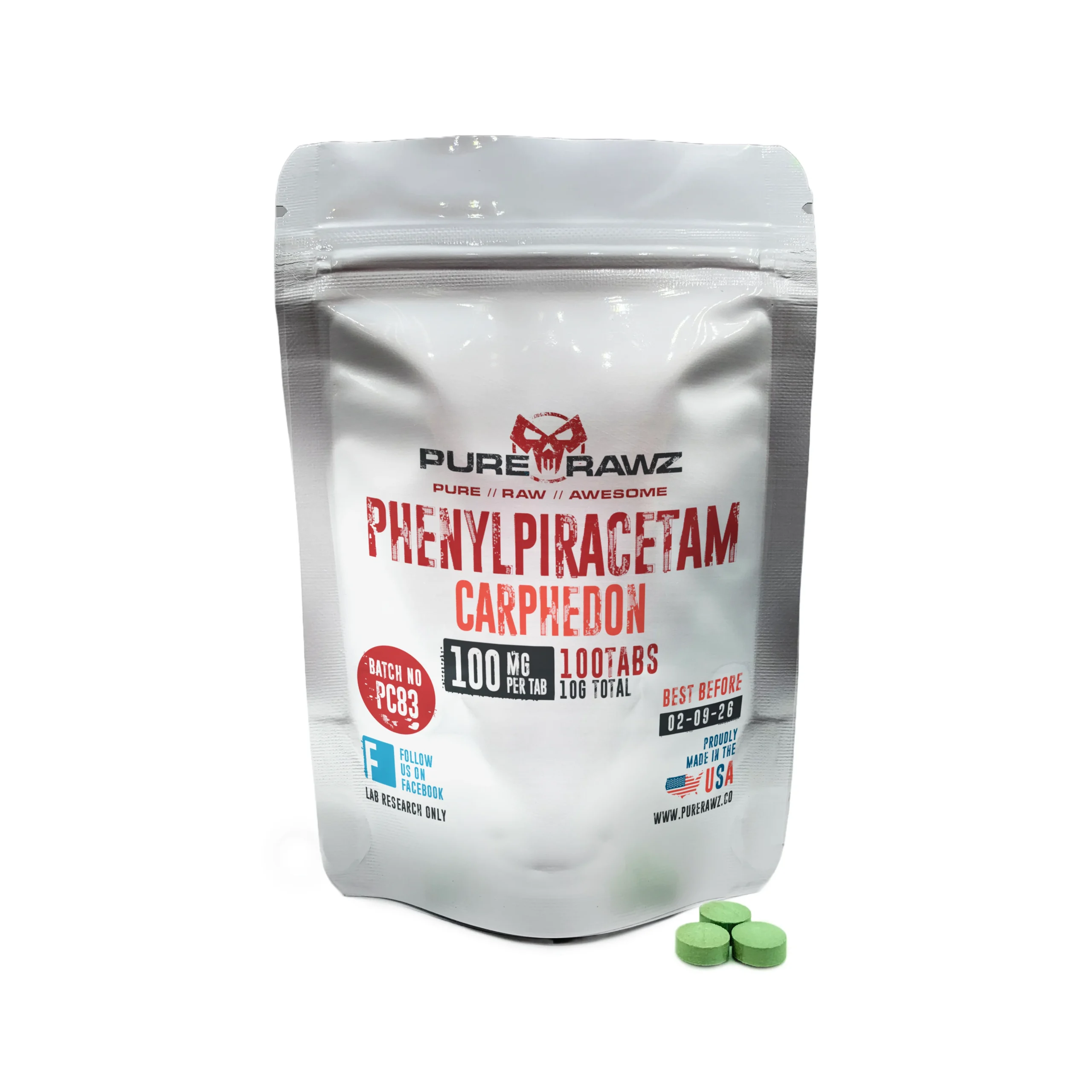
Phenylpiracetam Carphedon
$84.93
Earn 85 points upon purchasing this product.
✅ 99% Purity – Third-Party Tested
🚚 Free U.S. Shipping on Orders $100+
 Proudly Made in the USA
⚡ Fast & Reliable Shipping
🔒 Secure Checkout Guaranteed
Enjoy 24/7 customer support, 1st & 3rd party verified 99% purity, and free shipping on orders over $100!
Description
Phenylpiracetam (Carphedon)
Product Overview
Phenylpiracetam (Carphedon) is a synthetic substance that is a member of the racetam class of research chemicals. With a phenyl group added to the pyrrolidone ring, it is similar to piracetam.
The effects of racetam derivatives on brain metabolism and neural receptor systems have been investigated in relation to phenylpiracetam. Still, studies on the compound's complete pharmacological profile are being conducted in controlled laboratory environments.
Phenylpiracetam is only supplied by PureRawz for use in lab and scientific research. The United States does not approve of it. FDA for use in humans or animals.
| Property | Description |
| Compound Name | Phenylpiracetam (Carphedon) |
| Chemical Class | Racetam derivative |
| IUPAC Name | 2-(2-oxo-4-phenylpyrrolidin-1-yl)acetamide |
| CAS Number | 77472-70-9 |
| Molecular Formula | C12H14N2O2 |
| Molecular Weight | 218.25 g/mol |
Mechanism of Action
Although the exact mechanism of phenylpiracetam is still being studied, preclinical research has looked into a number of possible mechanisms.
Research indicates that phenylpiracetam may have an impact on glutamatergic neurotransmission, specifically via the AMPA and NMDA receptor systems, which are linked to memory functions and synaptic plasticity in experimental models.
More studies suggest that the substance may affect noradrenergic and dopaminergic signaling pathways. These systems of neurotransmitters are part of behavioral regulation, arousal, and cognitive processes.
Research Applications
Phenylpiracetam has been examined in laboratory settings for a range of neuroscience and behavioral research purposes, including:
- Assessing memory and learning mechanisms in animal models
- Research on synaptic plasticity and glutamate receptor signaling
- Experimental models analyzing the control of noradrenaline and dopamine
- Assessment of neuroprotective pathways in models of experimental brain damage
- Examination of cognitive signaling networks and activation of the central nervous system.
Why Buy Phenylpiracetam from PureRawz?
PureRawz supplies laboratory-grade research compounds tested for purity and identity. Each batch is accompanied by a Certificate of Analysis (COA) to support quality verification. Orders of $100 or more qualify for free shipping, and PureRawz frequently offers promotional discounts for research supply purchases.
Research Disclaimer
This information is provided for educational and scientific reference purposes only.
All products sold by PureRawz are intended strictly for laboratory and research use. These materials are not approved by the U.S. Food and Drug Administration (FDA) for human or veterinary use.
Any research involving this compound should be conducted by qualified professionals and must comply with applicable regulatory guidelines, including Institutional Review Board (IRB) or Institutional Animal Care and Use Committee (IACUC) oversight where required.
By completing a purchase, you agree to the PureRawz Terms and Conditions.
To know more about the product, contact: support@staging.purerawz.co
References
Gouliaev, A. H., & Senning, A. (1994). Piracetam and other structurally related nootropics. Brain Research Reviews, 19(2), 180 222. https://doi.org/10.1016/0165-0173(94)90011 6
Ostrovskaya, R. U., Trofimov, S. S., & Gudasheva, T. A. (2008). Phenylpiracetam and related compounds: Effects on cognitive processes and neuronal signaling in experimental models. Neuroscience and Behavioral Physiology, 38(2), 199 203.
Winblad, B. (2005). Piracetam: A review of pharmacological properties and experimental studies. CNS Drug Reviews, 11(2), 169 182. https://doi.org/10.1111/j.1527-3458.2005.tb00268.x
Voronina, T. A., & Seredenin, S. B. (2007). Racetam derivatives and their neuropharmacological activity. Experimental and Clinical Pharmacology, 70(4), 44 50.

Dr. Helma Wennemers
Dr. Helma Wennemers is a globally recognized chemist shaping modern peptide science and molecular design through highly original research in applied biosciences.
Her work explores how precise molecular architecture can be engineered to create new functional systems in chemistry and life sciences. Her contributions continue to redefine contemporary chemical research through creativity, depth, and structural innovation.
Please click here to access instructions on how to make a payment.
How to PayRelated products
-

Agrocybe 30% Bisporiust
Price range: $26.77 through $56.28 Select options This product has multiple variants. The options may be chosen on the product page -
Fonturacetam Phenylpiracetam Hydrazide 98%
Price range: $25.68 through $71.05 Select options This product has multiple variants. The options may be chosen on the product page -
HBT1
$92.36 Select options This product has multiple variants. The options may be chosen on the product page -
Centrophenoxine
$17.47 Select options This product has multiple variants. The options may be chosen on the product page


