
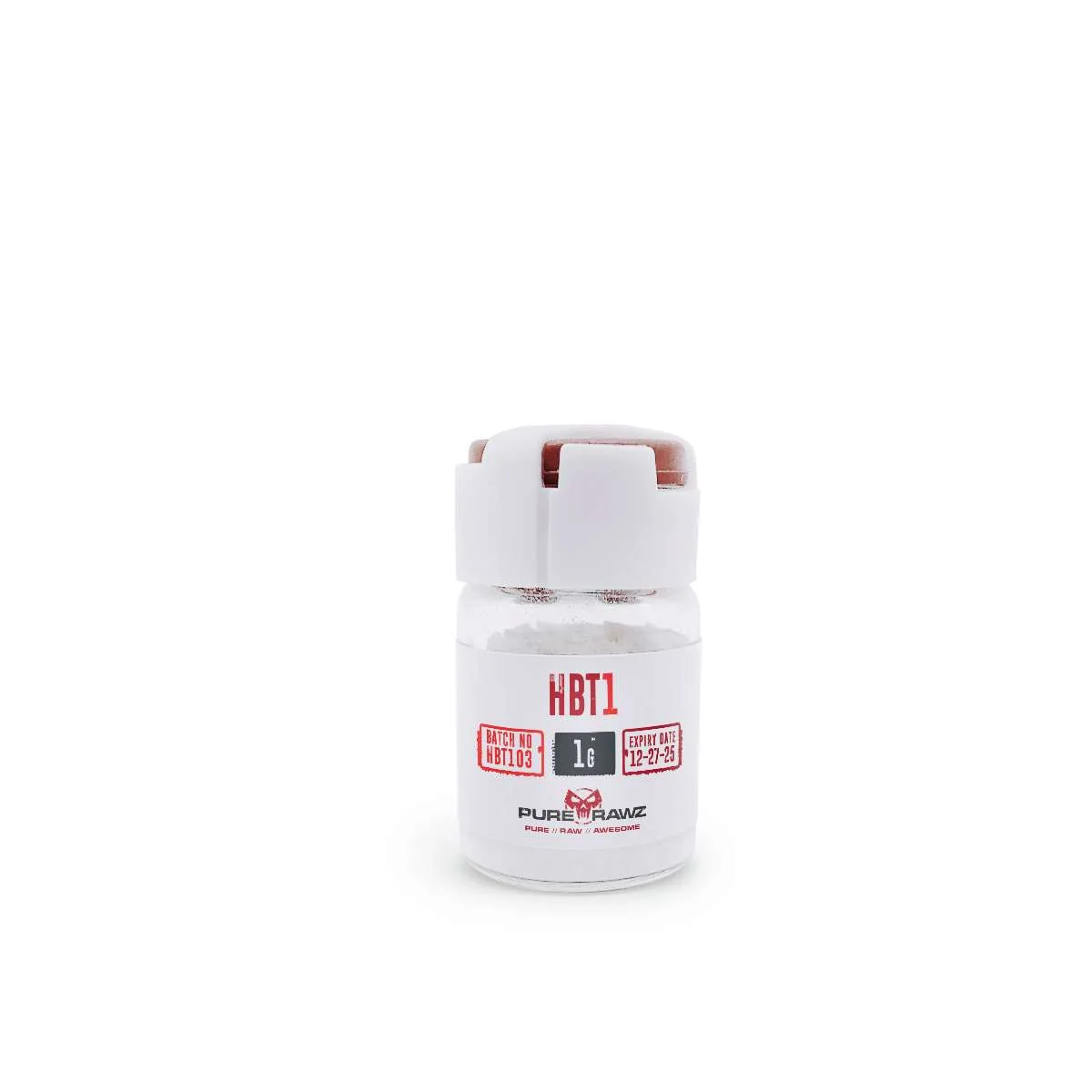
HBT1
$92.36
Earn 92 points upon purchasing this product.
✅ 99% Purity – Third-Party Tested
🚚 Free U.S. Shipping on Orders $100+
 Proudly Made in the USA
⚡ Fast & Reliable Shipping
🔒 Secure Checkout Guaranteed
Enjoy 24/7 customer support, 1st & 3rd party verified 99% purity, and free shipping on orders over $100!
Description
Overview of HBT1
HBT1 is a synthetic small-molecule compound under investigation as a research chemical. Researchers investigate its impact on glutamatergic receptor systems in conjunction with other substances.
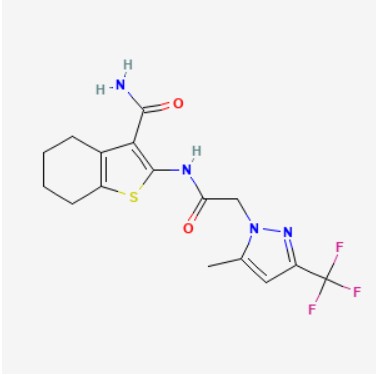
The compound is chemically defined and characterized by its distinct molecular structure, which includes a pyrazole and benzothiophene core. HBT1 is supplied exclusively for research purposes and has not been approved for human or animal use. Its well-defined chemical identity and purity make it suitable for in vitro and preclinical investigations into receptor pharmacology and signaling pathways.
Chemical and Molecular Properties
| HBT1 | |
| PubChem CID | 1222102 |
| Molecular Formula | C16H17F3N4O2S |
| Molecular Weight | 386.4 g/mol |
| Synonyms | RefChem: 908944 |
| IUPAC | 2-[[2-[5-methyl-3-(trifluoromethyl)pyrazol-1-yl]acetyl]amino]-4,5,6,7-tetrahydro-1-benzothiophene-3-carboxamide |
| CAS | 489408-02-8 |
| Labeling | Research Use Only (RUO), not for human or animal consumption. |
| Chemical Structure Depiction |
|
| Purity | ≥98% |
| Classification | Research Use Only (RUO) |
| Storage Temperature | Store at −20 °C in a dry, light-protected environment |
| Solubility | DMSO and other research-grade organic solvents |
| Safety | Handle with gloves, a lab coat, eye protection; use a fume hood if dust/aerosol is possible |
HBT1 Working Mechanism
AMPA Receptor Positive Allosteric Modulation
HBT1 mediates fast excitatory neurotransmission by acting as a positive allosteric modulator (PAM) of AMPA receptors, which are ionotropic glutamate receptors. In the receptor's ligand-binding domain (LBD), the chemical attaches to an allosteric site instead of the active glutamate-binding site.
Glutamate-mediated signaling is improved in experimental models by this binding, which stabilizes receptor conformations that promote channel opening in the presence of endogenous glutamate.
Glutamate-Dependent Receptor Potentiation
In in vitro electrophysiology studies, HBT1 demonstrates glutamate-dependent potentiation, meaning that receptor activity is enhanced only during ligand binding. This property reduces intrinsic agonistic activity while still promoting receptor signaling, allowing for the study of ion channel conductance and calcium influx in cellular models.
Modulation of Neurotrophic Signaling Pathways
HBT1's potentiation of AMPA receptors can affect intracellular signaling cascades linked to the expression of brain-derived neurotrophic factor (BDNF). The effects of allosteric modulation on intracellular calcium signaling and downstream transcriptional pathways have been investigated in studies employing neuronal cells. HBT1’s low intrinsic agonistic activity has been investigated as a tool for mechanistic research into receptor-mediated synaptic signaling without producing overstimulation artifacts observed with some other AMPA modulators.
Why Choose Purerawz for HBT1?
Buy HBT1 for laboratory research use from our online shop. At Purerawz, we provide high-quality reference materials. Each research compound comes with a Certificate of Analysis for verification of purity and concentration.
Note:
HBT1 is an investigational compound currently undergoing clinical evaluation and has not been established as safe or effective for any therapeutic use
Research Applications of HBT1
HBT1 is used exclusively as a research tool in preclinical and experimental models. Its primary applications include:
- AMPA Receptor Pharmacology – Studying allosteric modulation in binding assays and electrophysiology.
- Synaptic Signaling and Plasticity – Investigating excitatory neurotransmission and long-term potentiation pathways.
- Neurotrophic Signaling—Examining BDNF-related transcriptional pathways and calcium-dependent intracellular signaling.
- Molecular Pharmacology—Serving as a reference compound for characterizing next-generation AMPA receptor modulators.
Disclaimer
This information is for educational purposes only and not medical advice. Products are for research use only. Research must follow IRB or IACUC guidelines. Verify information independently before purchasing. By ordering, you agree to our Terms and Conditions. If you are not 100% satisfied with the product you received, please contact us at support@staging.purerawz.co
ATTENTION: All our products are for LABORATORY AND RESEARCH PURPOSES ONLY, not for veterinary or human use
Reference Links
Kunugi, A., Tajima, Y., Kuno, H., Sogabe, S., & Kimura, H. (2018). HBT1, a novel AMPA receptor potentiator with lower agonistic effect, avoided bell-shaped response in in vitro BDNF production. Journal of Pharmacology and Experimental Therapeutics, 364(3), 377–389. https://pubmed.ncbi.nlm.nih.gov/29298820/
PubChem Compound Summary for HBT1. National Center for Biotechnology Information, U.S. National Library of Medicine. https://pubchem.ncbi.nlm.nih.gov

Dr. Helma Wennemers
Dr. Helma Wennemers is a globally recognized chemist shaping modern peptide science and molecular design through highly original research in applied biosciences.
Her work explores how precise molecular architecture can be engineered to create new functional systems in chemistry and life sciences. Her contributions continue to redefine contemporary chemical research through creativity, depth, and structural innovation.
Please click here to access instructions on how to make a payment.
How to PayRelated products
-

PRL-8-53
Price range: $57.37 through $92.36 Select options This product has multiple variants. The options may be chosen on the product page -
IDRA-21
Price range: $17.47 through $89.62 Select options This product has multiple variants. The options may be chosen on the product page -
Vincamine
Price range: $15.83 through $49.18 Select options This product has multiple variants. The options may be chosen on the product page -
Emoxypine Succinate
$22.93 Select options This product has multiple variants. The options may be chosen on the product page


