
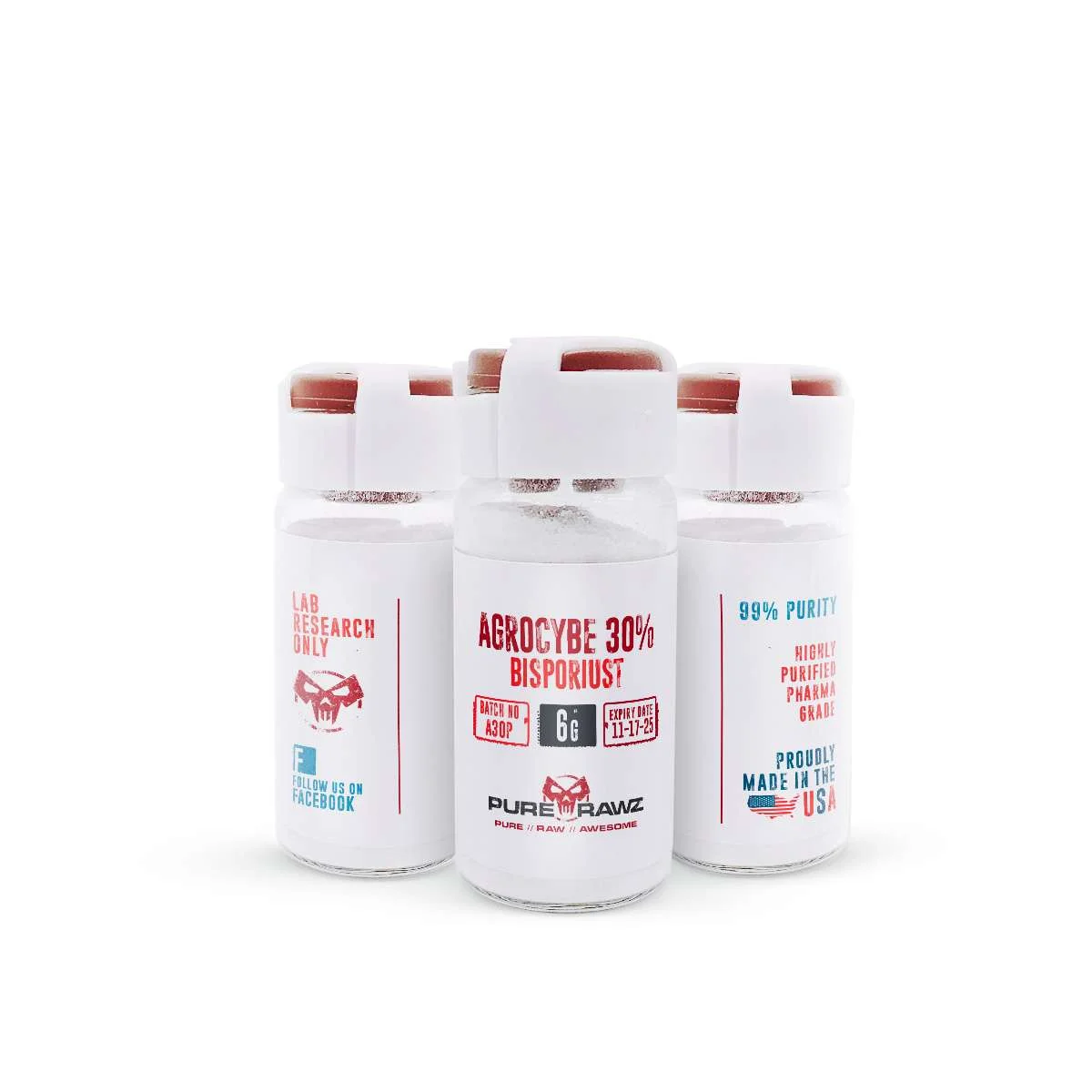
Agrocybe 30% Bisporiust
Price range: $26.77 through $56.28
Earn 27 - 56 points upon purchasing this product.
✅ 99% Purity – Third-Party Tested
🚚 Free U.S. Shipping on Orders $100+
 Proudly Made in the USA
⚡ Fast & Reliable Shipping
🔒 Secure Checkout Guaranteed
Enjoy 24/7 customer support, 1st & 3rd party verified 99% purity, and free shipping on orders over $100!
Description
Overview of Agrocybe 30% Bisporus
Agrocybe 30% Bisporus is a fungal-derived extract standardized to contain approximately 30% bioactive components associated with Agrocybe species. Agrocybe mushrooms are basidiomycete fungi that contain various naturally occurring biochemical constituents, including polysaccharides, proteins, and secondary metabolites.
In laboratory settings, extracts derived from Agrocybe species are investigated as bioactive research materials for biochemical and molecular biology studies. These extracts are commonly analyzed to characterize fungal polysaccharide structures, secondary metabolite composition, and molecular interactions within cellular research systems.
Agrocybe 30% Bisporus is a laboratory-grade bioactive compound intended only for scientific research, experimental analysis, and biochemical studies.
Chemical and Molecular Properties
| Agrocybe 30% Bisporus | |
| PubChem CID | Not applicable (multi-compound fungal extract) |
| Molecular Formula | Not valid |
| Molecular Weight | Not applicable |
| Source | Agrocybe species (fungal fruiting body extract) |
| Major Constituents | Fungal polysaccharides, proteins, and secondary metabolites |
| CAS | Not applicable |
| Labeling | Research Use Only (RUO), not for human or animal consumption. |
| Purity | Standardized to 30% Bisporus-associated bioactive compounds |
| Classification | Fungal-derived bioactive extract |
| Storage Temperature | Store in cool, dry conditions; protect from light |
| Solubility | Solubility varies depending on polysaccharide and metabolite fraction; commonly soluble in aqueous laboratory solvents |
| Safety | Handle with gloves, a lab coat, eye protection; use a fume hood if dust/aerosol is possible |
Agrocybe 30% Bisporus Mechanism
Agrocybe-Derived Polysaccharide Mechanism: Cellular Signaling Investigation
Polysaccharides isolated from mushroom species, including Agrocybe, are investigated in laboratory research for their interactions with cellular receptors and intracellular signaling pathways. Experimental studies examine how fungal polysaccharide structures interact with molecular recognition systems involved in cellular communication and biochemical regulation.
These molecular interactions are studied in in vitro experimental models to better understand how fungal-derived carbohydrate structures influence receptor-associated signaling networks and intracellular biochemical pathways.
Secondary Metabolite Interaction Mechanism: Molecular Pathway Studies
Fungal extracts from Agrocybe species also contain secondary metabolites that are analyzed for their interactions with cellular enzymes and protein signaling networks. Laboratory investigations examine how these compounds participate in biochemical pathways related to metabolic regulation, protein interaction networks, and intracellular molecular signaling systems.
These studies focus on understanding the molecular structure-function relationships of fungal-derived bioactive compounds within controlled experimental models.
Research Insights
Agrocybe 30% Bisporus is used in controlled laboratory research. It supports cellular studies of intracellular biochemical responses, signaling networks, and molecular regulatory mechanisms. The extract is applied in molecular biology research to study receptor interactions and biochemical signaling. It is also used in biochemistry investigations to analyze polysaccharide structures, enzyme activity, and molecular interactions. Additionally, Agrocybe 30% Bisporus is employed in analytical research to characterize fungal-derived molecular compounds in experimental laboratory settings.
Why Choose PureRawz?
Buy Agrocybe 30% Bisporus for laboratory research use from our online shop. At Purerawz, we provide high-quality reference materials. Each research compound comes with a Certificate of Analysis for verification of purity and concentration.
Note:
Agrocybe 30% Bisporus is an investigational compound currently undergoing clinical evaluation and has not been established as safe or effective for any therapeutic use.
Disclaimer
This information is for educational purposes only and not medical advice. Products are for research use only. Research must follow IRB or IACUC guidelines. Verify information independently before purchasing. By ordering, you agree to our Terms and Conditions. If you are not 100% satisfied with the product you received, please contact us at support@staging.purerawz.co
ATTENTION: All our products are for LABORATORY AND RESEARCH PURPOSES ONLY, not for veterinary or human use.
Reference Links
Ćilerdžić, J., Stajić, M., Vukojević, J., Milovanović, I., & Muzgonja, N. (2015). Antioxidant and antifungal potential of Pleurotus ostreatus and Agrocybe cylindracea basidiocarps and mycelia. Current Pharmaceutical Biotechnology, 16(2), 179-186. https://pubmed.ncbi.nlm.nih.gov/25483715/
Faculty of Agriculture and Biotechnology. (n.d.). Exploring the potency of wild mushrooms: A comprehensive review of antifungal activity in the Republic of North Macedonia. Universiteti i Tetovës. https://eprints.unite.edu.mk/1393/
Xiaoying, M., Peng, Z., Hong, W., Na, G., Jun, X., Ying, Z., Xun, C., & Guoli, L. (2025). From functional foods to immunotherapeutic agents: mechanistic insights into medicinal mushroom bioactives in chronic inflammation management. Frontiers in Nutrition, 12, 1725297. https://doi.org/10.3389/fnut.2025.1725297

Dr. Helma Wennemers
Dr. Helma Wennemers is a globally recognized chemist shaping modern peptide science and molecular design through highly original research in applied biosciences.
Her work explores how precise molecular architecture can be engineered to create new functional systems in chemistry and life sciences. Her contributions continue to redefine contemporary chemical research through creativity, depth, and structural innovation.
Please click here to access instructions on how to make a payment.
How to PayRelated products
-

L-Theanine
Price range: $11.45 through $24.57 Select options This product has multiple variants. The options may be chosen on the product page -
Sulbutiamine
Price range: $17.47 through $61.76 Select options This product has multiple variants. The options may be chosen on the product page -
Picamilon Sodium (Nicotinoyl-GABA)
$24.57 Select options This product has multiple variants. The options may be chosen on the product page -
Sale!
7,8 Dihydroxyflavone
Original price was: $27.31.$22.69Current price is: $22.69. Select options This product has multiple variants. The options may be chosen on the product page


