
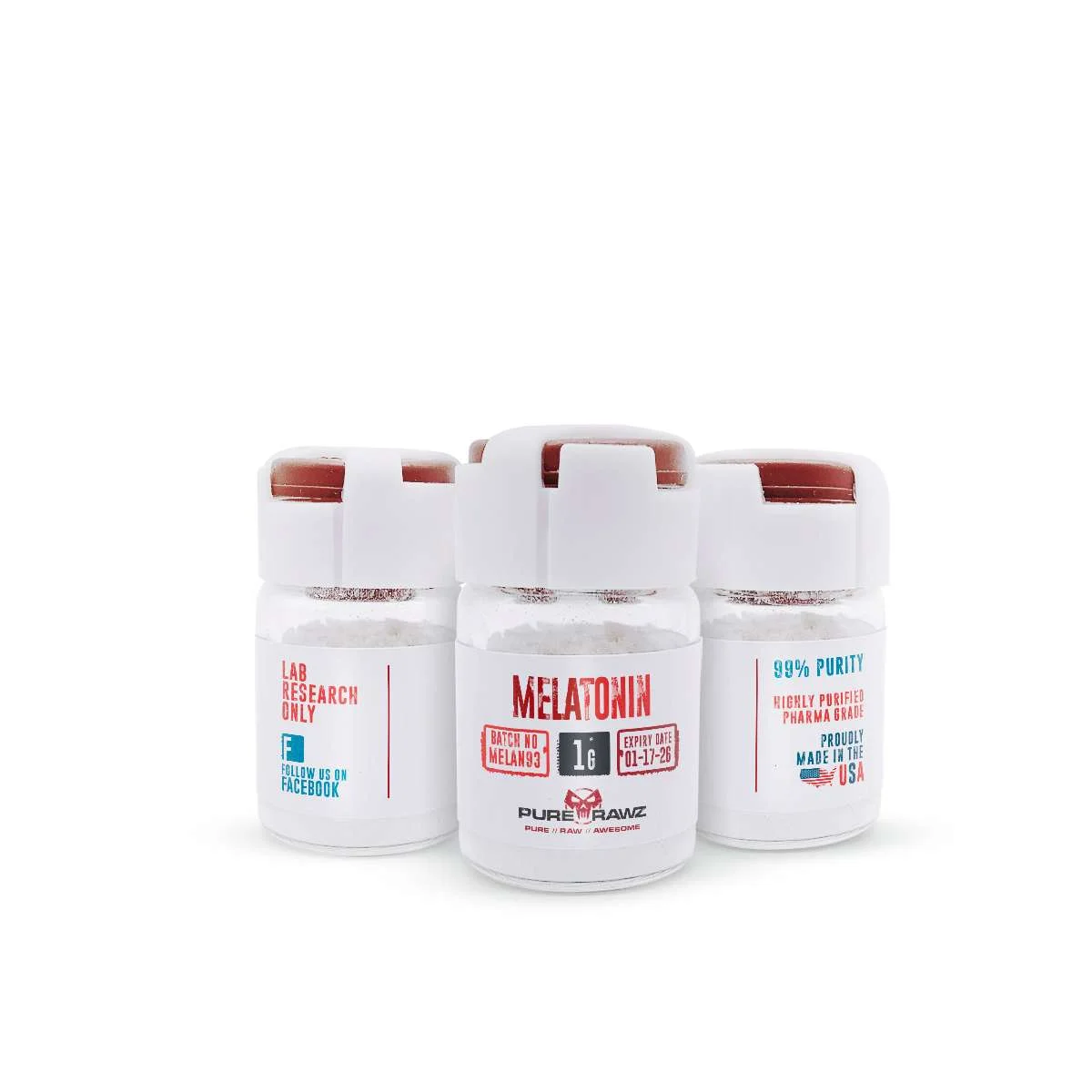
Melatonin
Price range: $18.57 through $43.70
Earn 19 - 44 points upon purchasing this product.
✅ 99% Purity – Third-Party Tested
🚚 Free U.S. Shipping on Orders $100+
 Proudly Made in the USA
⚡ Fast & Reliable Shipping
🔒 Secure Checkout Guaranteed
Enjoy 24/7 customer support, 1st & 3rd party verified 99% purity, and free shipping on orders over $100!
Description
Overview of Melatonin
Melatonin (N-acetyl-5-methoxytryptamine) is a naturally occurring indoleamine predominantly formed in the pineal gland of vertebrates; however, it can also be synthetically made for laboratory research. In experimental models, melatonin has been thoroughly investigated for its interactions with cellular signaling pathways, receptor systems, and oxidative processes. Its regulatory function in circadian rhythm-related signaling has been delineated using in vitro experiments, preclinical models, and biochemical investigations.
Melatonin is classified as an investigational research compound and is supplied exclusively for research use in controlled laboratory settings.
Chemical and Molecular Properties
| Melatonin | |
| PubChem CID | 896 |
| Molecular Formula | C13H16N2O2 |
| Molecular Weight | 232.28 g/mol |
| Synonyms | 73-31-4
Melatonine N-Acetyl-5-methoxytryptamine |
| IUPAC | (1S)-21-methyl-3,13,21-triazapentacyclo[11.8.0.02,10.04,9.015,20]henicosa-2(10),4,6,8,15,17,19-heptaen-14-one |
| CAS | 73-31-4 |
| Labeling | Research Use Only (RUO), not for human or animal consumption. |
| Chemical Structure Depiction | 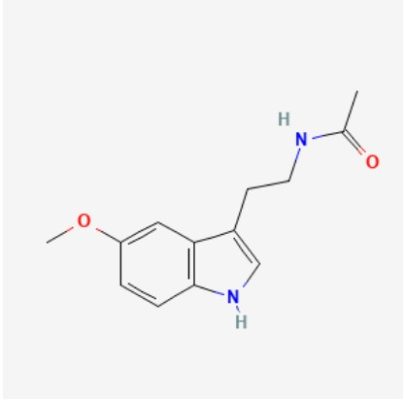 |
| Purity | ≥98% |
| Classification | Research Use Only (RUO) |
| Storage Temperature | Store at 2–8 °C, protected from light |
| Solubility | Water, DMSO (research-grade solvents) |
| Safety | Use gloves, lab coat, and eye protection; handle in fume hood if dust/aerosol is possible |
Melatonin Mechanism
Interaction with Melatonin Receptors (MT1 and MT2)
Melatonin binds to G protein-coupled melatonin receptors (MT1 and MT2) in experimental models. In cellular signaling assays, receptor engagement leads to modulation of intracellular cyclic AMP (cAMP) levels and downstream protein kinase A (PKA) pathways, influencing gene expression and cellular responses in preclinical systems.
Antioxidant and Free Radical Scavenging Properties
In in vitro studies, melatonin acts as a direct scavenger of reactive oxygen and nitrogen species and indirectly upregulates endogenous antioxidant enzymes such as superoxide dismutase (SOD) and glutathione peroxidase (GPx). These effects are examined in experimental cell cultures to characterize cellular redox balance and oxidative signaling mechanisms.
Modulation of Intracellular Signaling
Melatonin has been reported in research models to interact with intracellular targets, including mitochondrial membranes, where it can influence mitochondrial electron transport, membrane potential, and oxidative phosphorylation processes. These interactions are studied using preclinical and in vitro systems to evaluate mitochondrial function and cell signaling pathways.
Research Applications of Melatonin
Melatonin is widely used as a research tool in cellular, molecular, and biochemical studies. In preclinical and experimental models, melatonin serves as an investigational compound to study:
- Receptor-mediated signal transduction via MT1 and MT2 receptors
- Modulation of oxidative stress and antioxidant response pathways
- Intracellular mitochondrial signaling and metabolic regulation
- Cellular responses in circadian rhythm-associated pathways
Its well-characterized molecular profile makes it a valuable compound for mechanistic research, analytical studies, and in vitro pharmacology investigations
Why Choose Purerawz for Melatonin?
Buy Melatonin for laboratory research use from our online shop. At Purerawz, we provide high-quality reference materials. Each research compound comes with a Certificate of Analysis for verification of purity and concentration.
Note:
Melatonin is an investigational compound currently undergoing clinical evaluation and has not been established as safe or effective for any therapeutic use
Disclaimer
This information is for educational purposes only and not medical advice. Products are for research use only. Research must follow IRB or IACUC guidelines. Verify information independently before purchasing. By ordering, you agree to our Terms and Conditions. If you are not 100% satisfied with the product you received, please contact us at support@staging.purerawz.co
ATTENTION: All our products are for LABORATORY AND RESEARCH PURPOSES ONLY, not for veterinary or human use
Reference Links
Garcia JJ, Lopez‑Pingarron L, Almeida‑Sauza P, et al. Protective effects of melatonin in reducing oxidative stress and preserving membrane integrity. Journal of Pineal Research, 58(2), 225–237. https://pubmed.ncbi.nlm.nih.gov/24571249/
Liu J., Clough SJ., Hutchinson AJ., et al. MT1 and MT2 melatonin receptors: molecular pharmacology and signaling implications. Annual Review of Pharmacology and Toxicology, 56, 361–383. https://pubmed.ncbi.nlm.nih.gov/26514204
Okamoto, H., Cecon, E., Nureki, O., et al. Melatonin receptor structure and signaling. Journal of Pineal Research, 76(3), e12952. https://pubmed.ncbi.nlm.nih.gov/38587234/
PubChem Compound Summary for CID 896. (Melatonin). National Center for Biotechnology Information, U.S. National Library of Medicine. https://pubchem.ncbi.nlm.nih.gov/compound/896
Yan G., Yu L., Jiang S., Zhu J. Melatonin antagonizes oxidative stress‑induced mitochondrial dysfunction via melatonin receptor 1 (MT1) in cultured cells. Journal of Toxicological Sciences, 43(11), 659–669. https://pubmed.ncbi.nlm.nih.gov/30404999/

Dr. Helma Wennemers
Dr. Helma Wennemers is a globally recognized chemist shaping modern peptide science and molecular design through highly original research in applied biosciences.
Her work explores how precise molecular architecture can be engineered to create new functional systems in chemistry and life sciences. Her contributions continue to redefine contemporary chemical research through creativity, depth, and structural innovation.
Please click here to access instructions on how to make a payment.
How to PayRelated products
-

HBT1
$92.36 Select options This product has multiple variants. The options may be chosen on the product page -
Nooglutyl
$26.22 Select options This product has multiple variants. The options may be chosen on the product page -
Emoxypine Succinate
$22.93 Select options This product has multiple variants. The options may be chosen on the product page -
Sulbutiamine
Price range: $17.47 through $61.76 Select options This product has multiple variants. The options may be chosen on the product page


