
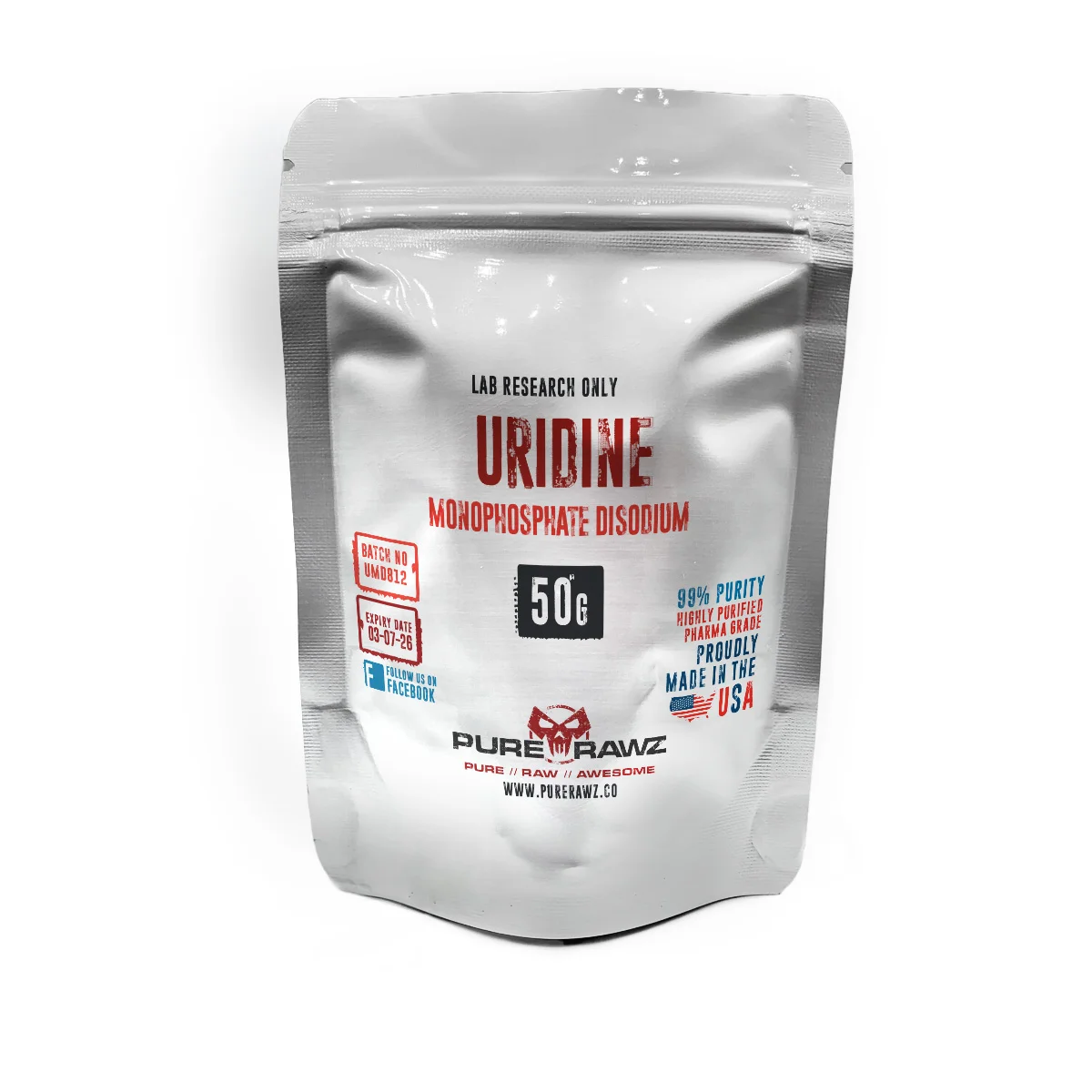
Uridine Monophosphate Disodium
$31.13
Earn 31 points upon purchasing this product.
✅ 99% Purity – Third-Party Tested
🚚 Free U.S. Shipping on Orders $100+
 Proudly Made in the USA
⚡ Fast & Reliable Shipping
🔒 Secure Checkout Guaranteed
Enjoy 24/7 customer support, 1st & 3rd party verified 99% purity, and free shipping on orders over $100!
Description
Overview of Uridine Monophosphate Disodium
Uridine Monophosphate Disodium is also called UMP Disodium. It is the disodium salt of uridine 5'-monophosphate. This is a ribonucleotide composed of the nucleobase uracil. This means that it is a ribose sugar and a phosphate group. Being a nucleotide component, UMP Disodium is used in laboratory settings to investigate:
- nucleotide metabolism
- phosphorylation pathways
- ribonucleoprotein assembly
- and signal transduction mechanisms
All this is done in cell-free systems, biochemical assays, and controlled experimental models.
Chemical and Molecular Properties
| Property | Description |
| Compound Name | Uridine 5'-monophosphate disodium salt |
| Synonyms | UMP Disodium; Uridine monophosphate sodium salt |
| Molecular Formula | C9H11N2Na2O9P |
| Molecular Weight | 364.14 g/mol |
| CAS Number | 17231-99-5 |
| Structural Class | Ribonucleotide (nucleotide monophosphate) |
| Chemical Nature | Organic salt of nucleoside phosphate |
| Research Classification | Biochemical research nucleotide |
Working Mechanism of Uridine Monophosphate Disodium
Nucleotide Structure and Role in Biochemical Pathways
UMP Disodium is a ribonucleotide consisting of:
- Uracil: a pyrimidine nucleobase
- Ribose: a pentose sugar
- Phosphate group: contributing to nucleotide charge and reactivity
In biochemical research, UMP Disodium is used to investigate:
- enzymatic phosphorylation pathways
- nucleotide interconversion processes
- and the regulation of nucleotide pools in cell-free or in vitro systems.
Phosphorylation and Nucleotide Interconversion
In controlled mechanistic studies, UMP Disodium can be phosphorylated to generate diphosphate (UDP) or triphosphate (UTP) derivatives. This is done by using purified kinase systems. These transformations serve as substrates for kinase assays. They also include nucleotide metabolism analysis in experimental models.
Biochemical Signal Transduction Investigations
UMP and its derivatives are also used in research to probe signal transduction pathways associated with nucleotide-dependent enzymes. These include nucleoside diphosphate kinases and phosphotransferases. These studies help clarify mechanistic aspects of energy transfer and nucleotide regulation in biochemical contexts.
All mechanistic descriptions above are based on controlled laboratory investigations. They do not imply clinical or functional outcomes outside of research settings.
Uridine Monophosphate Disodium Research Applications (Laboratory Use Only)
- Enzymatic phosphorylation assays
- Nucleotide metabolism pathway analysis
- Phosphotransferase and kinase system studies
- In vitro biochemical signal transduction investigations
All research applications are strictly limited to laboratory and analytical settings.
Why Choose Purerawz for Uridine Monophosphate Disodium?
Buy Uridine Monophosphate Disodium for laboratory research use from our online shop. At Purerawz, we provide high-quality reference materials. Each research compound comes with a Certificate of Analysis for verification of purity and concentration.
Note: Uridine Monophosphate Disodium (UMP Disodium) is an investigational compound currently undergoing scientific evaluation and has not been established as safe or effective for any therapeutic use.
Disclaimer
This information is for educational purposes only and not medical advice. Products are for research use only. Research must follow IRB or IACUC guidelines. Verify information independently before purchasing. By ordering, you agree to our Terms and Conditions. If you are not 100% satisfied with the product you received, please contact us at support@staging.purerawz.co
ATTENTION: All our products are for LABORATORY AND RESEARCH PURPOSES ONLY, not for veterinary or human use.
Reference Links
Kornberg, A. (1955). The role of phosphate and phosphotransfer reactions in nucleotide metabolism. Journal of Biological Chemistry, 217(1), 1 - 14. https://doi.org/10.1016/S0021-9258(18)75361-8/
Hou, Y., et al. (2020). Uridine metabolism and its molecular pathways in nucleotide biosynthesis. Nature Communications, 11, 527. https://doi.org/10.1038/s41467-020-14374-2/

Dr. Helma Wennemers
Dr. Helma Wennemers is a globally recognized chemist shaping modern peptide science and molecular design through highly original research in applied biosciences.
Her work explores how precise molecular architecture can be engineered to create new functional systems in chemistry and life sciences. Her contributions continue to redefine contemporary chemical research through creativity, depth, and structural innovation.
Please click here to access instructions on how to make a payment.
How to PayRelated products
-

Galantamine Hydrobromide
$57.37 Select options This product has multiple variants. The options may be chosen on the product page -
Agomelatine
$61.76 Select options This product has multiple variants. The options may be chosen on the product page -
PRL-8-53
Price range: $57.37 through $92.36 Select options This product has multiple variants. The options may be chosen on the product page -
Aniracetam
Price range: $60.24 through $130.25 Select options This product has multiple variants. The options may be chosen on the product page


