
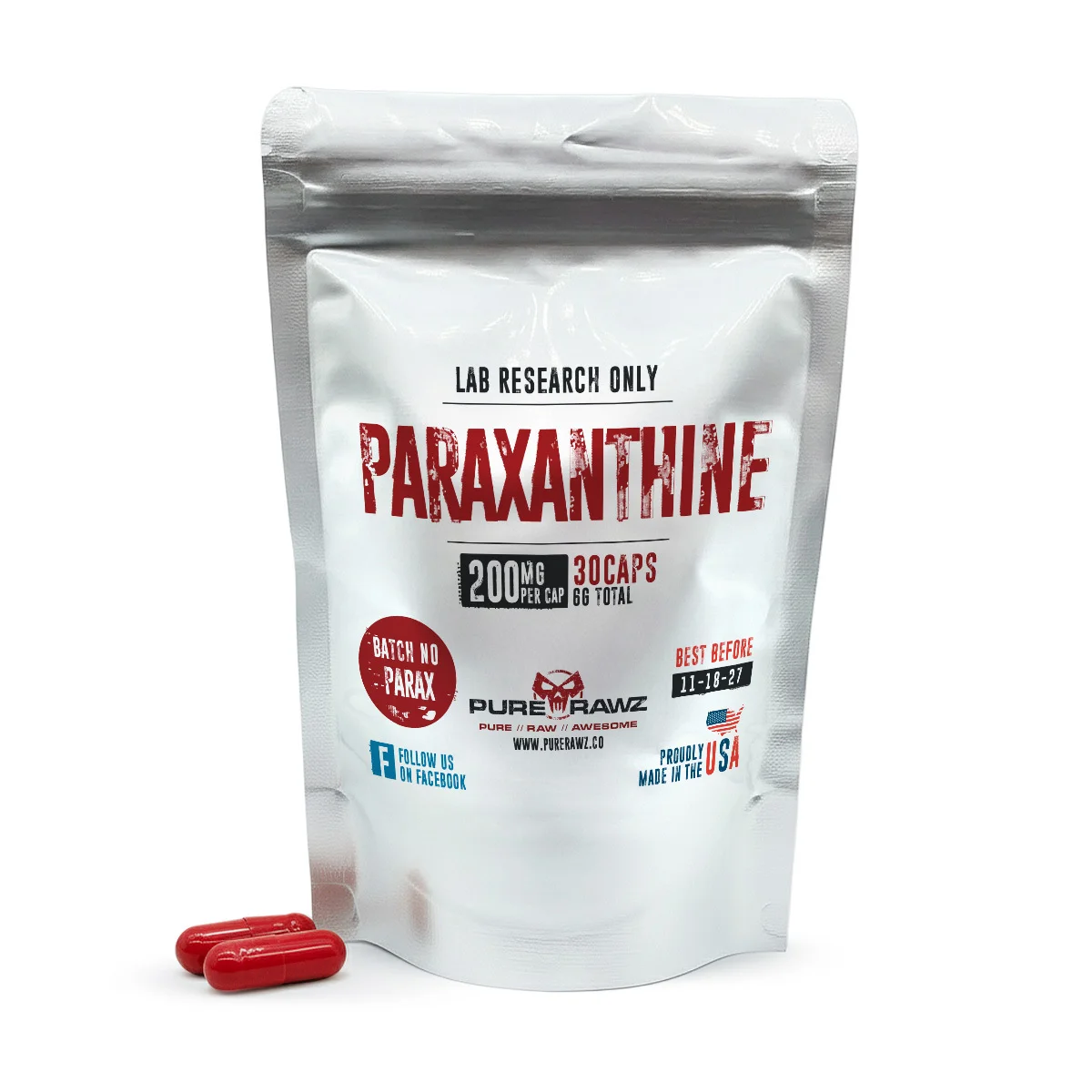
Paraxanthine Capsules
Price range: $22.98 through $49.98
Earn 23 - 50 points upon purchasing this product.
✅ 99% Purity – Third-Party Tested
🚚 Free U.S. Shipping on Orders $100+
 Proudly Made in the USA
⚡ Fast & Reliable Shipping
🔒 Secure Checkout Guaranteed
Enjoy 24/7 customer support, 1st & 3rd party verified 99% purity, and free shipping on orders over $100!
Description
Paraxanthine
Product Overview
Paraxanthine is a naturally occurring dimethylxanthine, a compound produced by the metabolic breakdown of caffeine. In mammals, hepatic cytochrome P450 enzymes convert caffeine into a variety of metabolites, the most common of which is paraxanthine.
Paraxanthine is a member of the methylxanthine family, which also contains theobromine, theophylline, and caffeine. These compounds can affect enzymatic and receptor-mediated signaling pathways in experimental biological systems because they share a structure derived from purines. The compound's interaction with adenosine receptors and its impact on intracellular signaling cascades connected to cellular metabolism are often the focus of investigations.
| Property | Data |
| Compound Name | Paraxanthine |
| PubChem CID | 4687 |
| CAS Number | 611-59-6 |
| Molecular Formula | C7H8N4O2 |
| Molecular Weight | 180.16 g/mol |
| Chemical Classification | Dimethylxanthine derivative |
| IUPAC Name | 1,7-dimethyl-3H-purine-2,6-dione |
| Synonyms | 1,7-Dimethylxanthine; p-Xanthine |
| Structure | 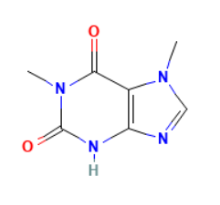 |
| Source Database | PubChem (NCBI) |
Working Mechanism
Receptor pharmacology and enzymatic signaling investigations have been the main methods used to investigate the molecular behavior of paraxanthine. Adenosine receptor activity is known to be influenced by methylxanthines. In cellular systems, adenosine typically acts as a neuromodulatory signaling molecule that controls neuronal excitability and metabolic demand.
In some experimental models, paraxanthine acts as a receptor antagonist and exhibits affinity for adenosine A1 and A2A receptor subtypes. Intracellular signaling pathways linked to cyclic AMP regulation may be changed by blocking adenosine from attaching to these receptors.
Research Applications
In lab studies aimed at investigating caffeine metabolism, paraxanthine is commonly used. The substance is frequently utilized as a reference marker when examining metabolic enzyme activity in pharmacokinetic research because it is the main metabolite produced following caffeine's hepatic biotransformation.
Methylxanthines are occasionally assessed for their impact on receptor-mediated signaling pathways in neurochemical investigations. In order to investigate how adenosine antagonists alter intracellular signaling mechanisms in neuronal or muscle cell cultures, paraxanthine has been added to receptor-binding experiments.
The compound has also appeared in experimental studies analyzing energy metabolism during cellular stress. Researchers occasionally monitor methylxanthine derivatives in metabolic experiments to understand how purine-based molecules influence enzyme activity and cellular adaptation under varying physiological conditions.
Why Buy at PureRawz
PureRawz sells laboratory compounds designed for supervised scientific research. Each batch is subjected to analytical verification, such as high-performance liquid chromatography (HPLC), to ensure compound identity and purity.
Each product comes with documentation that includes a Certificate of Analysis (COA) prepared by independent testing laboratories. This documentation provides traceability for researchers who keep laboratory records and do analytical validation.
Packaging measures are intended to preserve compound integrity throughout storage and delivery in professional research settings.
Note: Paraxanthine is only available as a research chemical. The chemical is not approved in the United States. Food and Drug Administration (FDA) for therapeutic purposes.
Research Disclaimer
The information provided is intended strictly for scientific reference and educational purposes. Products distributed by PureRawz are supplied solely for laboratory investigation and analytical research.
ATTENTION: All products are FOR LABORATORY AND RESEARCH PURPOSES ONLY and NOT FOR HUMAN OR ANIMAL USE.
All research activities should be conducted by qualified professionals and must comply with institutional oversight policies, such as IRB or IACUC, where applicable.
References
Benowitz, N. L. (1990). Clinical pharmacology of caffeine. Annual Review of Medicine, 41, 277 288. https://pubmed.ncbi.nlm.nih.gov/2184720/
National Center for Biotechnology Information. (2024). Paraxanthine compound summary. PubChem Database. https://pubchem.ncbi.nlm.nih.gov/compound/4687
Fredholm, B. B., Bättig, K., Holmén, J., Nehlig, A., & Zvartau, E. (1999). Actions of caffeine in the brain with special reference to factors that contribute to its widespread use. Pharmacological Reviews, 51(1), 83 133. https://pubmed.ncbi.nlm.nih.gov/10049999/
ClinicalTrials.gov. (2024). Methylxanthine pharmacology research database. https://clinicaltrials.gov

Dr. Helma Wennemers
Dr. Helma Wennemers is a globally recognized chemist shaping modern peptide science and molecular design through highly original research in applied biosciences.
Her work explores how precise molecular architecture can be engineered to create new functional systems in chemistry and life sciences. Her contributions continue to redefine contemporary chemical research through creativity, depth, and structural innovation.
Please click here to access instructions on how to make a payment.
How to PayRelated products
-

Osthole 98%
$47.52 Select options This product has multiple variants. The options may be chosen on the product page -
Anavar X Capsules (Turkesterone 20% + Beta-Ecdysterone + 5 Alpha-Hydroxy-Laxogenin + Epicatechin + Osthole 98%)
$155.49 Select options This product has multiple variants. The options may be chosen on the product page -
Magnesium Glycinate
Price range: $15.98 through $49.48 Select options This product has multiple variants. The options may be chosen on the product page -
Palmitoylethanolamide (PEA) – With Levagen Capsules
$43.60 Select options This product has multiple variants. The options may be chosen on the product page


