
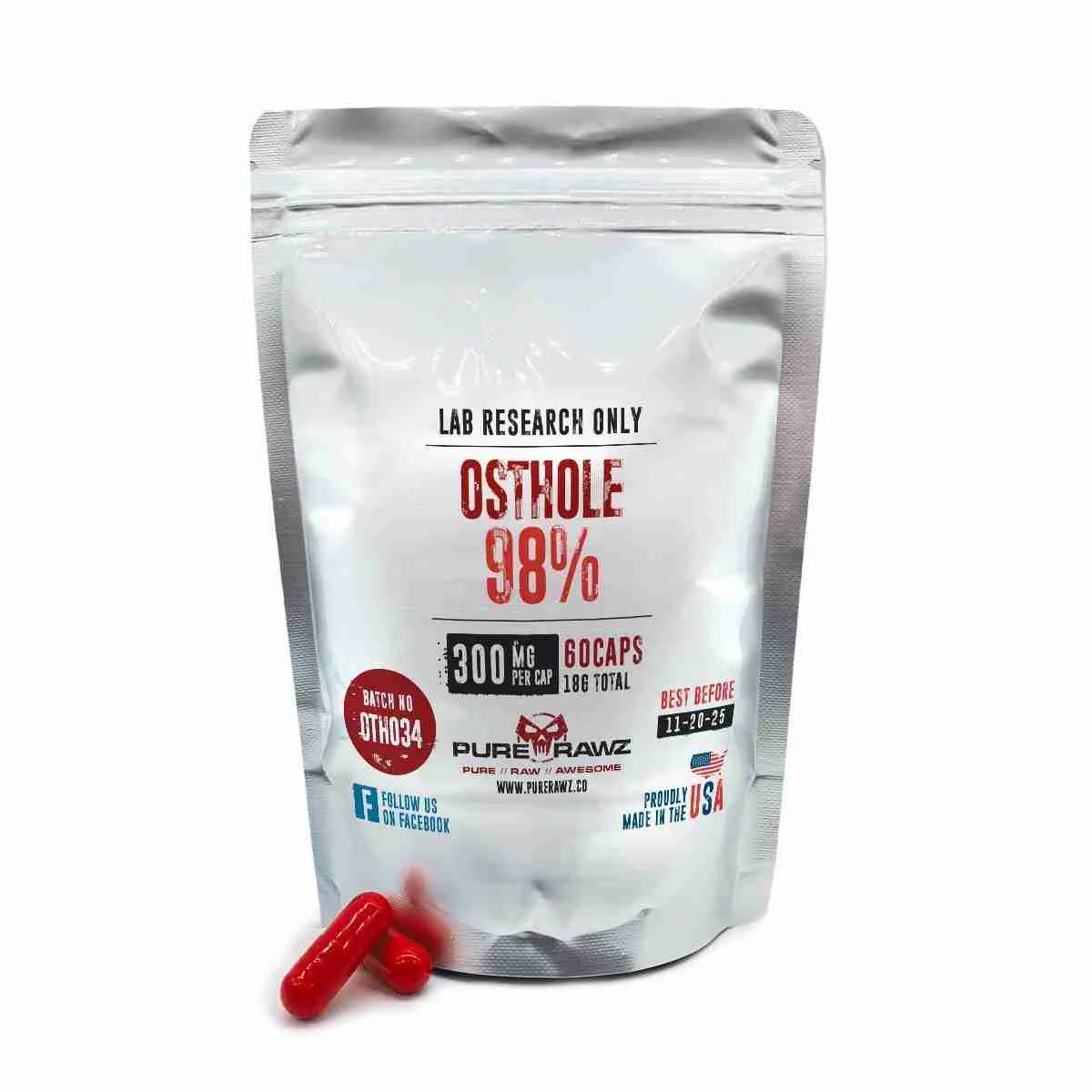
Osthole 98%
$47.52
Earn 48 points upon purchasing this product.
✅ 99% Purity – Third-Party Tested
🚚 Free U.S. Shipping on Orders $100+
 Proudly Made in the USA
⚡ Fast & Reliable Shipping
🔒 Secure Checkout Guaranteed
Enjoy 24/7 customer support, 1st & 3rd party verified 99% purity, and free shipping on orders over $100!
Description
Overview of Osthole 98%
Osthole (7-methoxy-8-(3-methyl-2-butenyl)-2H-chromen-2-one) is a naturally occurring prenylated coumarin compound commonly isolated from the mature fruit of Cnidium monnieri and other plant species, including Angelica, Archangelica, and Citrus. It belongs to the broader family of benzopyran-derived coumarins, a class of phytochemicals widely investigated for their biochemical activity in experimental systems.
Due to its defined chemical structure and occurrence in several medicinal plants, Osthole is utilized as a standard compound for studies in pharmacology and natural product chemistry. Not FDA approved. It is solely designed for use in laboratory research, not for human or animal consumption.
Chemical and Molecular Properties
| Osthole | |
| PubChem CID | 10228 |
| Molecular Formula | C15H16O3 |
| Synonyms | Osthol
Ostole Ostol |
| Molecular Weight | 244.28 g/mol |
| IUPAC | 7-methoxy-8-(3-methylbut-2-enyl)chromen-2-one |
| Chemical Structure Depiction | 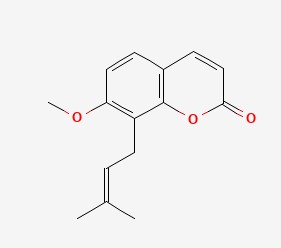 |
| Purity | ≥98% (research grade) |
| CAS | 484-12-8 |
| Classification | Prenylated coumarin |
| Storage Temperature | 2–8°C (refrigerated, protected from light) |
| Solubility | Soluble in sterile water; may dissolve in DMSO |
Mechanism of Action
Experimental studies indicate that osthole interacts with several intracellular signaling pathways. These interactions are examined primarily in cell-based assays and preclinical research models.
Modulation of Cyclic Nucleotide Signaling
Osthole has been reported to influence cyclic nucleotide pathways, including cyclic adenosine monophosphate (cAMP) and cyclic guanosine monophosphate (cGMP). These second messengers regulate kinase activity and transcriptional responses associated with cellular signaling networks.
Regulation of Kinase Signaling Pathways
Osthole has been observed to influence kinase signaling cascades, including
- Mitogen-activated protein kinase (MAPK) pathways
- PI3K/Akt signaling networks
These pathways play key roles in regulating cellular stress responses, apoptosis-related proteins, and transcription factors studied in molecular biology research.
Interaction with Inflammatory Enzyme Systems
Cell culture experiments have shown that osthole may modulate the activity of enzymes associated with inflammatory signaling pathways, including:
- Cyclooxygenase (COX) enzymes
- 5-Lipoxygenase (5-LO)
- Inducible nitric oxide synthase (iNOS)
These enzymes are commonly examined in biochemical studies investigating inflammatory mediator production and immune signaling pathways.
Calcium Channel and Ion Channel Modulation
Some electrophysiological research suggests that osthole may influence voltage-dependent calcium channels and related ion transport mechanisms. These interactions are studied in neuronal cell models to examine regulation of cellular excitability and signal transduction.
Research Applications of Osthole 98%
Osthole is widely used as a research compound in natural product pharmacology and molecular biology. Documented experimental applications include:
- Cellular Signaling Studies
- Inflammation Pathway Research
- Neurobiology and Ion Channel Research
- Natural Product Pharmacology
Why Choose PureRawz for Osthole 98%?
Buy Osthole 98% for laboratory research use from our online shop. At Purerawz, we provide high-quality reference materials. Each research compound comes with a Certificate of Analysis for verification of purity and concentration.
Note:
Osthole 98% is an investigational chemical currently undergoing clinical evaluation and has not been established as safe or effective for any therapeutic use.
Disclaimer
This information is for educational purposes only and not medical advice. Products are for research use only. Research must follow IRB or IACUC guidelines. Verify information independently before purchasing. By ordering, you agree to our Terms and Conditions. If you are not 100% satisfied with the product you received, please contact us at support@staging.purerawz.co
ATTENTION: All our products are for LABORATORY AND RESEARCH PURPOSES ONLY, not for veterinary or human use.
Reference Links
Lin H., You Q., Wei X., et al. Osthole, a Coumarin from Cnidium monnieri: A Review on Its Pharmacology, Pharmacokinetics, Safety, and Innovative Drug Delivery Platforms. American Journal of Chinese Medicine. https://pubmed.ncbi.nlm.nih.gov/39327653/
Li Y., Zhang Y., Wang H., et al. The in vitro and in vivo anti-inflammatory effect of osthole via blocking activation of the NF-κB and MAPK/p38 pathways. Inflammation. https://pubmed.ncbi.nlm.nih.gov/30878874/
Wang X., Zhang X., Yang L., et al. Osthole attenuates inflammatory responses and regulates the expression of inflammatory mediators in HepG2 cells. Pharmaceutical Biology. https://pubmed.ncbi.nlm.nih.gov/25876063/
Zhang Z., Leung W., Cheung H., Chan C. Osthole: A Review on Its Bioactivities, Pharmacological Properties, and Potential as a Natural Therapeutic Agent. Phytotherapy Research. https://pubmed.ncbi.nlm.nih.gov/26165199/
Chen Y., Fan X., Zhao Y., et al. Osthole induces apoptosis and suppresses proliferation via the PI3K/Akt pathway in cancer cells. Biochemical and Biophysical Research Communications. https://pubmed.ncbi.nlm.nih.gov/28902342/
Sun X., Wang H., Wang Y., et al. Antipruritic Effect of Natural Coumarin Osthole through Selective Inhibition of TRPV3 Channel. Molecular Pharmacology. https://pubmed.ncbi.nlm.nih.gov/30108138/
PubChem Compound Summary for Osthole (CID 10228). National Center for Biotechnology Information, U.S. National Library of Medicine. https://pubchem.ncbi.nlm.nih.gov/compound/10228

Dr. Helma Wennemers
Dr. Helma Wennemers is a globally recognized chemist shaping modern peptide science and molecular design through highly original research in applied biosciences.
Her work explores how precise molecular architecture can be engineered to create new functional systems in chemistry and life sciences. Her contributions continue to redefine contemporary chemical research through creativity, depth, and structural innovation.
Please click here to access instructions on how to make a payment.
How to PayRelated products
-

Paraxanthine Capsules
Price range: $22.98 through $49.98 Select options This product has multiple variants. The options may be chosen on the product page -
SLU-PP-332
Price range: $51.65 through $114.25 Select options This product has multiple variants. The options may be chosen on the product page -
Amino Tadalafil
Price range: $31.13 through $78.15 Select options This product has multiple variants. The options may be chosen on the product page -
Magnesium Glycinate
Price range: $15.98 through $49.48 Select options This product has multiple variants. The options may be chosen on the product page


