
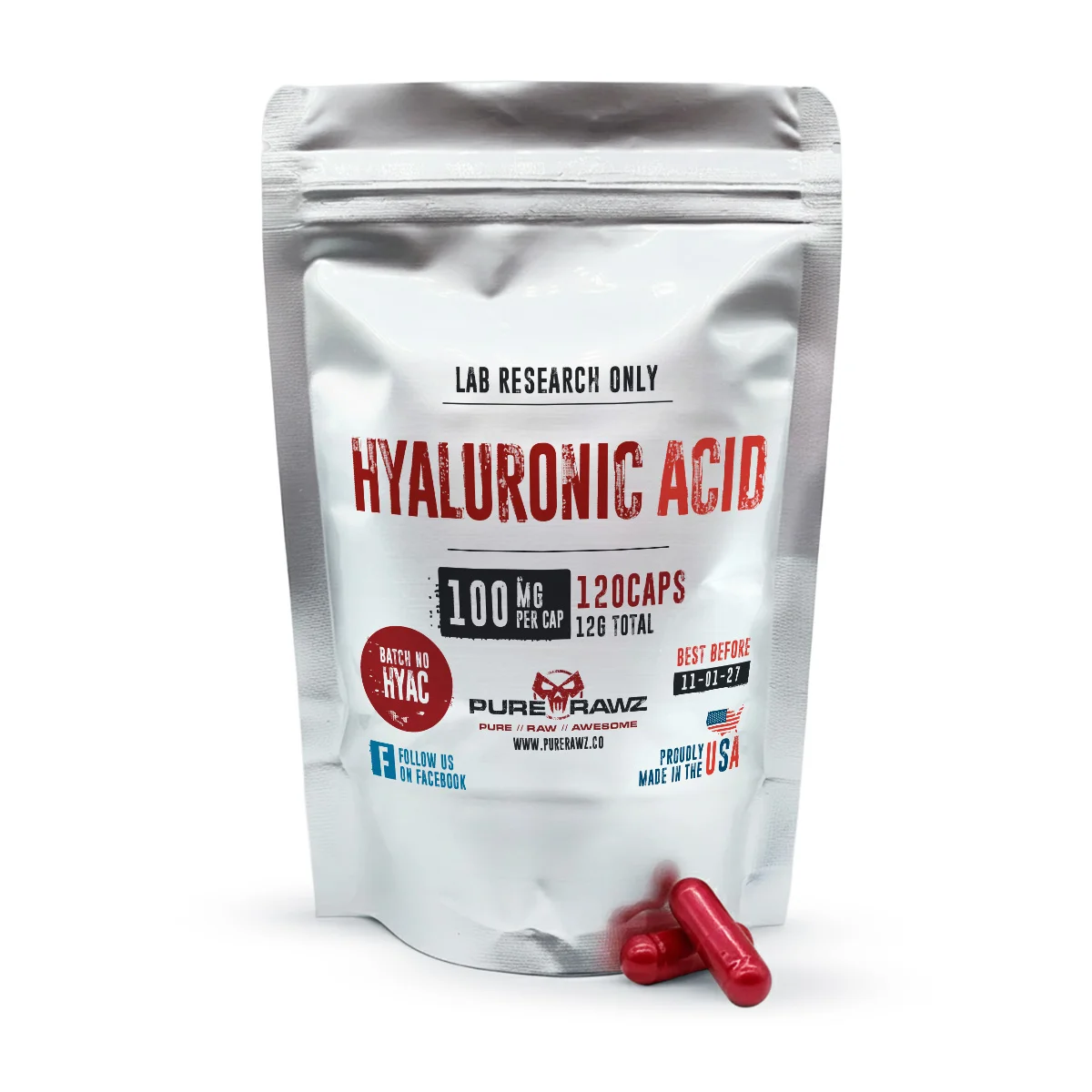
Hyaluronic Acid Capsules
$13.98
Earn 14 points upon purchasing this product.
✅ 99% Purity – Third-Party Tested
🚚 Free U.S. Shipping on Orders $100+
 Proudly Made in the USA
⚡ Fast & Reliable Shipping
🔒 Secure Checkout Guaranteed
Enjoy 24/7 customer support, 1st & 3rd party verified 99% purity, and free shipping on orders over $100!
Description
Hyaluronic Acid
Product Overview
Hyaluronic acid is a glycosaminoglycan polymer frequently studied for its role in hydration dynamics within connective tissue models. The compound has also been examined in experimental systems investigating extracellular matrix structure and connective tissue mechanics.
The compound occurs naturally in the body system and can be found in connective tissues. Hyaluronic acid is a polysaccharide known for its ability to bind water molecules and contribute to the extracellular matrix structure.
Researchers study hyaluronic acid to examine its involvement in water-binding capacity and matrix viscosity in experimental tissue models.
| Property | Data |
| Compound Name | Hyaluronic Acid |
| Molecular Formula | (C14H21NO11)n |
| Molecular Weight | Variable (polymeric structure) |
| Chemical Classification | Glycosaminoglycan polysaccharide |
| IUPAC Name | Hyaluronate polymer |
| CAS Number | 9004-61-9 |
| Structural Unit | D-glucuronic acid and N-acetyl-D-glucosamine |
| Source Database | PubChem (NCBI) |
Working Mechanism
Experimental studies examine how hyaluronic acid contributes to hydration dynamics and viscosity within extracellular matrices. Researchers observe that hyaluronic acid polymers may break down into smaller fragments during metabolic processing in experimental systems.
These fragments are studied for their interactions with extracellular matrix components and their ability to bind water molecules within biological systems. These molecules have been further shown to help maintain extracellular matrix structure, attract and retain water, and improve tissue elasticity.
This whole process appears to enhance the natural production of collagen and synovial fluid support in research models. These processes are investigated in relation to extracellular matrix organization and cellular signaling in connective tissue research models.
Research Applications
Hyaluronic acid was used to study molecular interactions and hydration dynamics in connective tissue models. Because it contains so much water, the polymer can have an impact on the viscosity and structural stability of biological matrices employed in experiments.
Additionally, the molecule is used in biochemical studies that concentrate on enzyme breakdown pathways.
Further research investigates the interactions of hyaluronic acid fragments with cellular receptors and signaling pathways related to matrix remodeling.
Why Buy at PureRawz
At Purerawz, you will get premium-quality hyaluronic acid capsules online at unbeatable prices. These capsules come to you in robust packaging so that they do not get damaged during shipment. Additionally, we work closely with the industry-leading manufacturers to make sure you receive quality products.
The Hyaluronic acid tablets at our online shop go through strict HPLC testing as well as first-and third-party testing. These capsules come along with a complete Certificate of Analysis (COA) for transparency and purity.
Note: Hyaluronic acid supplied by PureRawz is distributed strictly as a research material. This compound has not been approved by the U.S. Food and Drug Administration (FDA) for therapeutic or veterinary use when sold in this format. Handling and experimental use must follow applicable laboratory regulations.
Research Disclaimer
The information provided is intended for scientific reference and educational purposes only.
By placing an order, you agree to the PureRawz Terms and Conditions. If you are not satisfied with your order, please contact support@staging.purerawz.co.
ATTENTION: All products are FOR LABORATORY AND RESEARCH PURPOSES ONLY and NOT FOR HUMAN OR ANIMAL USE.
All experimental work should be conducted by qualified professionals and must comply with institutional regulatory oversight, such as IRB or IACUC guidelines, where applicable.
References
Fraser, J. R., Laurent, T. C., & Laurent, U. B. (1997). Hyaluronan: Its nature, distribution, functions and turnover. Journal of Internal Medicine, 242(1), 27 33. https://pubmed.ncbi.nlm.nih.gov/9260563/
National Center for Biotechnology Information. (2024). Hyaluronic acid compound summary. PubChem Database. https://pubchem.ncbi.nlm.nih.gov/compound/24759
Stern, R., & Jedrzejas, M. J. (2006). Hyaluronidases: Their genomics, structures, and mechanisms of action. Chemical Reviews, 106(3), 818 839. https://pubmed.ncbi.nlm.nih.gov/16522010/
ClinicalTrials.gov. (2024). Hyaluronan research database. https://clinicaltrials.gov

Dr. Helma Wennemers
Dr. Helma Wennemers is a globally recognized chemist shaping modern peptide science and molecular design through highly original research in applied biosciences.
Her work explores how precise molecular architecture can be engineered to create new functional systems in chemistry and life sciences. Her contributions continue to redefine contemporary chemical research through creativity, depth, and structural innovation.
Please click here to access instructions on how to make a payment.
How to PayRelated products
-
Sale!

5 Amino 1MQ + JBSFN + NMN + Resveratrol + Osthole 98% Capsules
Original price was: $417.55.$346.69Current price is: $346.69. Select options This product has multiple variants. The options may be chosen on the product page -
Rutin Capsules
$15.48 Select options This product has multiple variants. The options may be chosen on the product page -
Magnesium Glycinate
Price range: $15.98 through $49.48 Select options This product has multiple variants. The options may be chosen on the product page -
Palmitoylethanolamide (PEA) – With Levagen Capsules
$43.60 Select options This product has multiple variants. The options may be chosen on the product page


