
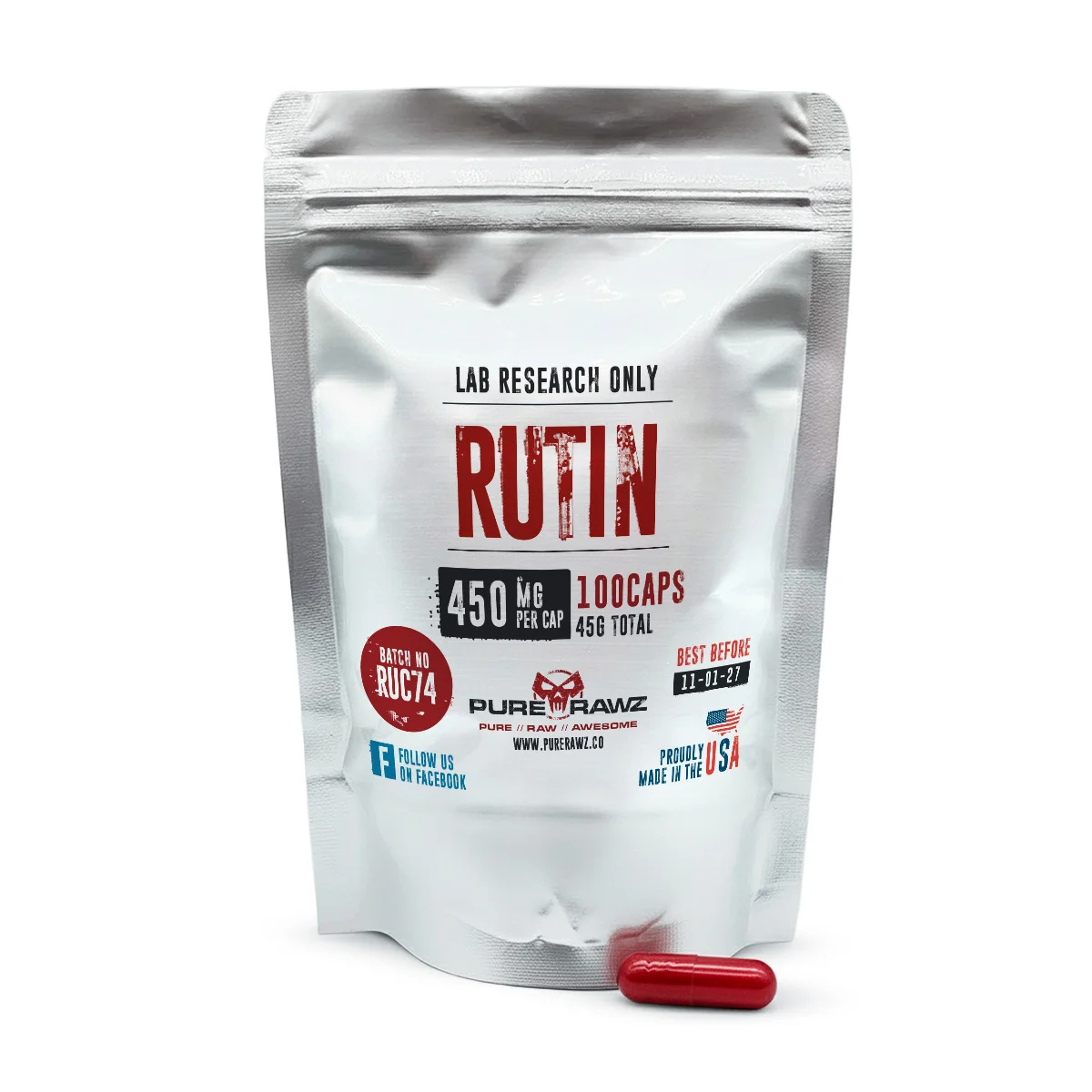
Rutin Capsules
$15.48
Earn 15 points upon purchasing this product.
✅ 99% Purity – Third-Party Tested
🚚 Free U.S. Shipping on Orders $100+
 Proudly Made in the USA
⚡ Fast & Reliable Shipping
🔒 Secure Checkout Guaranteed
Enjoy 24/7 customer support, 1st & 3rd party verified 99% purity, and free shipping on orders over $100!
Description
Rutin
Overview
Rutin is a plant-derived flavonoid glycoside present in many species. It appears in sources such as Fagopyrum esculentum (buckwheat), citrus plants, and several medicinal herbs.
From a chemical perspective, rutin is formed when the flavonol quercetin binds to the disaccharide rutinose. Because of this structure, the compound is frequently examined in studies related to oxidative chemistry, vascular biology, and inflammatory signaling.
| Property | Data |
| Compound Name | Rutin (Quercetin-3-O-rutinoside) |
| PubChem CID | 5280805 |
| CAS Number | 153-18-4 |
| Molecular Formula | C27H30O16 |
| Molecular Weight | 610.52 g/mol |
| Chemical Classification | Flavonoid glycoside |
| IUPAC Name | 2-(3,4-dihydroxyphenyl)-5,7-dihydroxy-3-[(2S,3R,4S,5S,6R)-3,4,5-trihydroxy-6-[[(2R,3R,4R,5R,6S)-3,4,5-trihydroxy-6-methyloxan-2-yl]oxymethyl]oxan-2-yl]oxychromen-4-one |
| Structure | 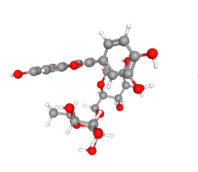 |
| Source Database | PubChem (NCBI) |
Working Mechanism
In laboratory environments, the polyphenolic structure of rutin allows participation in electron transfer reactions. When reactive oxygen species are present, the compound may enter redox cycles that influence the stability of certain radicals.
Some research also examines how rutin interacts with endothelial signaling systems. Laboratory models have explored connections between the compound and enzymes involved in nitric oxide production and vascular tone regulation.
These interactions are generally studied using cultured cells or isolated tissue preparations.
Research Applications
In vascular biology models, the compound is sometimes included in assays that examine endothelial permeability or capillary structure. These studies can help investigators observe how flavonoids interact with structural proteins found in vascular tissues.
Another research focus involves biochemical pathways linked to inflammatory signaling. In vitro experiments may analyze how flavonoids influence enzyme activity or gene expression connected with oxidative stress responses.
Why Buy at PureRawz
PureRawz distributes compounds intended for analytical and laboratory research.
- Each production batch undergoes verification using analytical techniques such as high-performance liquid chromatography (HPLC). These tests help confirm the identity and purity of the substance.
- Independent third-party Certificates of Analysis (COA) are provided for transparency and traceability in laboratory documentation.
Note: Rutin distributed by PureRawz is intended solely for laboratory investigation. The compound is not approved by the U.S. Food and Drug Administration (FDA) for therapeutic or diagnostic use.
Research Disclaimer
The material provided here is for informational and scientific reference purposes only. They are not intended for human or veterinary applications.
All experimental work involving laboratory compounds should be conducted by qualified professionals and must comply with institutional regulatory standards, including Institutional Review Board (IRB) or Institutional Animal Care and Use Committee (IACUC) guidelines when applicable.
ATTENTION: All products are FOR LABORATORY AND RESEARCH PURPOSES ONLY and NOT FOR HUMAN OR ANIMAL USE.
References
Ganeshpurkar, A., & Saluja, A. K. (2017). The pharmacological potential of rutin. Saudi Pharmaceutical Journal, 25(2), 149 164. https://pubmed.ncbi.nlm.nih.gov/28344466/
National Center for Biotechnology Information. (2024). Rutin compound summary. PubChem Database. https://pubchem.ncbi.nlm.nih.gov/compound/5280805
Kreft, S., Knapp, M., & Kreft, I. (1999). Extraction of rutin from buckwheat seeds. Journal of Agricultural and Food Chemistry, 47(11), 4649 4652. https://pubmed.ncbi.nlm.nih.gov/10552880/
ClinicalTrials.gov. (2024). Flavonoid research database. https://clinicaltrials.gov

Dr. Helma Wennemers
Dr. Helma Wennemers is a globally recognized chemist shaping modern peptide science and molecular design through highly original research in applied biosciences.
Her work explores how precise molecular architecture can be engineered to create new functional systems in chemistry and life sciences. Her contributions continue to redefine contemporary chemical research through creativity, depth, and structural innovation.
Please click here to access instructions on how to make a payment.
How to PayRelated products
-
Sale!

5 Amino 1MQ + JBSFN + NMN + Resveratrol + Osthole 98% Capsules
Original price was: $417.55.$346.69Current price is: $346.69. Select options This product has multiple variants. The options may be chosen on the product page -
ACP 105
Price range: $101.09 through $176.50 Select options This product has multiple variants. The options may be chosen on the product page -
SR 9011
Price range: $99.83 through $174.46 Select options This product has multiple variants. The options may be chosen on the product page -
Stenabolic (SR-9009)
Price range: $39.14 through $195.80 Select options This product has multiple variants. The options may be chosen on the product page


