
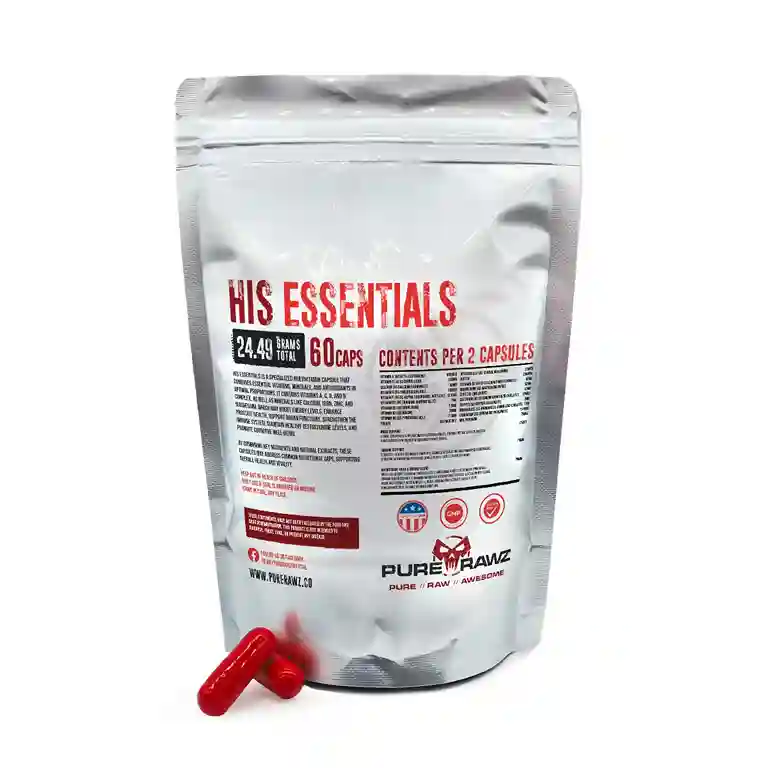
His Essentials
$18.47
Earn 18 points upon purchasing this product.
✅ 99% Purity – Third-Party Tested
🚚 Free U.S. Shipping on Orders $100+
 Proudly Made in the USA
⚡ Fast & Reliable Shipping
🔒 Secure Checkout Guaranteed
Enjoy 24/7 customer support, 1st & 3rd party verified 99% purity, and free shipping on orders over $100!
Description
Essentials Research Formulation Overview
Essentials is a multi-component formulation composed of vitamins, minerals, botanical extracts, and antioxidant compounds. Within investigational research contexts, formulations containing micronutrients and phytochemicals.
The formulation includes a variety of essential micronutrients such as vitamins A, C, D, E, and B-complex compounds, as well as trace minerals including zinc, selenium, chromium, and manganese.
In addition to micronutrients, the formulation contains botanical extracts and phytonutrients such as lutein, lycopene, stinging nettle extract, saw palmetto extract, echinacea extract, beta-glucans, spirulina, garlic extract, green tea extract, and grape seed extract. These compounds are frequently evaluated in in vitro studies and preclinical research models to investigate mechanisms related to antioxidant activity, phytochemical signaling pathways, and plant-derived bioactive compounds.
Chemical and Molecular Properties
| Compound Name | His Essentials Research Formulation |
| Chemical Type | Multi-component micronutrient and botanical extract formulation |
| Molecular Components | Combination of vitamins, trace minerals, carotenoids, polyphenols, and plant-derived phytochemicals |
| Chemical Class | Micronutrients, carotenoids, polyphenols, flavonoids, and botanical extracts |
| Structural Composition | Mixture of organic micronutrient molecules and plant-derived secondary metabolites |
| Key Phytochemical Sources | Extracts from Serenoa repens, Urtica dioica, Echinacea purpurea, Camellia sinensis, Vaccinium myrtillus, Vitis vinifera, Punica granatum, and other botanical sources |
| Vitamin Components | ncludes vitamin A (beta-carotene), vitamin C (ascorbic acid), vitamin D (cholecalciferol), vitamin E (tocopherol derivative), and B-complex vitamins |
| Mineral Components | Trace elements including zinc, selenium, chromium, manganese, copper, magnesium, calcium, and molybdenum |
| Storage Conditions | Store in a cool, dry environment away from direct light |
| Laboratory Status | Multi-component research chemical preparation |
| Regulatory Status | Not FDA-approved |
Mechanisms of Action
Because this formulation contains multiple biochemical compounds, its activity in experimental models is associated with several molecular mechanisms involving micronutrient cofactors and phytochemical signaling molecules.
In laboratory studies, these compounds are known to participate in:
- oxidation-reduction reactions
- DNA synthesis and repair pathways
- mitochondrial metabolic reactions
- coenzyme-dependent enzymatic systems
- neutralization of reactive oxygen species (ROS)
- modulation of oxidative stress signaling pathways
- regulation of redox-sensitive transcription factors
Potential Research Applications
Nutrient-Dependent Enzymatic Pathway Research
Formulations containing vitamins and minerals are frequently used in biochemical research models investigating the role of micronutrients as cofactors in enzymatic reactions. These studies may examine:
- enzyme activity influenced by micronutrient availability
- coenzyme-dependent metabolic reactions
- cellular metabolism associated with vitamin-dependent pathways
Oxidative Stress and Antioxidant Research
Several compounds within the formulation are commonly used in in vitro studies examining oxidative stress regulation. Laboratory investigations often evaluate:
- Reactive oxygen species generation
- Antioxidant compound interactions with redox systems
- Molecular responses to oxidative signaling
Phytochemical and Plant-Derived Compound Studies
The botanical extracts present in the formulation are frequently examined in experimental phytochemistry research. These studies may analyze:
- Plant-derived polyphenol signaling mechanisms
- Molecular pathways influenced by flavonoids and carotenoids
- Interactions between phytochemicals and cellular regulatory proteins
Disclaimer
This information is for educational purposes only and not medical advice. Products are for research use only. Research must follow IRB or IACUC guidelines. Verify information independently before purchasing. By ordering, you agree to our Terms and Conditions. If you are not 100% satisfied with the product you received, please contact us at support@staging.purerawz.co
ATTENTION: All our products are for LABORATORY AND RESEARCH PURPOSES ONLY, not for veterinary or human use
References:
- McEldrew, E. P., Lopez, M. J., & Milstein, H. (2025, February 19). Vitamin A. StatPearls - NCBI Bookshelf. https://www.ncbi.nlm.nih.gov/books/NBK482362/
- Rizvi, S., Raza, S. T., Ahmed, F., Ahmad, A., Abbas, S., & Mahdi, F. (2014, April 7). The role of vitamin E in human health and some diseases. https://pmc.ncbi.nlm.nih.gov/articles/PMC3997530/
- Saeidnia, S., Manayi, A., & Vazirian, M. (2015). Echinacea purpurea: Pharmacology, phytochemistry and analysis methods. Pharmacognosy Reviews/Bioinformatics Trends/Pharmacognosy Review, 9(17), 63. https://doi.org/10.4103/0973-7847.156353

Dr. Helma Wennemers
Dr. Helma Wennemers is a globally recognized chemist shaping modern peptide science and molecular design through highly original research in applied biosciences.
Her work explores how precise molecular architecture can be engineered to create new functional systems in chemistry and life sciences. Her contributions continue to redefine contemporary chemical research through creativity, depth, and structural innovation.
Please click here to access instructions on how to make a payment.
How to PayRelated products
-

Shroomz
$18.47 Read more -
Meta Up
$17.20 Select options This product has multiple variants. The options may be chosen on the product page -
Fat to Muscle
$47.80 Select options This product has multiple variants. The options may be chosen on the product page -
Any Cycle Capsules
$26.10 Select options This product has multiple variants. The options may be chosen on the product page


