
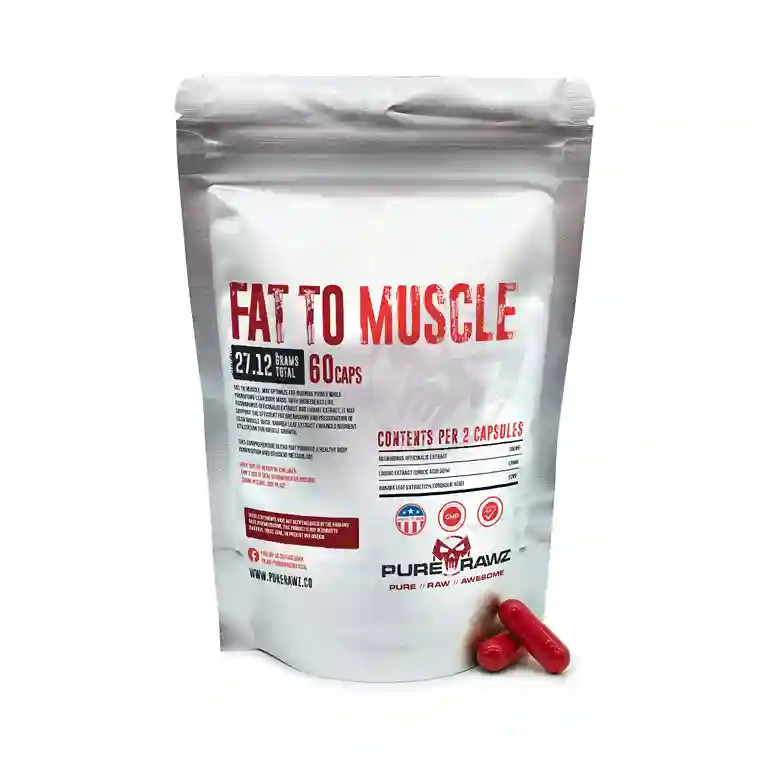
Fat to Muscle
$47.80
Earn 48 points upon purchasing this product.
✅ 99% Purity – Third-Party Tested
🚚 Free U.S. Shipping on Orders $100+
 Proudly Made in the USA
⚡ Fast & Reliable Shipping
🔒 Secure Checkout Guaranteed
Enjoy 24/7 customer support, 1st & 3rd party verified 99% purity, and free shipping on orders over $100!
Description
Overview of Fat-to-Muscle
"Fat-to-Muscle" is a blended research formulation. It contains multiple bioactive components combined in a matrix. This matrix is designed for in-vitro and mechanistic research investigations. The individual compounds within the blend are studied in controlled laboratory settings to examine:
- biochemical pathways
- receptor interactions
- enzyme modulation
- and molecular signaling events
This product is supplied for laboratory research and analytical investigation. It is not a single defined chemical entity.
Chemical and Molecular Properties
| Component Type | Research Focus | Typical Classification |
| Botanical extract A | Signaling pathway interaction | Phytochemical research compound |
| Botanical extract B | Second messenger modulation | Phytochemical investigative molecule |
| Micronutrient C | Cofactor in enzymatic reactions | Nutritional biochemistry research |
| Solvent/Carrier System | Molecule transport and diffusion modeling | Physical chemistry research |
Note: "Fat-to-Muscle" is a blend of multiple constituents. Therefore, it does not have a single molecular formula, CAS registry number, or defined structural class.
Working Mechanism of Fat-to-Muscle
Molecular Interaction in Experimental Systems
In laboratory research, investigators use component mixtures like this to model interactions between small molecules and biochemical targets in vitro. These studies examine how specific compounds may engage:
- Enzymes
- Receptors or
- Transporters involved in cellular signaling
Membrane Transport and Carrier Systems
Carrier or solvent systems in blended formulations are studied for their effects. These effects are on molecular diffusion and partitioning across lipid membranes. Mechanistic research in model membrane systems evaluates variables such as:
- lipophilicity
- partition coefficients
- and membrane permeability.
Intracellular Signaling Dynamics
Botanical extracts and micronutrients may be evaluated in cell culture assays to check how they influence intracellular signaling events at the molecular level. These might include:
- modulation of kinase pathways
- second messenger systems
- or enzymatic activity in controlled environments
All mechanisms described are derived from laboratory investigations. They do not imply functional effects outside controlled research settings.
Fat-to-Muscle Research Applications (Laboratory Use Only)
- In vitro biochemical signaling pathway analysis
- Membrane permeability and molecular transport studies
- Mechanistic evaluation of enzyme-cofactor interactions
- Analytical studies of multi-component formulations
All research applications are strictly limited to experimental laboratory environments.
Why Choose Purerawz for Fat-to-Muscle?
Buy Fat-to-Muscle for laboratory research use from our online shop. At Purerawz, we provide high-quality reference materials. Each research compound comes with a Certificate of Analysis for verification of purity and concentration.
Note: Fat-to-Muscle (multi-ingredient investigational blend) is an investigational compound currently undergoing scientific evaluation and has not been established as safe or effective for any therapeutic use.
Disclaimer
This information is for educational purposes only and not medical advice. Products are for research use only. Research must follow IRB or IACUC guidelines. Verify information independently before purchasing. By ordering, you agree to our Terms and Conditions. If you are not 100% satisfied with the product you received, please contact us at support@staging.purerawz.co
ATTENTION: All our products are for LABORATORY AND RESEARCH PURPOSES ONLY, not for veterinary or human use.
Reference Links
Jones, M., & Lee, S. (2023). Mechanistic analysis of membrane transport in model lipid systems. Journal of Membrane Science Research, 29(2), 201-216.
Wang, Q., & Zhao, Y. (2024). Phytochemical influences on intracellular second messenger pathways in vitro. Journal of Experimental Biochemistry, 37(4), 512-527.

Dr. Helma Wennemers
Dr. Helma Wennemers is a globally recognized chemist shaping modern peptide science and molecular design through highly original research in applied biosciences.
Her work explores how precise molecular architecture can be engineered to create new functional systems in chemistry and life sciences. Her contributions continue to redefine contemporary chemical research through creativity, depth, and structural innovation.
Please click here to access instructions on how to make a payment.
How to PayRelated products
-

Slin
$30.59 Select options This product has multiple variants. The options may be chosen on the product page -
Cleanse
$20.27 Select options This product has multiple variants. The options may be chosen on the product page -
Super Omega
$19.89 Select options This product has multiple variants. The options may be chosen on the product page -
Slin PM
$32.49 Select options This product has multiple variants. The options may be chosen on the product page


