
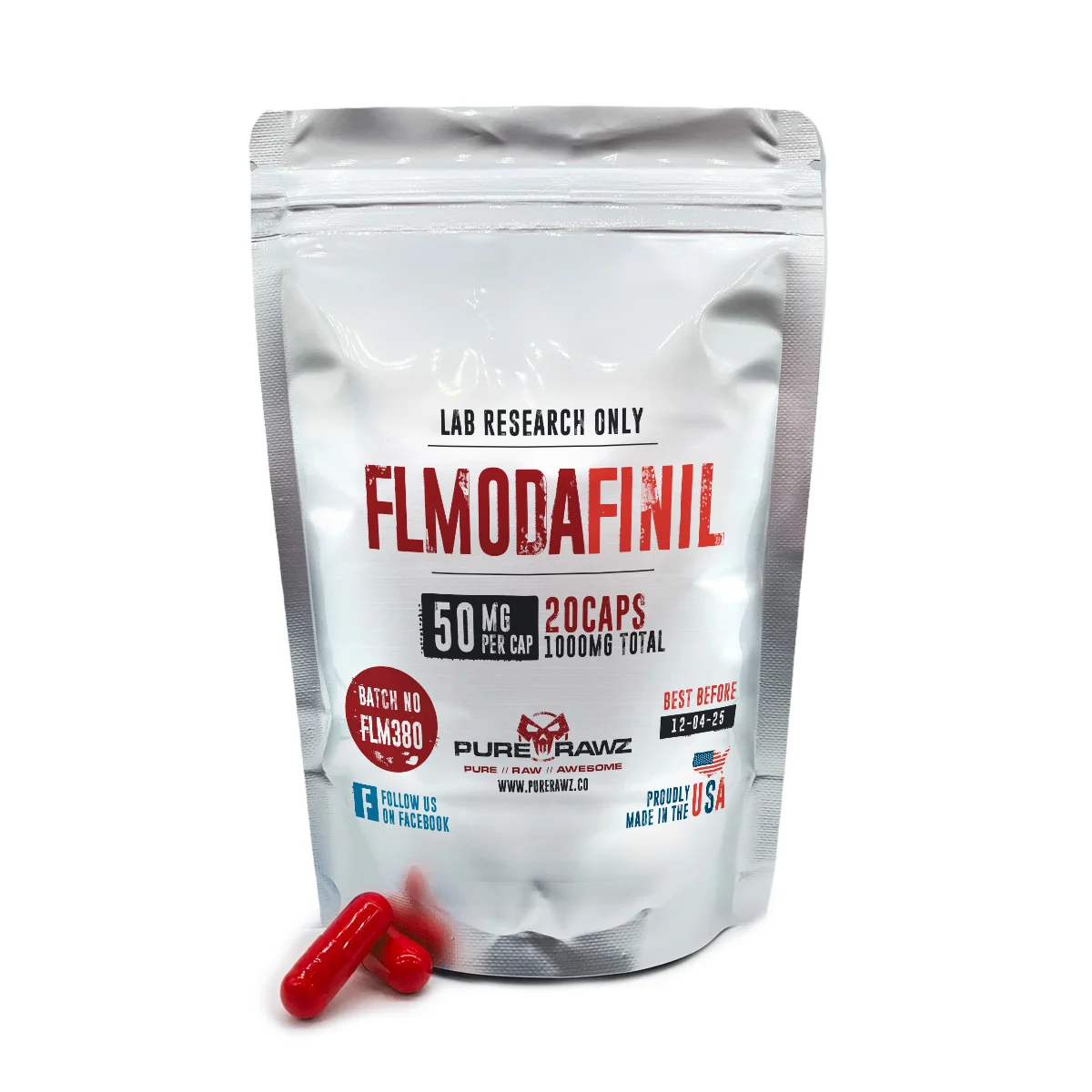
FLModafinil (CRL-40,940)
Price range: $53.35 through $236.99
Earn 53 - 237 points upon purchasing this product.
✅ 99% Purity – Third-Party Tested
🚚 Free U.S. Shipping on Orders $100+
 Proudly Made in the USA
⚡ Fast & Reliable Shipping
🔒 Secure Checkout Guaranteed
Enjoy 24/7 customer support, 1st & 3rd party verified 99% purity, and free shipping on orders over $100!
Description
Overview of FLModafinil
FLModafinil, also referenced in scientific literature as CRL-40,940 or bisfluoromodafinil, is an investigational compound structurally derived from modafinil, a diphenylmethyl sulfinylacetamide derivative. The compound belongs to a class of synthetic molecules studied in experimental neuropharmacology research for their interactions with neurotransmitter systems involved in wakefulness regulation and neural signaling.
Structurally, FLModafinil differs from modafinil through the substitution of two para-fluorine atoms on the phenyl rings, producing a bis-fluoro analog. This modification has been investigated in structure-activity relationship (SAR) studies examining how chemical substitutions influence pharmacological properties, receptor interactions, and transporter affinity in laboratory research models.
Within preclinical and in vitro investigations, FLModafinil has been evaluated for its potential interactions with neurotransmitter transporters and intracellular signaling systems associated with dopaminergic pathways. Because of its structural similarity to modafinil, research interest has focused on understanding how fluorinated derivatives influence neurotransmitter transporter modulation and cellular signaling processes.
Chemical and Molecular Properties
| Property | Information |
| CAS Number | 90280-13-0 |
| Molecular Formula | C15H13F2NO2S |
| Molecular Mass | 309.3 g/mol |
| Synonyms | CRL-40,940; Bisfluoromodafinil; Lauflumide |
| IUPAC Name | 2-[bis(4-fluorophenyl)methylsulfinyl]acetamide |
| Labeling | Research Use Only (RUO) |
Working Mechanism
Dopamine Transporter Interaction in Experimental Models
Experimental pharmacology research has investigated FLModafinil for its potential interaction with the dopamine transporter (DAT), a membrane protein responsible for regulating dopamine reuptake within synaptic spaces.
In in vitro transporter assays, compounds structurally related to modafinil have been examined for their ability to interact with DAT, influencing the reuptake process that regulates extracellular dopamine concentrations. Research models suggest that inhibition or modulation of this transporter can alter dopaminergic signaling dynamics within neuronal systems.
Neurotransmitter Signaling Pathways
Experimental studies examining modafinil analogues, including FLModafinil, have also explored interactions with broader neurotransmitter systems involved in arousal regulation and neurochemical signaling.
Laboratory investigations suggest that these compounds may influence signaling pathways associated with:
- dopaminergic neurotransmission
- glutamatergic signaling pathways
- orexin and histamine regulatory networks associated with wakefulness signaling
Structure-Activity Relationship (SAR) Research
The fluorinated phenyl substitution present in FLModafinil has been examined in structure-activity relationship studies exploring how chemical modifications influence transporter interactions and molecular signaling properties.
Research comparing modafinil and fluorinated derivatives investigates how structural differences affect:
- transporter-binding affinity
- lipophilicity and molecular stability
- signaling pathway activation in neuronal research models
Research Applications of FLModafinil in Laboratory Settings
Dopamine Transporter Research
Experimental studies may investigate how FLModafinil interacts with dopamine transporters using in vitro uptake assays and transporter-binding experiments.
Neurochemical Signaling Studies
Research models may explore the compound's influence on dopaminergic and glutamatergic signaling networks through biochemical pathway analysis and neurotransmitter measurement techniques.
Structure-Activity Relationship Investigations
FLModafinil may be included in comparative studies examining structural modifications of modafinil analogues and their influence on transporter affinity and molecular signaling interactions.
Experimental Neuropharmacology Models
Laboratory experiments may use the compound in research exploring neurotransmitter regulation mechanisms, intracellular signaling pathways, and molecular interactions within neuronal systems.
Note: FLModafinil is not approved by the FDA for human consumption. It is available for research purposes only.
Why Choose Purerawz for FLModafinil?
Buy FLModafinil for laboratory research use from our online shop. At Purerawz, we provide high-quality reference materials. Each research compound comes with a Certificate of Analysis for verification of purity and concentration.
Disclaimer
This information is for educational purposes only and not medical advice. Products are for research use only. Research must follow IRB or IACUC guidelines. Verify information independently before purchasing. By ordering, you agree to our Terms and Conditions. If you are not 100% satisfied with the product you received, please contact us at support@staging.purerawz.co
ATTENTION: All our products are for LABORATORY AND RESEARCH PURPOSES ONLY, not for veterinary or human use
Reference Links
PubChem. (2026). 2-((Bis(4-fluorophenyl)methyl)sulfinyl)acetamide. Nih.gov; PubChem. https://pubchem.ncbi.nlm.nih.gov/compound/2-bis4-fluorophenylmethylsulfinylacetamide
Napoletano, F., Schifano, F., Corkery, J. M., Guirguis, A., Arillotta, D., Zangani, C., & Vento, A. (2020). The psychonauts world of cognitive enhancers. Frontiers in Psychiatry, 11, 546796. https://doi.org/10.3389/fpsyt.2020.546796

Dr. Helma Wennemers
Dr. Helma Wennemers is a globally recognized chemist shaping modern peptide science and molecular design through highly original research in applied biosciences.
Her work explores how precise molecular architecture can be engineered to create new functional systems in chemistry and life sciences. Her contributions continue to redefine contemporary chemical research through creativity, depth, and structural innovation.
Please click here to access instructions on how to make a payment.
How to PayRelated products
-

Kava Extract 70% Kavalactones
Price range: $19.66 through $47.52 Select options This product has multiple variants. The options may be chosen on the product page -
Sale!
7,8 Dihydroxyflavone
Original price was: $27.31.$22.69Current price is: $22.69. Select options This product has multiple variants. The options may be chosen on the product page -
Methylene Blue
Price range: $14.91 through $178.19 Select options This product has multiple variants. The options may be chosen on the product page -
PRL-8-53
Price range: $57.37 through $92.36 Select options This product has multiple variants. The options may be chosen on the product page


