
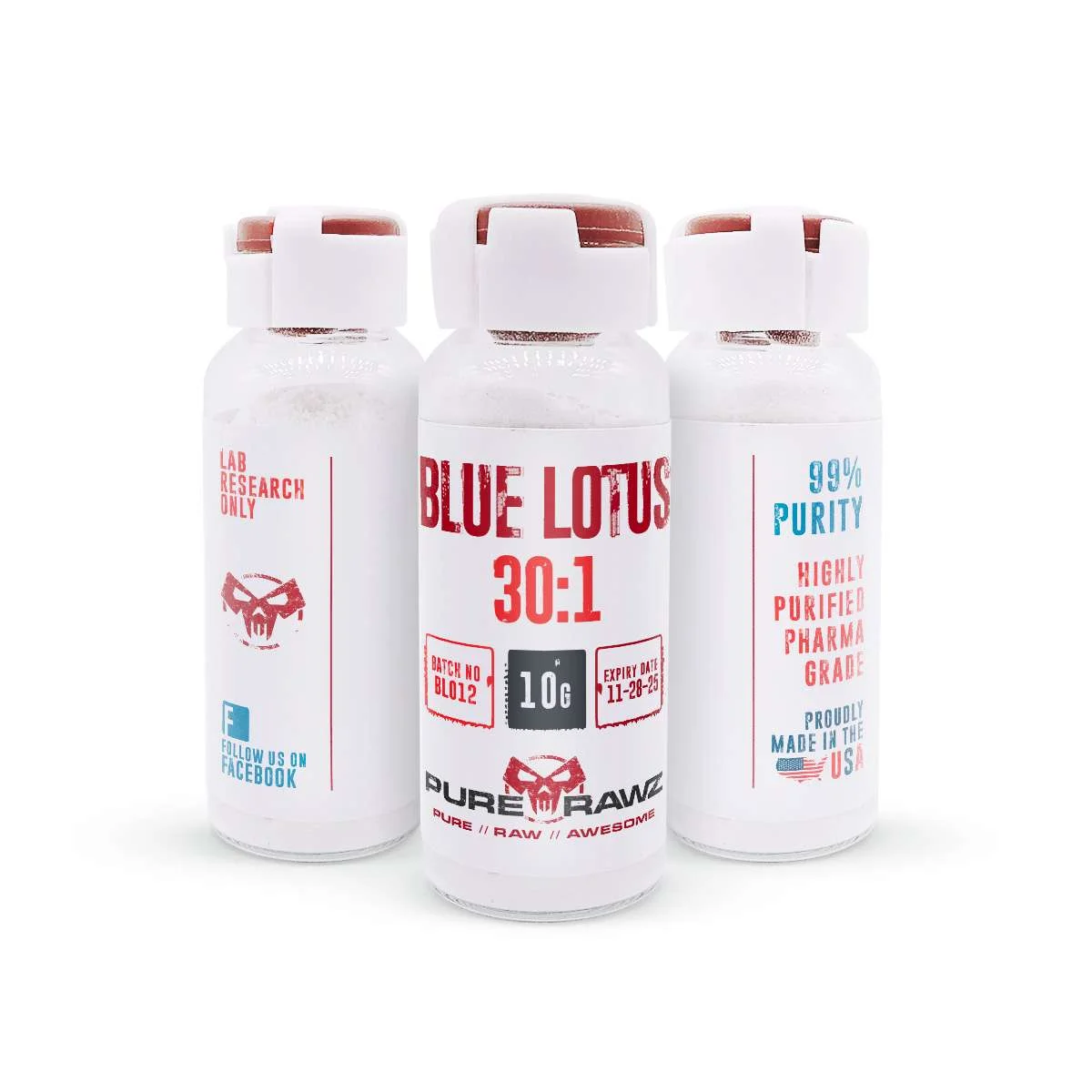
Blue Lotus 30:1
Price range: $16.91 through $40.98
Earn 17 - 41 points upon purchasing this product.
✅ 99% Purity – Third-Party Tested
🚚 Free U.S. Shipping on Orders $100+
 Proudly Made in the USA
⚡ Fast & Reliable Shipping
🔒 Secure Checkout Guaranteed
Enjoy 24/7 customer support, 1st & 3rd party verified 99% purity, and free shipping on orders over $100!
Description
Blue Lotus 30:1 Overview
Blue Lotus refers to botanical material derived from Nymphaea caerulea, an aquatic flowering plant belonging to the Nymphaeaceae family. Within scientific contexts, extracts from this plant are investigated as natural product research materials due to the presence of multiple bioactive alkaloids and flavonoids.
Phytochemical investigations have identified several compounds in Nymphaea caerulea, most notably aporphine alkaloids, including apomorphine and nuciferine, along with various flavonoids, phenolic compounds, and glycosides.
These constituents have been examined in in vitro assays and experimental pharmacology models that explore interactions with neurotransmitter receptor systems and intracellular signaling pathways.
Because of this diverse phytochemical profile, Blue Lotus extracts are commonly studied in natural product chemistry, neuropharmacology research models, and phytochemical analysis frameworks.
Researchers often utilize standardized plant extracts to evaluate alkaloid-receptor interactions, enzyme modulation, and molecular signaling mechanisms within controlled laboratory environments.
Chemical and Molecular Properties
| Blue Lotus 30:1 | |
| CAS Number | 475-83-2 |
| Molar Mass | 373.38 g/mol |
| Chemical Formula | C21H23NO5 |
| IUPAC Name | (6aR,9R)-Nucifer-5-en-7-yl acetate |
Working Mechanism of Blue Lotus 30:1
Alkaloid-Receptor Interactions
The primary alkaloids identified in Nymphaea caerulea, particularly nuciferine and apomorphine, have been examined in in vitro receptor-binding assays due to their structural similarity to known dopaminergic ligands.
In experimental receptor models, aporphine alkaloids may interact with dopamine receptor subtypes (D1-D5) and other monoaminergic receptor systems. Molecular docking studies and receptor binding experiments suggest that these alkaloids can associate with G-protein-coupled receptor (GPCR) binding pockets, influencing receptor conformation and downstream signaling pathways in controlled experimental environments.
Monoaminergic Signaling Pathways
Experimental research on nuciferine indicates interactions with multiple receptor systems within monoaminergic signaling networks, including:
- Dopaminergic receptors
- Serotonergic receptor subtypes
- Adrenergic receptor systems
These interactions are typically investigated in cell-based receptor assays, ligand binding experiments, and molecular pharmacology studies designed to evaluate receptor affinity and signaling modulation.
Flavonoid-Associated Cellular Signaling
Flavonoids such as quercetin and kaempferol present in Blue Lotus extracts are widely studied in cell culture experiments for their interactions with intracellular signaling pathways.
These compounds may influence biochemical systems involved in:
- Kinase-mediated signaling cascades
- Transcription factor activation
- Cellular redox regulatory pathways
Such mechanisms are commonly explored in in vitro experimental models evaluating plant-derived polyphenols and their interactions with cellular signaling proteins.
Research Applications of Blue Lotus 30:1 in Laboratory Settings
Natural Product Chemistry Research
Blue Lotus extracts are frequently used in phytochemical research to investigate the structural diversity of plant-derived alkaloids and flavonoids. Research methods often include:
- High-performance liquid chromatography (HPLC)
- Gas chromatography-mass spectrometry (GC-MS)
- Nuclear magnetic resonance (NMR) spectroscopy
These techniques enable detailed characterization of secondary metabolites and structural analysis of aporphine alkaloids.
Receptor Binding and Neurochemical Studies
Alkaloids such as nuciferine and apomorphine are utilized in experimental receptor binding assays that examine interactions with monoaminergic receptor systems. Such studies may involve:
- Ligand binding experiments
- Receptor affinity analysis
- Molecular docking simulations
- GPCR signaling investigations
These models contribute to basic research on receptor pharmacology and ligand-receptor interaction dynamics.
Cellular Signaling and Molecular Pathway Analysis
Flavonoids present in Blue Lotus extracts are also studied in in vitro cellular models investigating:
- Signal transduction pathways involving kinase activation
- Regulation of transcription factors
- Cellular biochemical responses to plant-derived polyphenols
These experiments often utilize cultured cell lines and biochemical pathway assays to observe molecular interactions.
Why Choose Purerawz for Blue Lotus 30:1?
Buy Blue Lotus 30:1 for laboratory research use from our online shop. At Purerawz, we provide high-quality reference materials. Each research compound comes with a Certificate of Analysis for verification of purity and concentration.
Disclaimer
This information is for educational purposes only and not medical advice. Products are for research use only. Research must follow IRB or IACUC guidelines. Verify information independently before purchasing. By ordering, you agree to our Terms and Conditions. If you are not 100% satisfied with the product you received, please contact us at support@staging.purerawz.co
Reference Links
- Sekti, B. H. (2021). TEST OF ANTIOXIDANT CONTENT IN BLUE LOTUS (Nymphaea stellata wild) LEAVES WITH DPPH METHOD (1,1-Diphenyl-2-Picrylhydrazyl). Jurnal Jamu Kusuma, 1(2), 46-50. https://doi.org/10.37341/jurnaljamukusuma.v1i2.10
- Singha, S., Kumar, S., Nayak, S. K., Kumar, P., Banik, A., & Srivastava, P. P. (2023). Blue lotus (Nymphaea nouchali) flower and leaf supplements enhance growth and hemato-immunological parameters in Indian major carp (Labeo rohita) juveniles. Animal Feed Science and Technology, 304, 115741. https://doi.org/10.1016/j.anifeedsci.2023.115741

Dr. Helma Wennemers
Dr. Helma Wennemers is a globally recognized chemist shaping modern peptide science and molecular design through highly original research in applied biosciences.
Her work explores how precise molecular architecture can be engineered to create new functional systems in chemistry and life sciences. Her contributions continue to redefine contemporary chemical research through creativity, depth, and structural innovation.
Please click here to access instructions on how to make a payment.
How to PayRelated products
-

Evodiamine
Price range: $21.13 through $34.53 Select options This product has multiple variants. The options may be chosen on the product page -
Nicotinamide Mononucleotide (NMN)
Price range: $52.99 through $55.19 Select options This product has multiple variants. The options may be chosen on the product page -
Flammulina Velutipes 30%
Price range: $24.57 through $59.56 Select options This product has multiple variants. The options may be chosen on the product page -
Chaga 30% Extract POLYSACCHARIDES
Price range: $14.20 through $36.61 Select options This product has multiple variants. The options may be chosen on the product page


