

The peptide concentration is the actual peptide content present in a sample. And the label accuracy reflects what is stated on the peptide vial. It has been observed that, in a few peptide vials, the labeled value may differ from the true peptide content,
To be an expert researcher, you need to first understand the peptide concentration and label accuracy. Since not every peptide sample indicates the accurate peptide concentration, users may get confused and buy the wrong sample.
Buying a peptide that has a different label accuracy than the actual peptide can interfere with the experimental results. In this blog, we will help you identify peptide concentration and label accuracy so that you do not have to worry about your research outcomes.
Peptide concentration refers to the actual amount of peptide found in a peptide sample. It is expressed as mass (such as milligrams) per vial or as mass per unit volume in solution.
Net peptide content (peptide concentration) represents the true peptide content. Its weight is not necessarily equal to the total sample weight, which may include water, salts, and counterions.
It is important to know that peptide concentration and peptide purity are different. However, they are interrelated analytical parameters. Here is the difference.
| Peptide Concentration | Peptide Purity |
| Refers to the actual amount of peptide present in a sample (usually in milligrams or mg/mL). It tells you how much active peptide you have, regardless of other substances in the vial. | Refers to the proportion of the sample that is the intended peptide compared to impurities. Expressed as a percentage (%). For example, 98% purity means 98% is the peptide, 2% is impurities. |
Peptide purity tells you what fraction of the sample is the intended peptide and what fraction is impurities.
Peptide concentration is treated as a quantitative parameter that represents the true peptide content, independent of labeling claims. In research applications, the peptide concentration is extremely important for the following reasons.
Researchers rely on precise peptide concentrations to control experimental conditions. Low peptide concentration may reduce peptide effectiveness.
In science, the experiments must give the same results when they are repeated. An accurate peptide concentration helps with experimental reproducibility.
Research scientists consider various methods to determine peptide concentration. A few of the frequent methods are given below.
The information you see on the peptide vial, i.e., concentration, purity, or net peptide content, refers to label accuracy. The purpose of label accuracy is to ensure that the information provided on the vial is truthful and reliable, reflecting the actual contents inside.
| Label Accuracy | Actual Measured Peptide Content |
| The peptide amount stated on the vial is simply based on the manufacturer's calculations. Though few manufacturers do provide direct analytical testing. | It describes the true peptide amount confirmed through laboratory analysis. |
| It does not consider non-peptide content (e.g., TFA or acetate) | It considers these factors as well |
| It is for identification and reference purposes. | Actual measured peptide content is necessary for accurate dosing and research reliability |
Label accuracy holds a substantial amount of importance because of the following factors.
The accurate labels help researchers compare results across different studies. With the authentic label accuracy, researchers do not have to worry about the hidden variations in peptide content.
An accurate label helps researchers know the exact peptide amount. Knowing the exact peptide amount prevents unnecessary wastage of expensive reagents or repeating experiments.
Label accuracy is confirmed via:
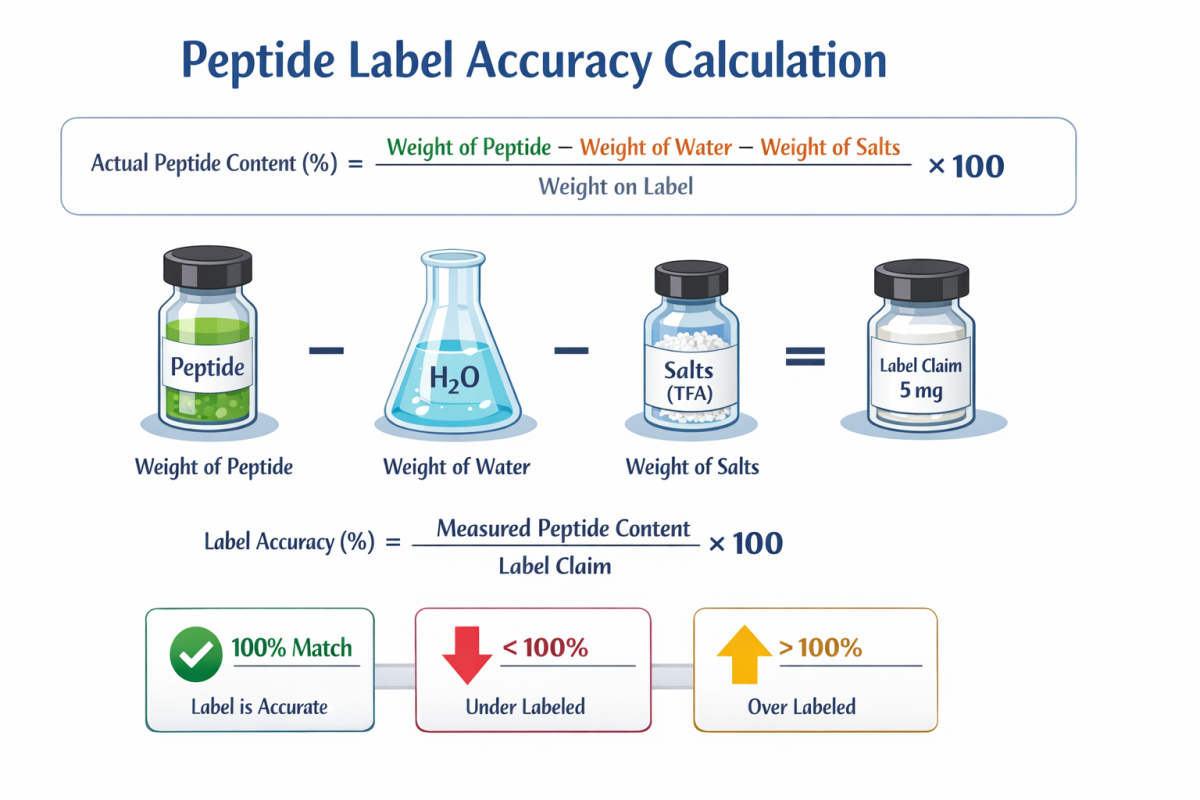
Many vendors may print “99% purity” on their peptides. However, for better research outcomes, you need to understand the gap between what’s on the label and the true peptide content.
The percentage you see on the peptide vial is chromatographic purity (e.g., “99% purity...
The actual amount of peptide by weight after removing water, salts, and impurities is what really matters for accurate dosing.
| The only way to learn about the real peptide content is by reviewing (Certificate of Analysis) COAs. and conducting analytical tests. For this purpose, you can take assistance from reputable analytical labs. |
The regulatory and analytical standards in the USA hold paramount importance in this matter as well. Various researchers follow established regulatory and scientific guidelines, including.
Along with a few other factors, accurate peptide concentration helps you determine reliable and reproducible experiments. Whereas, label claims show chromatographic purity but may include water, salts, or impurities.
However, understanding label accuracy will help prevent dosing errors in research models. Furthermore, it may support automation and build trust in peptide research.
You may also need to know that
