
🔥 WE HAVE THE BEST COMPOUNDS ON THE PLANET
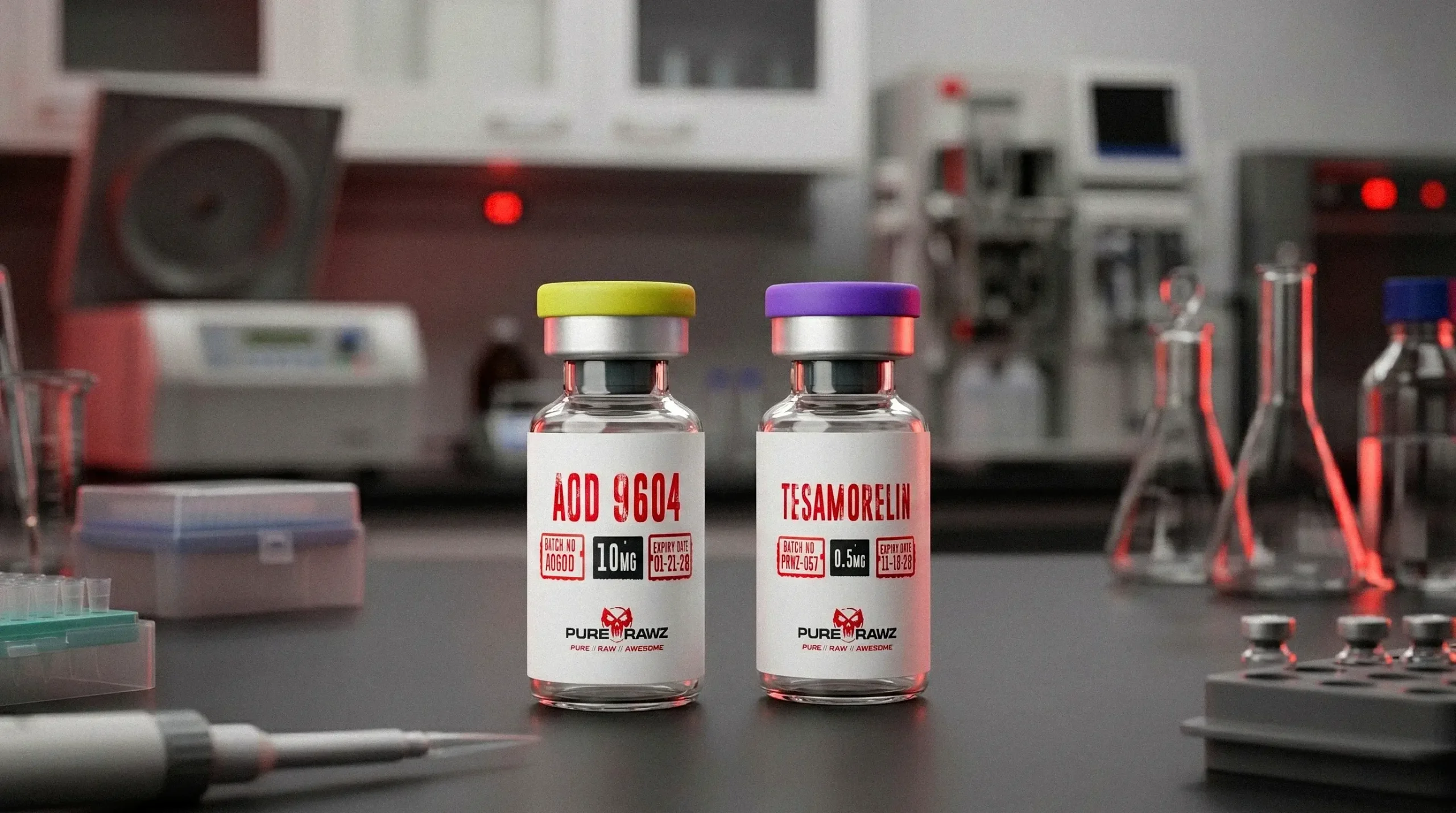
In different preclinical models, Tesamorelin and AOD 9604 have been explored for their possible roles in lipid metabolism. Researchers have observed that Tesamorelin signals the pituitary gland to release growth hormone by binding to the GHRH receptor [1].
AOD 9604, by contrast, is studied for direct effects at the adipocyte level in research preclinical models independent of the growth hormone receptor and, based on research published in Endocrinology, independent of beta-3 adrenergic signaling as well [6].
In the following blog, we are going to talk about Tesamorelin vs AOD 9604 and their key differences.
The blog will also cover what research suggests about these two peptides and how they may work in laboratory settings.
Tesamorelin has limited FDA approval for one specific medical indication only. AOD 9604 has no FDA approval for any human or veterinary use. This article is for educational and research reference purposes only. Nothing here is medical advice, and nothing here describes off-label or non-approved use. All peptides referenced are sold strictly for laboratory research purposes.
If you only have thirty seconds, here is the short version. Tesamorelin is a synthetic GHRH analog. It binds to the growth hormone–releasing hormone receptor and triggers a cAMP–PKA cascade in pituitary cells. That is textbook endocrine signaling.
AOD 9604 is a small fragment of human growth hormone residues 176 to 191. It is studied for direct effects on fat cells in lab models, and its activity does not depend on the GHRH receptor, the growth hormone receptor, or IGF-1. The mechanism is still not fully mapped.
Tesamorelin has FDA approval for one narrow indication. AOD 9604 does not have FDA approval at all. Both continue to show up in preclinical research, but for very different reasons.
Tesamorelin is a synthetic 44-amino acid analog of growth hormone-releasing hormone (GHRH). It carries a trans-3-hexenoic acid modification at its N-terminus. Studies have shown that trans-3-hexenoic acid modification may shield it from breakdown by DPP-IV enzymes [1].
In different preclinical research models, Tesamorelin has been studied as a GHRH receptor agonist on pituitary somatotroph cells.
The peptide is also investigated in the context of visceral adipose tissue regulation and lipid metabolism research [1, 4].
AOD 9604 is a synthetic 16-amino acid peptide fragment. It is derived from the C-terminal region of human growth hormone (residues 176–191) [5].
Researchers use synthetic AOD 9604 to investigate adipose tissue regulation. This occurs independently of the hypothalamic-pituitary-growth hormone axis.
Researchers have observed that Tesamorelin functions as a selective agonist of the growth hormone-releasing hormone (GHRH) receptor.
Various preclinical studies have suggested that Tesamorelin binds to the Gs-coupled GHRH receptor. It activates adenylate cyclase, which leads to an increase in intracellular cyclic adenosine monophosphate (cAMP).
The increased cAMP level may trigger activation of protein kinase A (PKA). This further adds to phosphorylation of downstream targets involved in transcriptional regulation.
The signaling cascade results in increased expression of genes associated with growth hormone synthesis in engineered pituitary-like research models [1].
In vitro systems, AOD 9604 is studied as a synthetic peptide fragment from human growth hormone. Its proposed activity is assessed independently of the growth hormone receptor and systemic endocrine pathways [5].
The peptide is also investigated for the modulation of intracellular lipolytic and lipogenic processes. These processes may include changes in triglyceride breakdown and fatty acid mobilization in investigational models.
These effects are typically assessed through biochemical endpoints such as glycerol release and fatty acid oxidation markers [5].
AOD 9604 does not activate the growth hormone receptor or induce IGF-1 signaling in preclinical models. Instead, its observed activity is described as growth hormone–independent [6].
Research on Tesamorelin and AOD 9604 has been conducted in different controlled experimental settings. Investigations in this area are still ongoing. Based on current laboratory findings, researchers have reported the following observations regarding these two synthetic peptides.
Researchers have suggested that Tesamorelin research is centered on hormone receptor signaling and endocrine pathway activation.
A few studies have shown that AOD 9604 research is centered on direct metabolic effects in adipose tissue cells without endocrine receptor activation.
Research on Tesamorelin and AOD 9604 has been conducted in a controlled experimental setting. The observations discussed in this section are based primarily on non-human experimental systems. These findings do not reflect outcomes from human or whole-organism physiological models in this context.
| Feature | Tesamorelin | AOD 9604 |
| Molecular class | Synthetic growth hormone–releasing hormone (GHRH) analog | Synthetic peptide fragment of human growth hormone (GH 176–191 region) |
| Primary molecular target | Growth hormone–releasing hormone (GHRH) receptor | In vitro models studied as receptor-independent peptides |
| Core mechanism in vitro | Activates Gs-coupled GHRH receptor → increases cAMP → activates PKA signaling → alters gene transcription related to GH synthesis pathways [1] | Modulates lipid metabolism in adipocyte systems; effects assessed via changes in lipolysis and lipid handling pathways [5, 6] |
| Second messenger involvement in research models | Strong involvement of cAMP–PKA signaling cascade | No consistent second messenger pathway has been established |
| Effect on endocrine-related signaling (in vitro context) | Indirect activation of growth hormone–associated transcriptional pathways in engineered pituitary-like systems | Does not activate GHRH receptor or GH receptor signaling pathways [6] |
| IGF-1 axis involvement in models | Not directly modeled in vitro | Not associated with IGF-1 signaling in in vitro experimental setups [6] |
| Primary measurable outputs in lab studies | cAMP levels, PKA activity, GH-related gene expression markers | Lipid breakdown markers (e.g., glycerol release, fatty acid metabolism indicators) [5] |
| Mechanistic classification | Receptor-mediated endocrine signaling agonist | Metabolic modulator studied for direct cellular lipid effects |
Synthetic peptides are fragile. Heat, moisture, light, and contamination all degrade them. For lab work, the basics aren't optional:
Any researcher sourcing peptides for serious lab work should verify all of the above before use. Sourcing without documentation is not research. At PureRawz, every batch ships with full third-party analytical documentation for exactly this reason.
Are Tesamorelin and AOD 9604 the same thing? No, and they're not even close. Tesamorelin is a 44-amino acid GHRH analog that activates a hormonal receptor in research preclinical models. Whereas AOD 9604 is a 16-amino acid fragment of human growth hormone that works on fat cells without going through the receptor.
Why didn't AOD 9604 become a drug? The clinical trial results didn't support the efficacy needed for an obesity drug approval. Therefore, the development program was eventually wound down. It exists today as a research peptide, not a therapeutic compound.
Which one has more research behind it, Tesamorelin or AOD 9604? Tesamorelin, by a clear margin. It has a fuller preclinical record plus clinical trial data tied to its approved indication [2, 3, 4]. AOD 9604 has a smaller research footprint, mostly concentrated in preclinical adipocyte and metabolic studies from the late 1990s through mid-2000s [5, 6].
Can Tesamorelin and AOD 9604 both be studied in the same research model? Yes, and in fact, some research designs do exactly that to separate endocrine-mediated effects from direct fat cell effects in the same experimental system.
Tesamorelin and AOD 9604 end up in the same conversation because both affect lipid metabolism in lab settings. But the conversation only goes so far before the comparison falls apart.
For researchers, the choice between them is straightforward once you know what you're trying to study. They're not competitors. They're tools designed for different questions.
If you're reading this as someone outside research, neither of these peptides is something to source for personal use. Any decision about peptides in a health context belongs in a conversation with a qualified healthcare provider — not driven by a blog post, a forum thread, or a marketing claim.

Dr. Helma Wennemers is a globally recognized chemist shaping modern peptide science and molecular design through highly original research in applied biosciences.
Her work explores how precise molecular architecture can be engineered to create new functional systems in chemistry and life sciences.Her contributions continue to redefine contemporary chemical research through creativity, depth, and structural innovation.
We are offering the following products on sale. Hurry up before the sale ends!
As part of our exclusive upscale promotion, you can add some of our top research compounds to your order at a special discounted rate.