
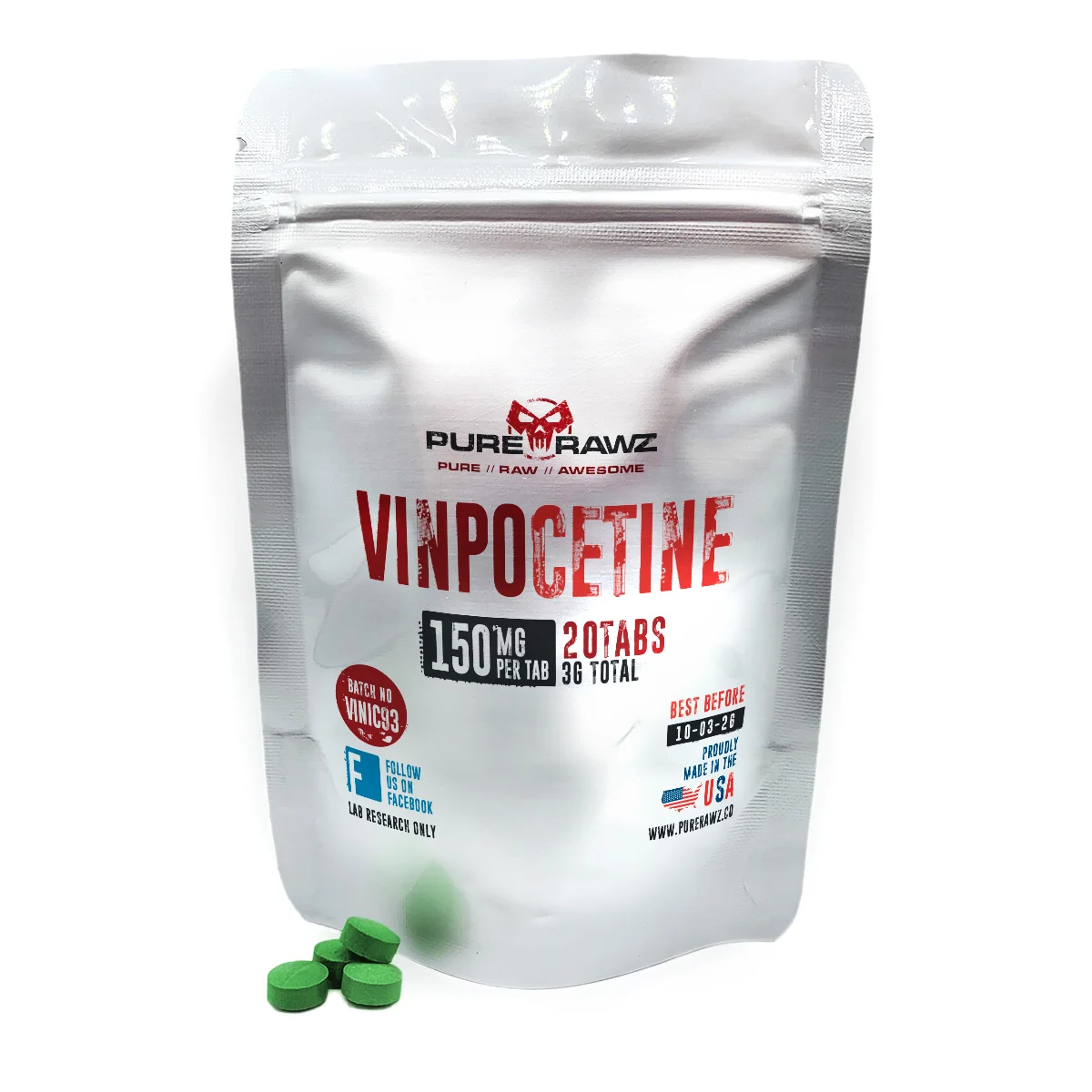
Vinpocetine
Price range: $38.23 through $68.86
Earn 38 - 69 points upon purchasing this product.
✅ 99% Purity – Third-Party Tested
🚚 Free U.S. Shipping on Orders $100+
 Proudly Made in the USA
⚡ Fast & Reliable Shipping
🔒 Secure Checkout Guaranteed
Enjoy 24/7 customer support, 1st & 3rd party verified 99% purity, and free shipping on orders over $100!
Description
Vinpocetine Overview
Vinpocetine is a semisynthetic derivative of the alkaloid vincamine, which is originally isolated from the periwinkle plant Vinca minor. In controlled laboratory environments, vinpocetine is investigated for its interactions with neuronal signaling pathways and its potential role in neurobiological research models.
Researchers study vinpocetine to better understand its influence on cellular signaling, oxidative processes, and vascular-related mechanisms in experimental systems. Due to these characteristics, the compound has attracted interest in studies focused on neuroprotection, cellular metabolism, and signal transduction pathways.
Chemical and Molecular Properties
| PubChem CID | 443955 |
| Molecular Formula | C22H26N2O2 |
| Molecular Weight | 350.5 g/mol |
| Synonyms | Apovincaminic acid ethyl ester
Ethyl apovincamin-22-oate Ethyl (+)-cis-apovincaminate cis-Apovincaminic acid ethyl ester Ethyl (+)-apovincaminate (3a,16a)-Eburnamenine-14-carboxylic acid ethyl ester Vinpocetinum |
| IUPAC | ethyl (15S,19S)-15-ethyl-1,11-diazapentacyclo[9.6.2.02, 7.08, 18.015, 19]nonadeca-2,4,6,8(18),16-pentaene-17-carboxylate |
| CAS | 42971-09-5 |
| Labeling | Research Use Only (RUO), not for human or animal consumption |
| Chemical Structure Depiction | 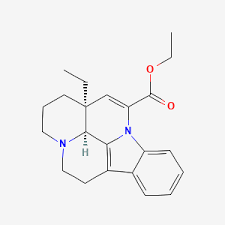 |
| Purity | 99% Purity |
| Classification | Research Use Only (RUO) |
| Storage Temperature | Store in room temperature of 25°C to 30°C (77°F to 86°F) |
Mechanisms of Action
In laboratory models, vinpocetine has been investigated for its potential interaction with several cellular pathways associated with neuronal function.
One proposed mechanism involves inhibition of phosphodiesterase type 1 (PDE1). In experimental systems, PDE1 inhibition has been associated with increased intracellular levels of cyclic nucleotides such as cyclic adenosine monophosphate (cAMP) and cyclic guanosine monophosphate (cGMP), which may influence intracellular signaling activity.
Research models have also examined vinpocetine's interaction with voltage-dependent sodium channels and its potential role in modulating calcium ion movement across cellular membranes. These mechanisms are studied in relation to neuronal excitability and signaling regulation.
Potential Research Applications
In controlled experimental settings, vinpocetine is explored to evaluate its effects on several biological and cellular processes.
Researchers investigate vinpocetine for:
- Characterizing PDE1-related intracellular signaling pathways in laboratory models
- Studying oxidative stress responses in neuronal cell research systems
- Examining mechanisms associated with inflammatory signaling pathways, including NF-kB-related processes
- Evaluating cellular energy metabolism and mitochondrial-associated activity in experimental environments
- Investigating mechanisms related to vascular signaling and cerebral perfusion in controlled models
These investigations aim to further understand the compound's biochemical interactions and cellular responses in research contexts.
Disclaimer
This information is for educational purposes only and not medical advice. Products are for research use only. Research must follow IRB or IACUC guidelines. Verify information independently before purchasing. By ordering, you agree to our Terms and Conditions. If you are not 100% satisfied with the product you received, please contact us at support@staging.purerawz.co
ATTENTION: All our products are for LABORATORY AND RESEARCH PURPOSES ONLY, not for veterinary or human use
References:
- Zhang, Y., Li, J., & Yan, C. (2017). An update on vinpocetine: New discoveries and clinical implications. European Journal of Pharmacology, 819, 30-34. https://doi.org/10.1016/j.ejphar.2017.11.041
- Bonoczk, P., Gulyas, B., Adam-Vizi, V., Nemes, A., Karpati, E., Kiss, B., Kapas, M., Szantay, C., Koncz, I., Zelles, T., & Vas, A. (2000). Role of sodium channel inhibition in neuroprotection: effect of vinpocetine. Brain Research Bulletin, 53(3), 245-254. https://doi.org/10.1016/s0361-9230(00)00354-3
- Feigin, V. L., Doronin, B. M., Popova, T. F., Gribatcheva, E. V., & Tchervov, D. V. (2001). Vinpocetine treatment in acute ischaemic stroke: a pilot single-blind randomized clinical trial. European Journal of Neurology, 8(1), 81-85. https://doi.org/10.1046/j.1468-1331.2001.00181.x

Dr. Helma Wennemers
Dr. Helma Wennemers is a globally recognized chemist shaping modern peptide science and molecular design through highly original research in applied biosciences.
Her work explores how precise molecular architecture can be engineered to create new functional systems in chemistry and life sciences. Her contributions continue to redefine contemporary chemical research through creativity, depth, and structural innovation.
Please click here to access instructions on how to make a payment.
How to PayRelated products
-

Noopept
Price range: $10.32 through $51.64 Select options This product has multiple variants. The options may be chosen on the product page -
Jackhammer Tablets (Mirodenafil + Amino Tadalafil + SR-9011)
$124.51 Select options This product has multiple variants. The options may be chosen on the product page -
Arimistane
Price range: $67.96 through $234.28 Select options This product has multiple variants. The options may be chosen on the product page -
Enclomiphene Citrate
Price range: $62.85 through $133.90 Select options This product has multiple variants. The options may be chosen on the product page


