
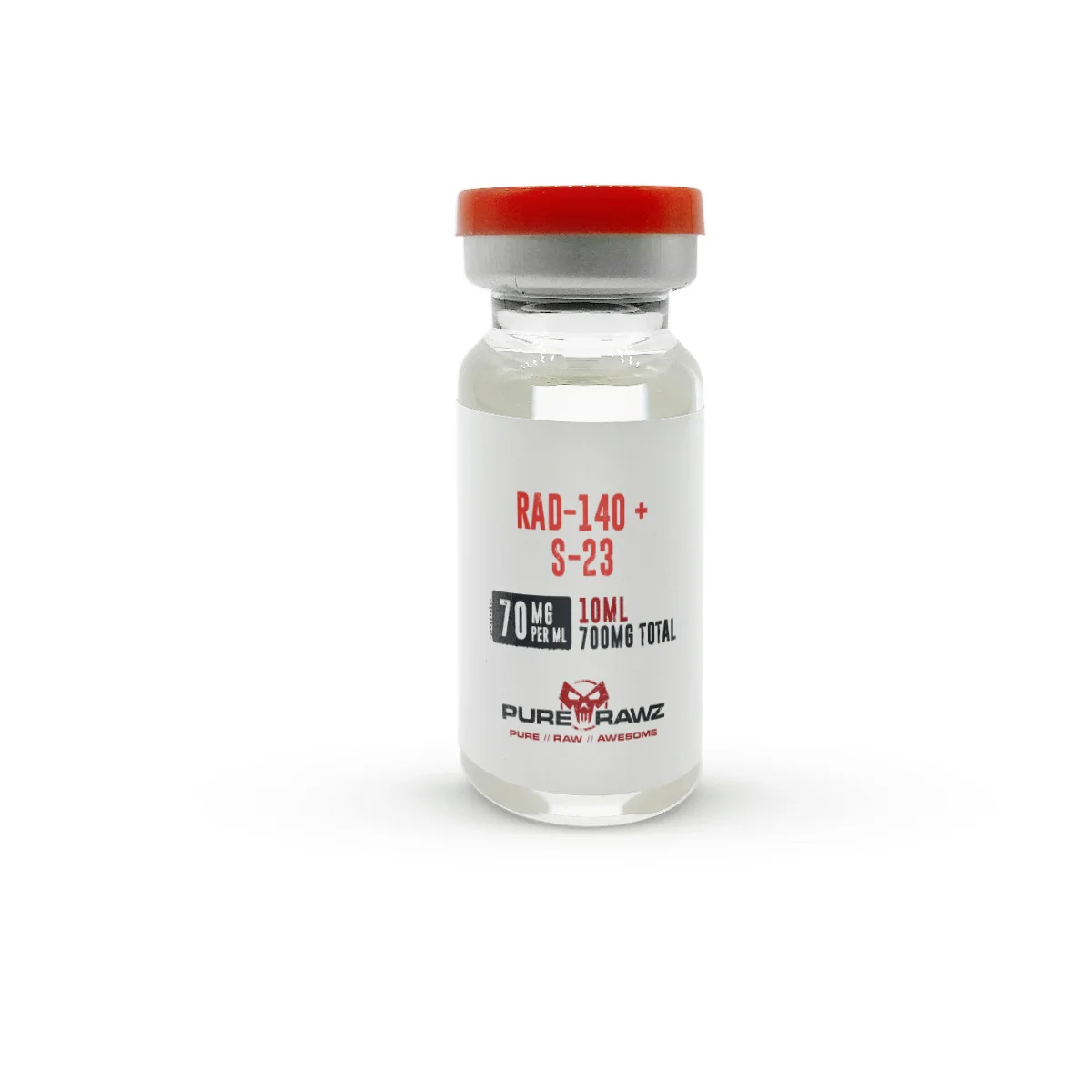
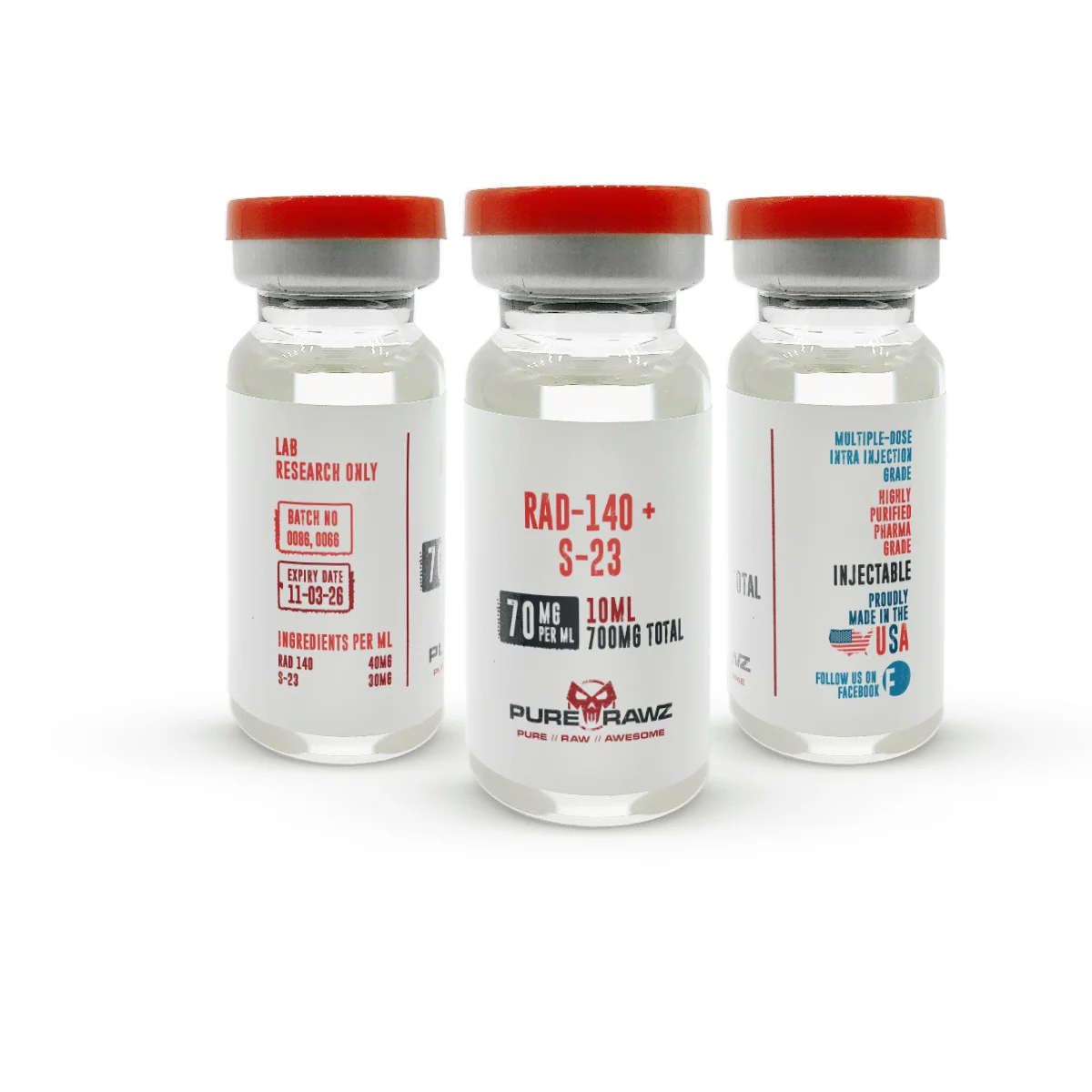
RAD-140 + S-23 Injectable
$138.26
Earn 138 points upon purchasing this product.
✅ 99% Purity – Third-Party Tested
🚚 Free U.S. Shipping on Orders $100+
 Proudly Made in the USA
⚡ Fast & Reliable Shipping
🔒 Secure Checkout Guaranteed
Enjoy 24/7 customer support, 1st & 3rd party verified 99% purity, and free shipping on orders over $100!
Description
What is RAD-140 + S-23 Injectable?
RAD-140 and S-23 are selective androgen receptor modulators (SARMs) combined in a single investigational injectable. This is in preparation for preclinical and in vitro research applications. This formulation is intended to facilitate experimental evaluation of androgen receptor (AR) modulation in controlled laboratory settings.
The combination enables research models to examine receptor binding dynamics, transcriptional modulation, and downstream intracellular signaling associated with selective AR agonism.
Product Specifications
- RAD-140 content: 40 mg/mL
- S-23 content: 30 mg/mL
- Total concentration: 70 mg/mL
- Volume: 10 mL
- Total compound content: 700 mg
This formulation is supplied strictly for laboratory research purposes.
Mechanistic Rationale for Combined Investigation
Both RAD-140 and S-23 are classified as nonsteroidal androgen receptor ligands. In experimental systems, SARMs are studied for their:
- Selective AR binding affinity
- Tissue-specific transcriptional modulation in experimental models
- Differential recruitment of coactivator and corepressor proteins
- Modulation of androgen-responsive gene expression
Combined evaluation in preclinical systems may allow researchers to investigate:
- Competitive and cooperative receptor binding kinetics
- Synergistic or additive transcriptional activity
- Effects on AR-mediated intracellular signaling pathways
- Differential gene expression patterns in experimental cell lines
No conclusions regarding safety or efficacy in humans have been established.
RAD-140 (Testolone)
RAD-140, also referred to in research literature as Testolone, is a nonsteroidal selective androgen receptor modulator. It is under investigation in experimental oncology and neurobiology models.
Chemical Properties of RAD-140
| Property | Value |
| CAS Number | 1182367-47-0 |
| Molecular Formula | C20H16ClN5O2 |
| Molecular Weight | 393.83 g/mol |
| IUPAC Name | 2-chloro-4-{[(1R,2S)-1-[5-(4-cyanophenyl)-1,3,4-oxadiazol-2-yl]-2-hydroxypropyl]amino}-3-methylbenzonitrile |
(Only verified chemical data included.)
Molecular Mechanism of RAD-140
In vitro studies demonstrate that RAD-140 functions as a high-affinity androgen receptor ligand. Upon binding:
- The RAD-140-AR complex translocates to the nucleus.
- It interacts with androgen response elements (AREs) in DNA.
- Recruitment of transcriptional cofactors alters gene expression patterns.
- Downstream signaling cascades, which includes MAPK/ERK pathway modulation, have been observed in cellular models.
Preclinical investigations suggest tissue-selective transcriptional activity, with differential agonist and antagonist behavior that depend on cellular context.
Importantly:
- RAD-140 does not undergo aromatization to estrogenic metabolites.
- It does not convert to dihydrotestosterone (DHT).
- Activity is mediated through direct AR interaction.
RAD-140 in Preclinical Research
Experimental models have investigated RAD-140 in:
- AR-positive breast cancer cell lines
- Neuroprotection models, which assess MAPK/ERK signaling
- Skeletal tissue research models
- Androgen-responsive gene transcription assays
These studies remain within the scope of preclinical and in vitro research.
Safety Status (Research Context)
RAD-140 remains investigational. Clinical safety and long-term toxicology data are limited. Hepatic enzyme elevations have been reported in certain research observations that involve SARMs as a class. Comprehensive safety characterization requires further controlled study.
S-23
S-23 is a synthetic, nonsteroidal selective androgen receptor agonist investigated in experimental endocrinology and reproductive biology models.
Chemical Properties of S-23
| Property | Value |
| CAS Number | 1010396-29-8 |
| Molecular Formula | C18H13ClF4N2O3 |
| Molecular Weight | 416.76 g/mol |
| IUPAC Name | (2S)-3-(4-chloro-3-fluorophenoxy)-N-[4-cyano-3-(trifluoromethyl)phenyl]-2-hydroxy-2-methylpropanamide |
(Only verified chemical data included.)
Molecular Mechanism of S-23
S-23 is characterized in vitro as a high-affinity full androgen receptor agonist.
Mechanistically:
- S-23 binds to the ligand-binding domain of the androgen receptor.
- Ligand binding induces conformational change.
- AR dimerization and nuclear translocation occur.
- Interaction with androgen response elements alters transcriptional activity.
- Co-regulator recruitment influences tissue-specific gene expression patterns.
In experimental reproductive models, S-23 has demonstrated modulation of hypothalamic-pituitary-gonadal (HPG) axis signaling through AR-mediated feedback mechanisms.
S-23 in Preclinical Research
S-23 has been evaluated in:
- Reproductive endocrinology models
- Bone mineral density research models
- AR transcriptional activation assays
- Experimental male contraception studies in rodent models
All findings remain confined to preclinical research settings.
Safety Status (Research Context)
S-23 remains investigational and is not approved for therapeutic use. Toxicological profiling is incomplete. As with other compounds in the SARM class, further research is required to clarify hepatic, cardiovascular, and endocrine system impacts in controlled experimental conditions.
Why Choose Purerawz for RAD-140 + S-23?
Buy RAD-140 + S-23 for laboratory research use from our online shop. At Purerawz, we provide high-quality reference materials. Each research compound comes with a Certificate of Analysis for verification of purity and concentration.
Disclaimer
This information is for educational purposes only and not medical advice. Products are for research use only. Research must follow IRB or IACUC guidelines. Verify information independently before purchasing. By ordering, you agree to our Terms and Conditions. If you are not 100% satisfied with the product you received, please contact us at support@staging.purerawz.co
Reference Links
- Jayaraman, A., Christensen, A., Moser, V. A., Vest, R. S., Miller, C. P., Hattersley, G., & Pike, C. J. (2014). Selective androgen receptor modulator RAD140 is neuroprotective in cultured neurons and Kainate-Lesioned male rats. Endocrinology, 155(4), 1398-1406. https://doi.org/10.1210/en.2013-1725
- Gao, W., Kim, J., & Dalton, J. T. (2006). Pharmacokinetics and pharmacodynamics of nonsteroidal androgen receptor ligands. Pharmaceutical Research, 23(8), 1641–1658. https://doi.org/10.1007/s11095-006-9024-3
- Miller, C. P., Shomali, M., Lyttle, C. R., St L O’Dea, L., Herendeen, H., Gallacher, K., Paquin, D., Compton, D. R., Sahoo, B., Kerrigan, S. A., Burge, M. S., Nickels, M., Green, J. L., Katzenellenbogen, J. A., Tchesnokov, A., & Hattersley, G. (2010). Design, synthesis, and preclinical characterization of the Selective Androgen Receptor Modulator (SARM) RAD140. ACS Medicinal Chemistry Letters, 2(2), 124–129. https://doi.org/10.1021/ml1002508
- Walfish, P. G., Yoganathan, T., Yang, Y., Hong, H., Butt, T. R., & Stallcup, M. R. (1997). Yeast hormone response element assays detect and characterize GRIP1 coactivator-dependent activation of transcription by thyroid and retinoid nuclear receptors. Proceedings of the National Academy of Sciences, 94(8), 3697–3702. https://doi.org/10.1073/pnas.94.8.3697
- Dumbacher, M., Van Dooren, T., Princen, K., De Witte, K., Farinelli, M., Lievens, S., Tavernier, J., Dehaen, W., Wera, S., Winderickx, J., Allasia, S., Kilonda, A., Spieser, S., Marchand, A., Chaltin, P., Hoogenraad, C. C., & Griffioen, G. (2018). Modifying Rap1-signalling by targeting Pde6δ is neuroprotective in models of Alzheimer’s disease. Molecular Neurodegeneration, 13(1), 50. https://doi.org/10.1186/s13024-018-0283-3
Schwartzman, K. H., Kohli, U., Chaudhuri, N. R., & Hoda, M. (2024). Myopericarditis following use of selective androgen receptor modifier "RAD-140." JACC Case Reports, 29(15), 102423. https://doi.org/10.1016/j.jaccas.2024.102423

Dr. Helma Wennemers
Dr. Helma Wennemers is a globally recognized chemist shaping modern peptide science and molecular design through highly original research in applied biosciences.
Her work explores how precise molecular architecture can be engineered to create new functional systems in chemistry and life sciences. Her contributions continue to redefine contemporary chemical research through creativity, depth, and structural innovation.
Please click here to access instructions on how to make a payment.
How to PayRelated products
-

L-Carnitine
Price range: $22.35 through $183.06 Select options This product has multiple variants. The options may be chosen on the product page -
MK-777 (Acetamoren)
Price range: $69.99 through $191.99 Select options This product has multiple variants. The options may be chosen on the product page -
Pre Reactor 2.0 Injectable (L-Soleucine + L-Leucine + Valine)
$127.32 Select options This product has multiple variants. The options may be chosen on the product page -
S-23 SARM
Price range: $57.83 through $139.79 Select options This product has multiple variants. The options may be chosen on the product page


