
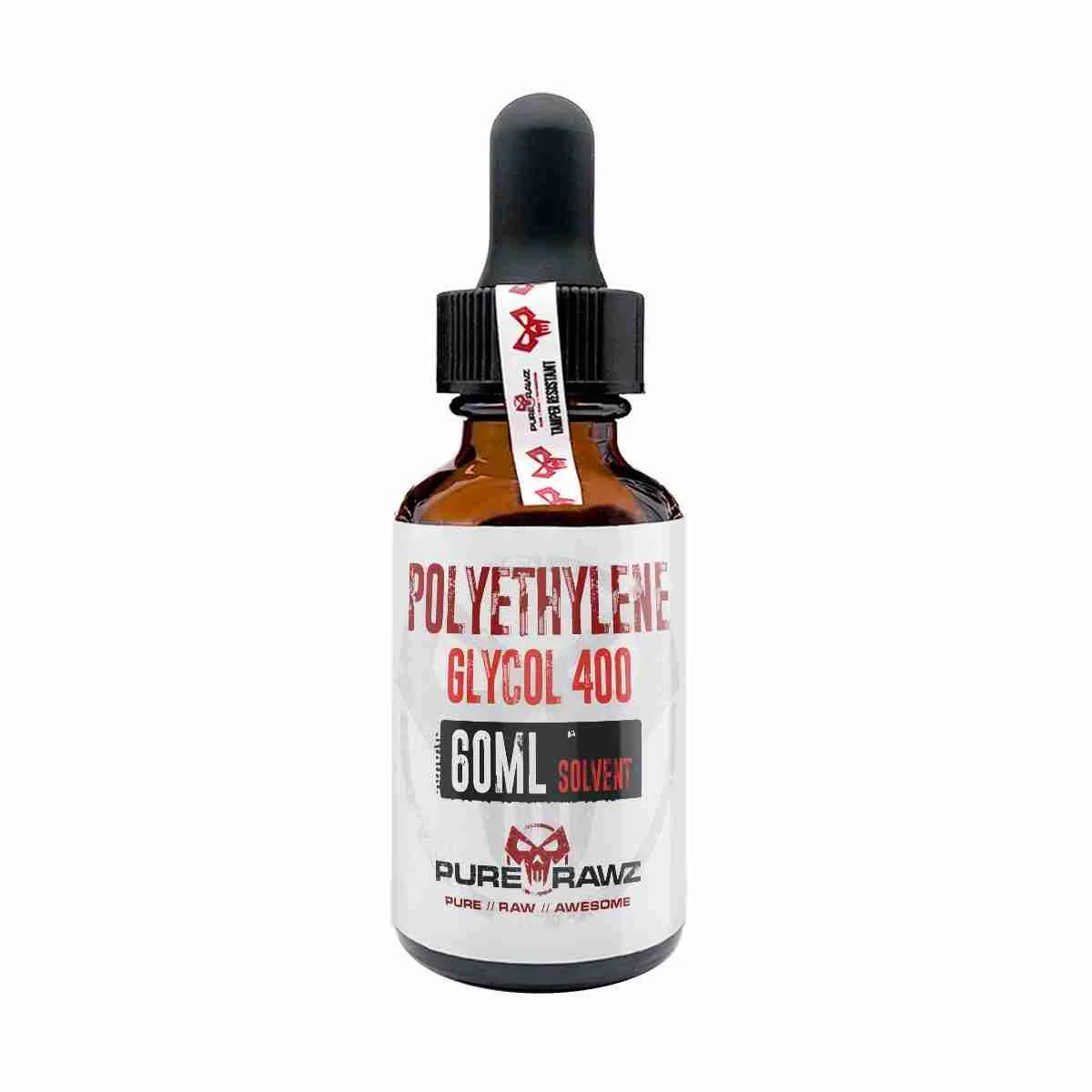
Polyethylene Glycol 400 – Solvent USP Grade
$9.27
Earn 9 points upon purchasing this product.
✅ 99% Purity – Third-Party Tested
🚚 Free U.S. Shipping on Orders $100+
 Proudly Made in the USA
⚡ Fast & Reliable Shipping
🔒 Secure Checkout Guaranteed
Enjoy 24/7 customer support, 1st & 3rd party verified 99% purity, and free shipping on orders over $100!
Description
Polyethylene Glycol 400
PEG 400 is a low-molecular-weight grade of polyethylene glycol, also known as polyethylene glycol 400.
PEG (polyethylene glycol) is a polyether compound formed by polymerization of ethylene oxide. The general chemical formula for PEG is H(OCH2CH2) nOH, where n is the quantity of ethylene glycol units that make up a mole of the polymer.
The molecular weight then determines the properties of each type or category of PEG. Low-molecular-weight PEGs such as PEG 200–600 consist of a distribution of ethylene glycol repeating units, with PEG 400 averaging about 8–9 units.
What is Polyethylene Glycol 400?
In research contexts, Polyethylene Glycol 400 (PEG 400) is a low-molecular-weight polyethylene glycol polymer used mainly as a solvent, excipient, or chemical reagent in laboratory experiments.
Potential Applications of PEG 400
PEG 400 is a solvent, plasticizer, and surfactant used in laboratory research to reduce water's surface tension. Here are some of the other potential applications of the compound:
- Might used as a co-solvent in analytical chemistry and sample preparation
- Medium in chemical synthesis reactions
- Viscosity modifier in laboratory formulations
- Control substance in pharmacological and toxicological research
In research settings, PEG 400 is mainly used as a laboratory solvent and formulation vehicle to help dissolve experimental compounds.
How does PEG-400 work?
Polyethylene Glycol 400 (PEG-400) works primarily as a hydrophilic cosolvent and solubilizing agent. Its chemical structure contains repeating ether groups (–O–CH2–CH2–).
These ether oxygen atoms can form hydrogen bonds with water molecules and polar functional groups of solutes. Whereas the hydrocarbon segments interact weakly with non-polar regions of compounds.
This dual interaction reduces intermolecular forces between poorly soluble molecules and disperses them within the solvent system. Thus, it increases the apparent solubility and stability of hydrophobic compounds in aqueous media.
Disclaimer
This information is for educational purposes only and does not constitute medical advice. THE PRODUCTS DESCRIBED HEREIN ARE FOR LABORATORY AND RESEARCH USE ONLY. All clinical research must be conducted with oversight from the appropriate Institutional Review Board (IRB). All preclinical research must be conducted with oversight from the appropriate Institutional Animal Care and Use Committee (IACUC) following the guidelines of the Animal Welfare Act (AWA).
Our content is intended to be used and must be used for informational purposes only.
By completing and paying for your order, you agree to our Terms and Conditions. Customer satisfaction is our number one priority. If you are not 100% satisfied with the product you received, please contact us at support@staging.purerawz.co
ATTENTION: All our products are for LABORATORY AND RESEARCH PURPOSES ONLY, not for veterinary or human usage.
Reference Links
- PubChem. (n.d.). Concept 8781. Pubchem.ncbi.nlm.nih.gov.https://pubchem.ncbi.nlm.nih.gov/compound/Polyethylene-Glycol-400
- Dabaja, A., Dabaja, A., & Abbas, M. (2023). Polyethylene Glycol. PubMed; StatPearls Publishing. https://www.ncbi.nlm.nih.gov/books/NBK557652/
- (2026). Clinicaltrials.gov.https://clinicaltrials.gov/study/NCT02260076

Dr. Helma Wennemers
Dr. Helma Wennemers is a globally recognized chemist shaping modern peptide science and molecular design through highly original research in applied biosciences.
Her work explores how precise molecular architecture can be engineered to create new functional systems in chemistry and life sciences. Her contributions continue to redefine contemporary chemical research through creativity, depth, and structural innovation.
Please click here to access instructions on how to make a payment.
How to PayRelated products
-

Benzyl Benzoate USP Grade – Solvent
Price range: $11.45 through $16.91 Select options This product has multiple variants. The options may be chosen on the product page -
Propylene Glycol – Solvent
$9.27 Select options This product has multiple variants. The options may be chosen on the product page -
Bacteriostatic Water
Price range: $11.34 through $15.67 Select options This product has multiple variants. The options may be chosen on the product page -
Cold Pack (Peptide Transport)
$14.75 Add to cart


