
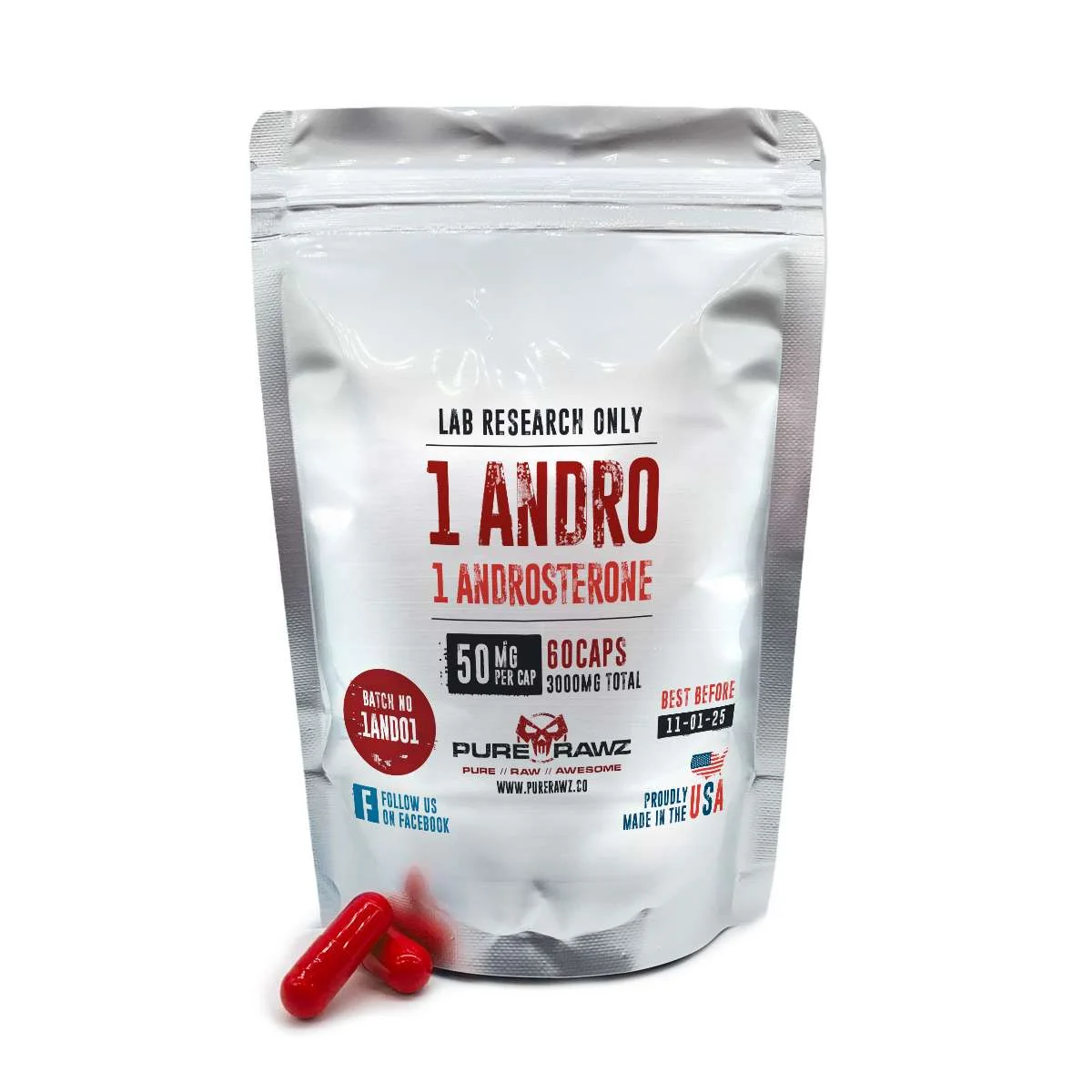
1-Andro
Price range: $34.41 through $132.80
Earn 34 - 133 points upon purchasing this product.
✅ 99% Purity – Third-Party Tested
🚚 Free U.S. Shipping on Orders $100+
 Proudly Made in the USA
⚡ Fast & Reliable Shipping
🔒 Secure Checkout Guaranteed
Enjoy 24/7 customer support, 1st & 3rd party verified 99% purity, and free shipping on orders over $100!
Description
1-Andro Overview
1-Andro, also referred to as 1-Androsterone or 1-DHEA (3β-hydroxy-androst-1-ene-17-one), is classified as a prohormone-type compound. Prohormones are chemical precursors that may undergo enzymatic transformation into hormonally active metabolites during metabolic processes.
In biochemical research contexts, 1-Andro has been examined for its potential conversion into 1-testosterone (dihydroboldenone). This androgenic compound has been investigated for its anabolic properties and its interaction with androgen receptors in experimental studies. Experimental findings have explored how such metabolites interact with androgen-sensitive biological pathways and tissues in controlled study environments.
Chemical and Molecular Properties
| Property | Information |
| CAS Number | 23633-63-8 |
| Molecular Formula | C19H28O2 |
| Molecular Mass | 288.4 g/mol |
| Synonyms | 1-Androsterone, U5M72D8OWZ, DTXSID20737265, 1-Dehydroepiandrosterone |
| IUPAC Name | (3R,5S,8R,9S,10R,13S,14S)-3-hydroxy-10,13-dimethyl-3,4,5,6,7,8,9,11,12,14,15,16-dodecahydrocyclopenta[a]phenanthren-17-one |
| Storage | 15-30°C (59-86°F) |
Mechanism of Action
From a biochemical perspective, prohormone compounds such as 1-Andro may undergo enzymatic transformations during metabolic processing.
Research literature suggests that 1-Andro may be metabolically converted into 1-testosterone, an androgen investigated for its interaction with androgen receptor pathways. These receptor interactions are of interest in studies examining:
- Androgen-responsive signaling mechanisms
- Hormone precursor metabolism
- Steroidogenic enzymatic pathways
Potential Research Applications
In controlled laboratory environments, 1-Andro may be investigated as a steroidal precursor compound for studies involving androgen-related metabolic pathways and biochemical signaling mechanisms. Researchers may utilize this compound as a reference material when examining hormone precursor transformations and receptor-associated processes.
Steroidogenesis and Metabolic Conversion Studies
1-Andro may be examined in experimental models exploring steroidogenic pathways, particularly those involving the enzymatic conversion of precursor compounds into biologically active metabolites.
Androgen Receptor Signaling Research
1-Andro has been investigated for its interaction with androgen receptor pathways due to the metabolites associated with it. Studies often focus on how 1‑Andro metabolites bind to androgen receptors in experimental settings.
Hormone Precursor Biochemistry
Researchers may study 1-Andro to better understand the biochemical characteristics of prohormone-type compounds, including their structural properties, metabolic stability, and enzymatic transformation patterns.
Note: 1‑Androsterone is not approved by the FDA for any medical or human use. It is intended for laboratory and research purposes only.
Where to Buy 1-Androsterone?
PureRawz supplies high-quality 1-Andro designed for laboratory and research purposes. The compound is produced under controlled conditions to support consistency in studies examining biochemical pathways and compound interactions in experimental settings.
All the products are subjected to strict quality assurance procedures and are verified by an independent third-party Certificate of Analysis (COA). This documentation confirms important parameters such as compound identity, purity, and overall product quality to support reliable research use.
Disclaimer
This information is for educational purposes only and not medical advice. Products are for research use only. Research must follow IRB or IACUC guidelines. Verify information independently before purchasing. By ordering, you agree to our Terms and Conditions. If you are not 100% satisfied with the product you received, please contact us at support@staging.purerawz.co
ATTENTION: All our products are for LABORATORY AND RESEARCH PURPOSES ONLY, not for veterinary or human use.
Reference Links
PubChem. (2024). 1-Androsterone. Nih.gov; PubChem. https://pubchem.ncbi.nlm.nih.gov/compound/1-Androsterone
Therina du Toit, Groessl, M., Emanuele Pignatti, Swart, A. C., & Fluck, C. E. (2025). Characterization of Steroid Metabolic Pathways in Established Human and Mouse Cell Models. International Journal of Molecular Sciences, 26(19), 9721-9721. https://doi.org/10.3390/ijms26199721
Friedel, A., Geyer, H., Kamber, M., Laudenbach-Leschowsky, U., Schanzer, W., Thevis, M., Vollmer, G., Zierau, O., & Diel, P. (2006). 17β-Hydroxy-5alpha-androst-1-en-3-one (1-testosterone) is a potent androgen with anabolic properties. Toxicology Letters, 165(2), 149-155. https://doi.org/10.1016/j.toxlet.2006.03.001

Dr. Helma Wennemers
Dr. Helma Wennemers is a globally recognized chemist shaping modern peptide science and molecular design through highly original research in applied biosciences.
Her work explores how precise molecular architecture can be engineered to create new functional systems in chemistry and life sciences. Her contributions continue to redefine contemporary chemical research through creativity, depth, and structural innovation.
Please click here to access instructions on how to make a payment.
How to PayRelated products
-

ACP 105
Price range: $101.09 through $176.50 Select options This product has multiple variants. The options may be chosen on the product page -
Mirodenafil + Amino Tadalafil Tablets
$84.93 Select options This product has multiple variants. The options may be chosen on the product page -
Jackhammer Tablets (Mirodenafil + Amino Tadalafil + SR-9011)
$124.51 Select options This product has multiple variants. The options may be chosen on the product page -
Enclomiphene Citrate
Price range: $62.85 through $133.90 Select options This product has multiple variants. The options may be chosen on the product page


