
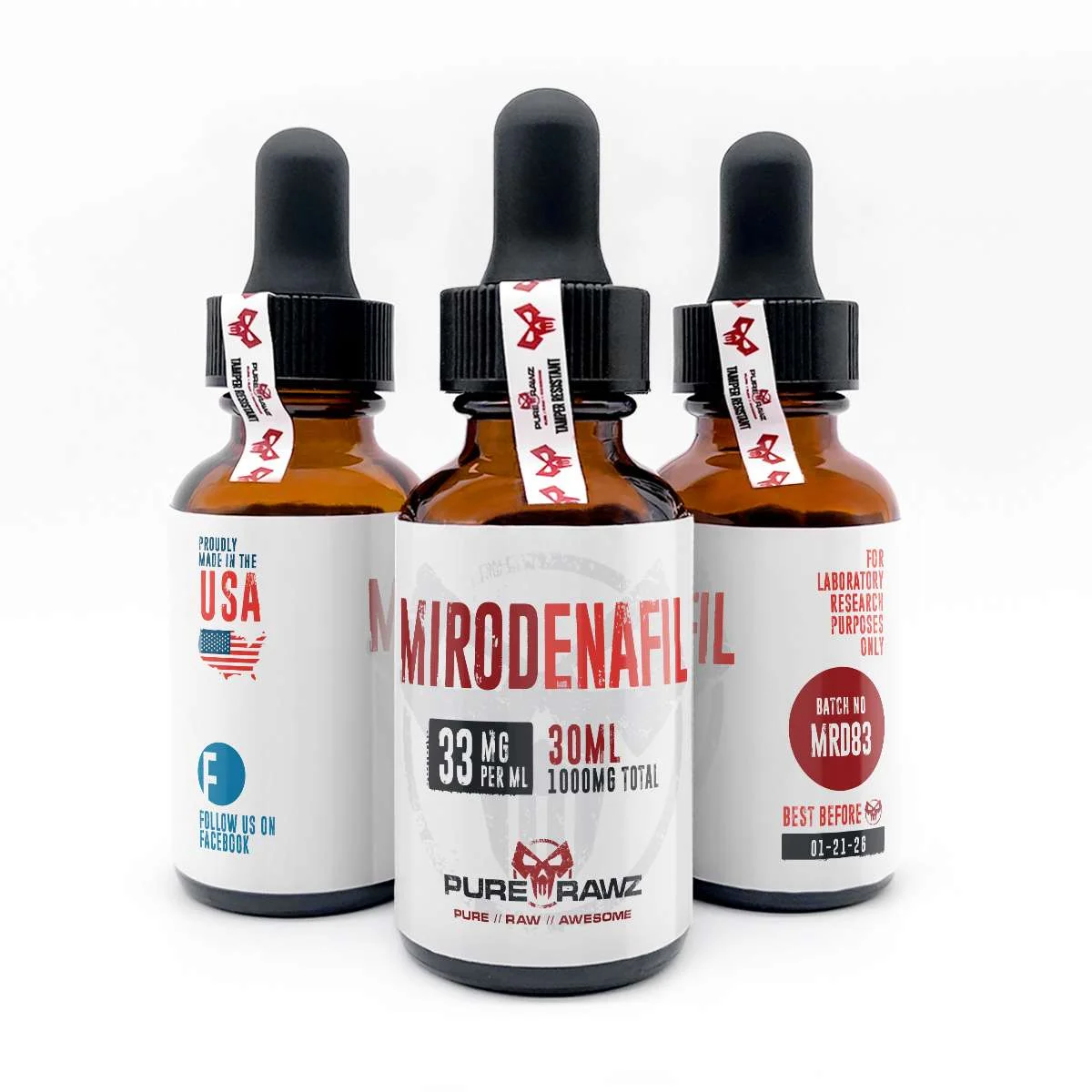
Mirodenafil
Price range: $58.42 through $100.62
Earn 58 - 101 points upon purchasing this product.
✅ 99% Purity – Third-Party Tested
🚚 Free U.S. Shipping on Orders $100+
 Proudly Made in the USA
⚡ Fast & Reliable Shipping
🔒 Secure Checkout Guaranteed
Enjoy 24/7 customer support, 1st & 3rd party verified 99% purity, and free shipping on orders over $100!
Description
Mirodefanil Overview
Mirodenafil is a synthetic small-molecule compound classified within the phosphodiesterase type 5 (PDE5) inhibitor category. Compounds in this class are widely studied for their ability to interact with the phosphodiesterase-5 enzyme, which plays a role in cyclic nucleotide signaling pathways.
Within experimental research settings, mirodenafil has been examined for its biochemical interaction with PDE5 and its influence on cyclic guanosine monophosphate (cGMP) signaling pathways. Various controlled investigations have explored its pharmacological profile and receptor-enzyme interactions in laboratory models.
Mirodenafil has been included in multiple research studies evaluating compounds designed to modulate PDE5 activity. These investigations explore its biochemical properties, enzyme selectivity, and potential influence on signaling pathways associated with smooth muscle relaxation mechanisms in experimental systems.
Chemical and Molecular Properties
| PubChem CID | 135497803 |
| Molecular Formula | C26H37N5O5S |
| Molecular Weight | 531.7 g/mol |
| Synonyms | 862189-95-5
mirodenafilo mirodenafilum SK-3530 |
| IUPAC | 5-ethyl-2-[5-[4-(2-hydroxyethyl)piperazin-1-yl]sulfonyl-2-propoxyphenyl]-7-propyl-3H-pyrrolo[3,2-d]pyrimidin-4-one |
| CAS | 862189-95-5 |
| Labeling | Research Use Only (RUO), not for human or animal consumption. |
| Chemical Structure Depiction | |
| Purity | 99% Purity |
| Classification | Research Use Only (RUO) |
| Storage Temperature | Store at -80°C (-112°F for up to 6 months. Store at -20°C (-4°F) for up to 1 month |
Mechanism of Action
Mirodenafil acts as a phosphodiesterase type 5 (PDE5) inhibitor, influencing intracellular cyclic nucleotide signaling in experimental models. Research studies have investigated how mirodenafil interacts with PDE5 to affect cGMP-dependent signaling pathways, which are involved in smooth muscle relaxation mechanisms in controlled laboratory environments.
Key points from experimental research:
- Nitric oxide (NO) signaling: In physiological systems, NO can stimulate guanylate cyclase, which converts guanosine triphosphate (GTP) into cyclic guanosine monophosphate (cGMP).
- cGMP accumulation: Increased cGMP acts as a second messenger in smooth muscle tissues, promoting relaxation in controlled laboratory assays.
- PDE5 regulation: PDE5 enzymes hydrolyze cGMP into 5'-GMP, reducing its signaling effect in tissues.
- Competitive inhibition: Mirodenafil binds competitively to PDE5 in vitro, reducing cGMP breakdown and prolonging its signaling activity in experimental models.
- Tissue-level effects: Studies in isolated tissue and organ bath systems have demonstrated dose-dependent changes in smooth muscle relaxation associated with PDE5 inhibition.
- Research relevance: Modulation of NO-cGMP signaling via PDE5 inhibitors like mirodenafil is widely studied for understanding intracellular pathways and tissue responses under controlled experimental conditions.
Potential Research Applications
Mirodenafil has been investigated extensively in preclinical and laboratory research to characterize its pharmacokinetic profile, enzyme interactions, and tissue-level effects.
- Pharmacokinetic and Tissue Distribution Studies
Preclinical studies in animal models indicate that mirodenafil exhibits higher tissue and plasma exposure than comparable PDE5 inhibitors, with measurable pharmacokinetic peaks and elimination profiles.
- Tissue Relaxation Studies
Organ bath studies in rabbit tissue show that mirodenafil induces dose-dependent smooth muscle relaxation in controlled experimental models.
- Experimental Research in Neurological Injury Models
Preclinical studies in spinal cord injury models show that mirodenafil modulates tissue response parameters, demonstrating measurable effects on PDE5-related signaling compared with sildenafil.
- Combination Research Models
Research exploring mirodenafil combined with dapoxetine investigates their interactive effects on ejaculatory delay and related signaling pathways in experimental models.
Disclaimer
This information is for educational purposes only and not medical advice. Products are for research use only. Research must follow IRB or IACUC guidelines. Verify information independently before purchasing. By ordering, you agree to our Terms and Conditions. If you are not 100% satisfied with the product you received, please contact us at support@staging.purerawz.co
ATTENTION: All our products are for LABORATORY AND RESEARCH PURPOSES ONLY, not for veterinary or human use
References:
- Lee, S. K., Kim, Y., Kim, T. K., Im, G., Lee, B., Kim, D., Jin, C., & Yoo, H. H. (2008). Determination of mirodenafil and sildenafil in the plasma and corpus cavernous of SD male rats. Journal of Pharmaceutical and Biomedical Analysis, 49(2), 513-518. https://doi.org/10.1016/j.jpba.2008.11.004
- Lee, W. K., Lee, S. H., Cho, S. T., Lee, Y. S., Oh, C. Y., Yoo, C., Cho, J. S., Lee, S. K., & Yang, D. Y. (2013). Comparison Between On-Demand Dosing of Dapoxetine Alone and Dapoxetine Plus Mirodenafil in Patients with Lifelong Premature Ejaculation: Prospective, Randomized, Double-Blind, Placebo-Controlled, Multicenter Study. The Journal of Sexual Medicine, 10(11), 2832-2841. https://doi.org/10.1111/jsm.12287
- Park, H. J., Moon, K. H., Lee, S. W., Lee, W. K., Kam, S. C., Lee, J. H., & Park, N. C. (2014). Mirodenafil for the treatment of erectile Dysfunction: A Systematic Review of the literature. The World Journal of Men S Health, 32(1), 18. https://doi.org/10.5534/wjmh.2014.32.1.18

Dr. Helma Wennemers
Dr. Helma Wennemers is a globally recognized chemist shaping modern peptide science and molecular design through highly original research in applied biosciences.
Her work explores how precise molecular architecture can be engineered to create new functional systems in chemistry and life sciences. Her contributions continue to redefine contemporary chemical research through creativity, depth, and structural innovation.
Please click here to access instructions on how to make a payment.
How to PayRelated products
-

T3 Liothyronine Sodium
$75.16 Select options This product has multiple variants. The options may be chosen on the product page -
Raloxifene Liquid
Read more -
Benzyl Alcohol USP Grade – Solvent
Price range: $10.92 through $17.47 Select options This product has multiple variants. The options may be chosen on the product page -
DMSO Dimethyl Sulfoxide – Solvent
$11.45 Select options This product has multiple variants. The options may be chosen on the product page


