
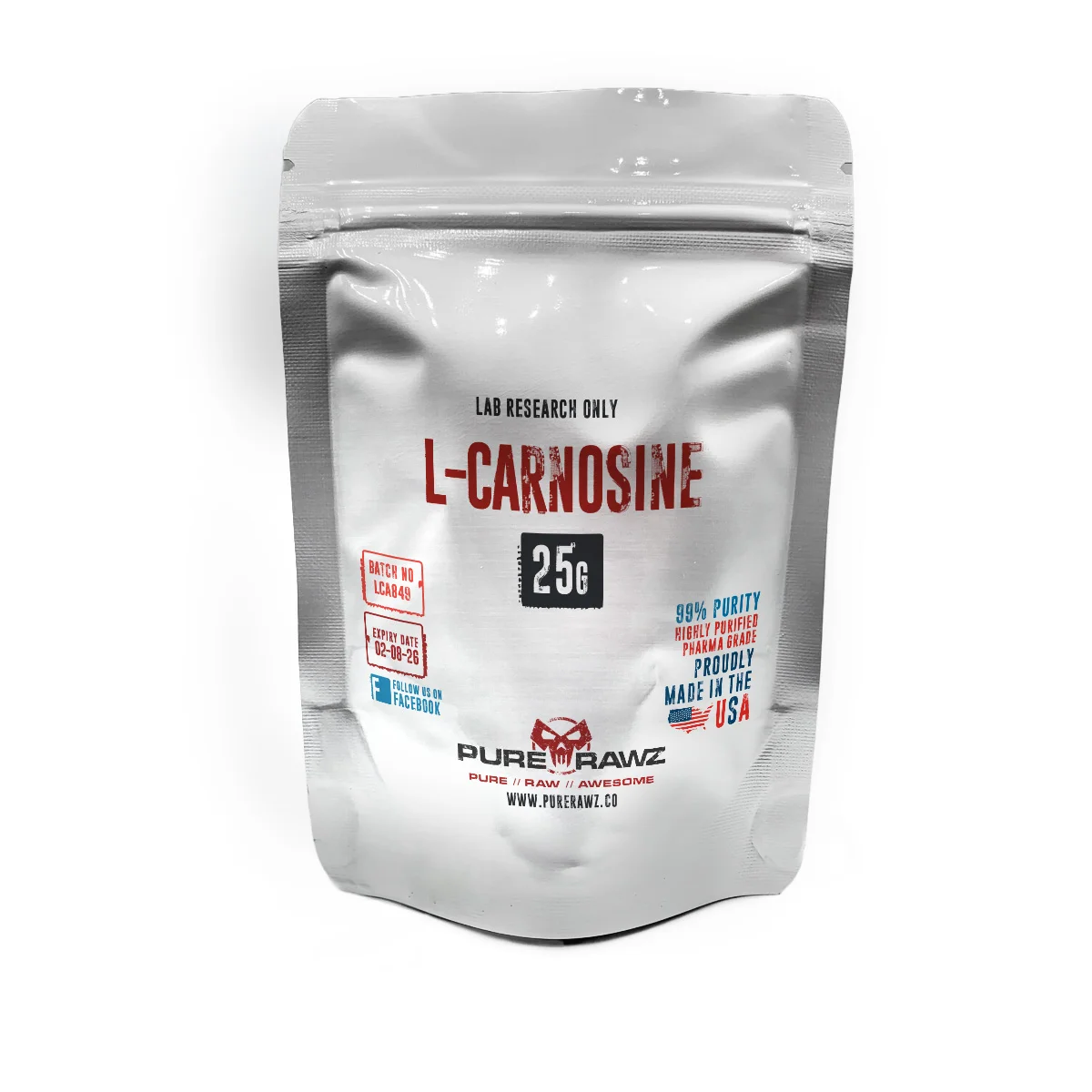
L-Carnosine
Price range: $28.95 through $81.42
Earn 29 - 81 points upon purchasing this product.
✅ 99% Purity – Third-Party Tested
🚚 Free U.S. Shipping on Orders $100+
 Proudly Made in the USA
⚡ Fast & Reliable Shipping
🔒 Secure Checkout Guaranteed
Enjoy 24/7 customer support, 1st & 3rd party verified 99% purity, and free shipping on orders over $100!
Description
L-Carnosine
Overview
L-Carnosine is a dipeptide composed of two amino acids known as beta-alanine and histidine. It is found in skeletal muscle, cardiac tissue, and the hypothalamus of different research models. A few preliminary studies have shown that L-Carnosine may play an important role in cellular protection, investigated for potential roles in cellular protection and metabolic signaling pathways in laboratory models.
| Pubchem CID | 439224 |
| Molecular Formula | C9H14N4O3 |
| Molecular Weight | 226.23 g/mol |
| Synonyms | L-Carnosine
Carnosine 305-84-0 beta-Alanyl-L-histidine Ignotine |
| IUPAC | beta-alanyl-L-histidine |
| Structure | 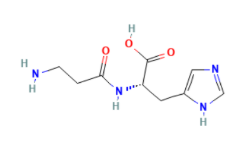 |
| CAS | 305-84-0 |
Working Mechanism of L-Carnosine
Research-based studies on experimental models have shown that L-Carnosine may work in different ways. Here is a proper breakdown of its working mechanism:
pH Buffering
A few preliminary studies have suggested that L-Carnosine acts as an intracellular buffer in skeletal muscle in experimental models.
It may help maintain acid-base balance in cells, particularly in muscle and brain tissues, as observed in a few experimental settings. Research suggested that stable pH conditions may influence cellular stress responses during metabolic activity in experimental systems.
This buffering effect may support enzyme function, energy metabolism, and overall cellular homeostasis in research models.
In a few experimental models, its antioxidant capacity appears to support mitochondrial health and energy production.
Anti-Glycation Effect
Researchers have found that L-Carnosine may react with aldehyde and carbonyl groups from sugars and oxidized lipids.
It may prevent them from binding to proteins and forming advanced glycation end products (AGEs) in research models. By doing so, interactions with collagen, elastin, and other structural proteins have been examined in preclinical models.
Research Applications
L-Carnosine is still under investigation; however, preliminary studies have shown its research applications in subject models.
- L-carnosine has been incorporated into laboratory studies examining intracellular buffering capacity in metabolically active tissues. Because the molecule can influence pH balance, experimental systems frequently use it to evaluate how acid–base regulation affects enzymatic activity and metabolic flux.
- Another area of investigation involves the compound’s role in carbonyl scavenging chemistry. Researchers analyze how L-carnosine interacts with aldehydes and lipid peroxidation products in order to understand mechanisms of protein glycation and structural damage.
Why Buy at PureRawz?
You can buy L-Carnosine from Purerawz, where you will get every research compound at cost-effective prices. PureRawz provides you with third-party tested and authentic L-Carnosine. They also give a certificate of analysis (COA) of this product for transparency and purity. Aside from it, they also ensure a smooth and hassle-free buying experience with 24/7 customer support.
Research Disclaimer
This information is for educational purposes only and does not constitute medical advice.
All clinical research must be conducted with oversight from the appropriate Institutional Review Board (IRB). All preclinical research must be conducted with oversight from the appropriate Institutional Animal Care and Use Committee (IACUC) following the guidelines of the Animal Welfare Act (AWA).
You should independently research and verify any information that you find on our Website and wish to rely upon.
ATTENTION: All our products are for LABORATORY AND RESEARCH PURPOSES ONLY, not for veterinary or human use.
References
Babizhayev, M. A. (1989). Antioxidant activity of L-carnosine, a natural histidine-containing dipeptide in crystalline lens. Biochimica et Biophysica Acta (BBA) General Subjects, 1004(3), 363 371. https://pubmed.ncbi.nlm.nih.gov/2758030/
Babizhayev, M. A., Seguin, M. C., Gueyne, J., Evstigneeva, R. P., Ageyeva, E. A., & Zheltukhina, G. A. (1994). L-carnosine (β-alanyl-L-histidine) and carcinine act as natural antioxidants with hydroxyl radical scavenging activity. Biochemical Journal, 304(2), 509 516. https://pubmed.ncbi.nlm.nih.gov/7998987/
Hipkiss, A. R. (1998). Carnosine, a protective and anti-ageing peptide? The International Journal of Biochemistry & Cell Biology, 30(8), 863 868. https://pubmed.ncbi.nlm.nih.gov/9744078/
Reddy, V. P., Garrett, M. R., Perry, G., & Smith, M. A. (2005). Carnosine: A versatile antioxidant and antiglycating agent. Science of Aging Knowledge Environment, 2005(18), pe12. https://pubmed.ncbi.nlm.nih.gov/15872311/
Boldyrev, A. A., Aldini, G., & Derave, W. (2013). Physiology and pathophysiology of carnosine. Physiological Reviews, 93(4), 1803 1845.

Dr. Helma Wennemers
Dr. Helma Wennemers is a globally recognized chemist shaping modern peptide science and molecular design through highly original research in applied biosciences.
Her work explores how precise molecular architecture can be engineered to create new functional systems in chemistry and life sciences. Her contributions continue to redefine contemporary chemical research through creativity, depth, and structural innovation.
Please click here to access instructions on how to make a payment.
How to PayRelated products
-

Nooglutyl
$26.22 Select options This product has multiple variants. The options may be chosen on the product page -
L-Tetrahydropalmatine (L-THP)
$25.68 Select options This product has multiple variants. The options may be chosen on the product page -
L-Theanine
Price range: $11.45 through $24.57 Select options This product has multiple variants. The options may be chosen on the product page -
Methylene Blue
Price range: $14.91 through $178.19 Select options This product has multiple variants. The options may be chosen on the product page


