
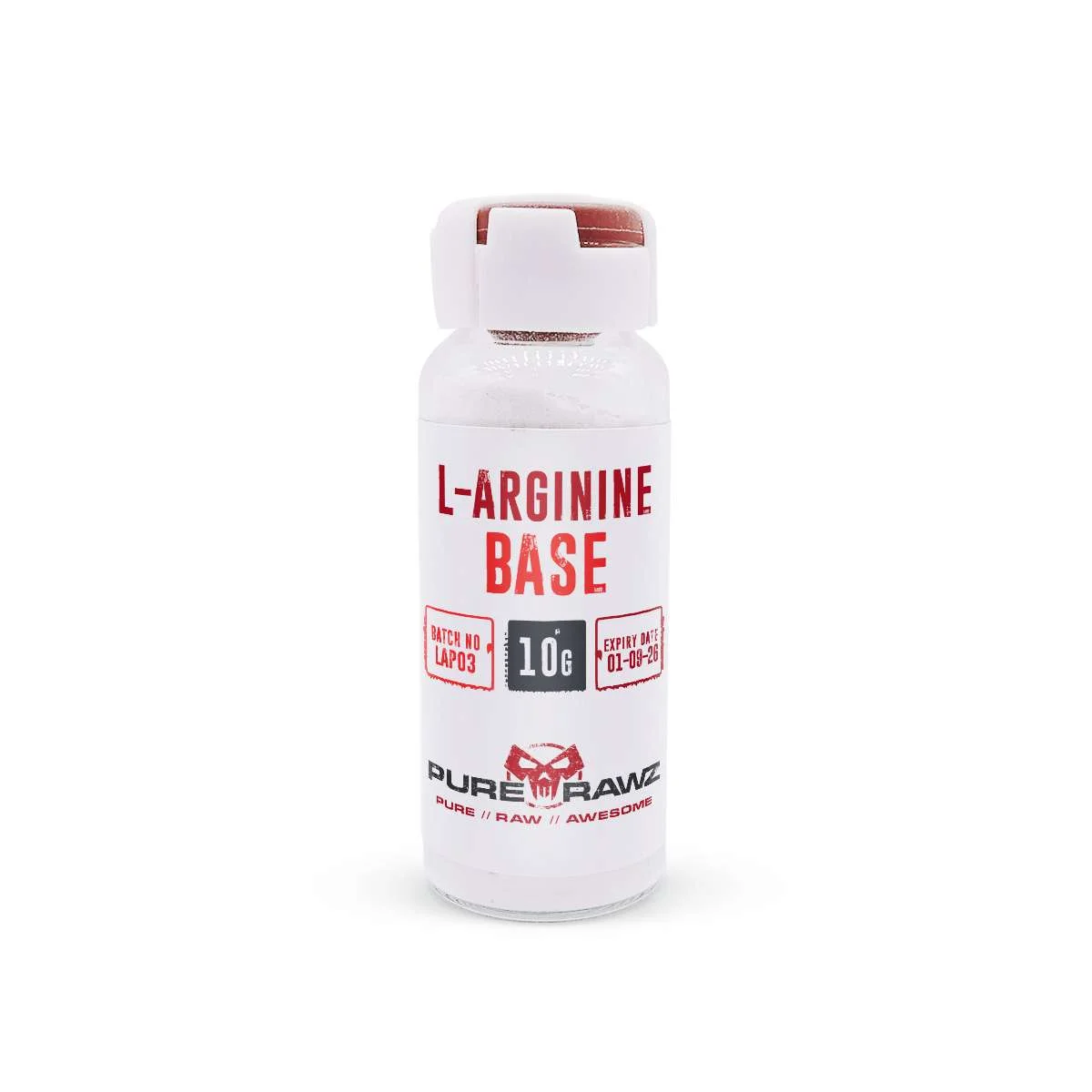
L-Arginine Base
$6.55
Earn 7 points upon purchasing this product.
✅ 99% Purity – Third-Party Tested
🚚 Free U.S. Shipping on Orders $100+
 Proudly Made in the USA
⚡ Fast & Reliable Shipping
🔒 Secure Checkout Guaranteed
Enjoy 24/7 customer support, 1st & 3rd party verified 99% purity, and free shipping on orders over $100!
Description
Overview of L-Arginine Base
L-Arginine Base is an amino acid that is studied in biochemical and nutritional research. It plays a role in protein synthesis and is involved in metabolic pathways related to cellular growth and tissue function. L-arginine is also investigated for its role in the production of nitric oxide, which is a signaling molecule associated with vascular and cellular processes.
Researchers study L-arginine to understand its involvement in immune pathways, metabolic activity, and cellular signaling mechanisms. Due to its involvement in several biological processes, it is widely used in experimental studies related to vascular signaling, hormone pathways, and cellular metabolism.
Chemical Properties of L-Arginine Base
| Property | Information |
| CAS Number | 74-79-3 |
| Molecular Weight | 174.20 g/mol |
| Chemical Formula | C6H14N4O2 |
| IUPAC Name | (2S)-2-amino-5-(diaminomethylideneamino)pentanoic acid |
| Synonyms | L-arginine, arginine, L-Arg, Arginina, Argininum |
| Storage | 2-8°C (36-46°F) |
Mechanism of Action of L-Arginine Base
L-Arginine Base is studied in biochemical research for its role in nitrogen metabolism and amino acid pathways. It is observed as a component of the urea cycle, a metabolic process involved in the conversion of ammonia into less toxic compounds. During this process, ammonia is first converted into carbamoyl phosphate, which reacts with ornithine to form citrulline as part of the early steps of the cycle.
Further reactions in the pathway lead to the formation of argininosuccinate, which is then converted into arginine. Enzymatic reactions break down arginine to produce urea and regenerate ornithine. This allows the cycle to continue. These biochemical processes are studied to understand nitrogen regulation, metabolic pathways, and cellular detoxification mechanisms in research models.
Research Findings on L-Arginine Base
Research studies have shown that L-Arginine Base has effects on nitric oxide production and vascular signaling pathways. The L-arginine exposure can influence endothelial function pathways through nitric oxide–related mechanisms. These findings help researchers study vascular signaling processes.[R]
Other research has examined the relationship between L-arginine and metabolic regulation pathways. Some analyses observed associations between L-arginine and markers related to cardiovascular signaling pathways. These findings are still being studied to better understand nitric-oxide-related biological pathways.[R]
Disclaimer
This information is for educational purposes only and not medical advice. Products are for research use only. Research must follow IRB or IACUC guidelines. Verify information independently before purchasing. By ordering, you agree to our Terms and Conditions. If you are not 100% satisfied with the product you received, please contact us at support@staging.purerawz.co
ATTENTION: All our products are for LABORATORY AND RESEARCH PURPOSES ONLY, not for veterinary or human use

Dr. Helma Wennemers
Dr. Helma Wennemers is a globally recognized chemist shaping modern peptide science and molecular design through highly original research in applied biosciences.
Her work explores how precise molecular architecture can be engineered to create new functional systems in chemistry and life sciences. Her contributions continue to redefine contemporary chemical research through creativity, depth, and structural innovation.
Please click here to access instructions on how to make a payment.
How to PayRelated products
-

L-Theanine
Price range: $11.45 through $24.57 Select options This product has multiple variants. The options may be chosen on the product page -
Agomelatine
$61.76 Select options This product has multiple variants. The options may be chosen on the product page -
Sulbutiamine
Price range: $17.47 through $61.76 Select options This product has multiple variants. The options may be chosen on the product page -
Fonturacetam Phenylpiracetam Hydrazide 98%
Price range: $25.68 through $71.05 Select options This product has multiple variants. The options may be chosen on the product page


