
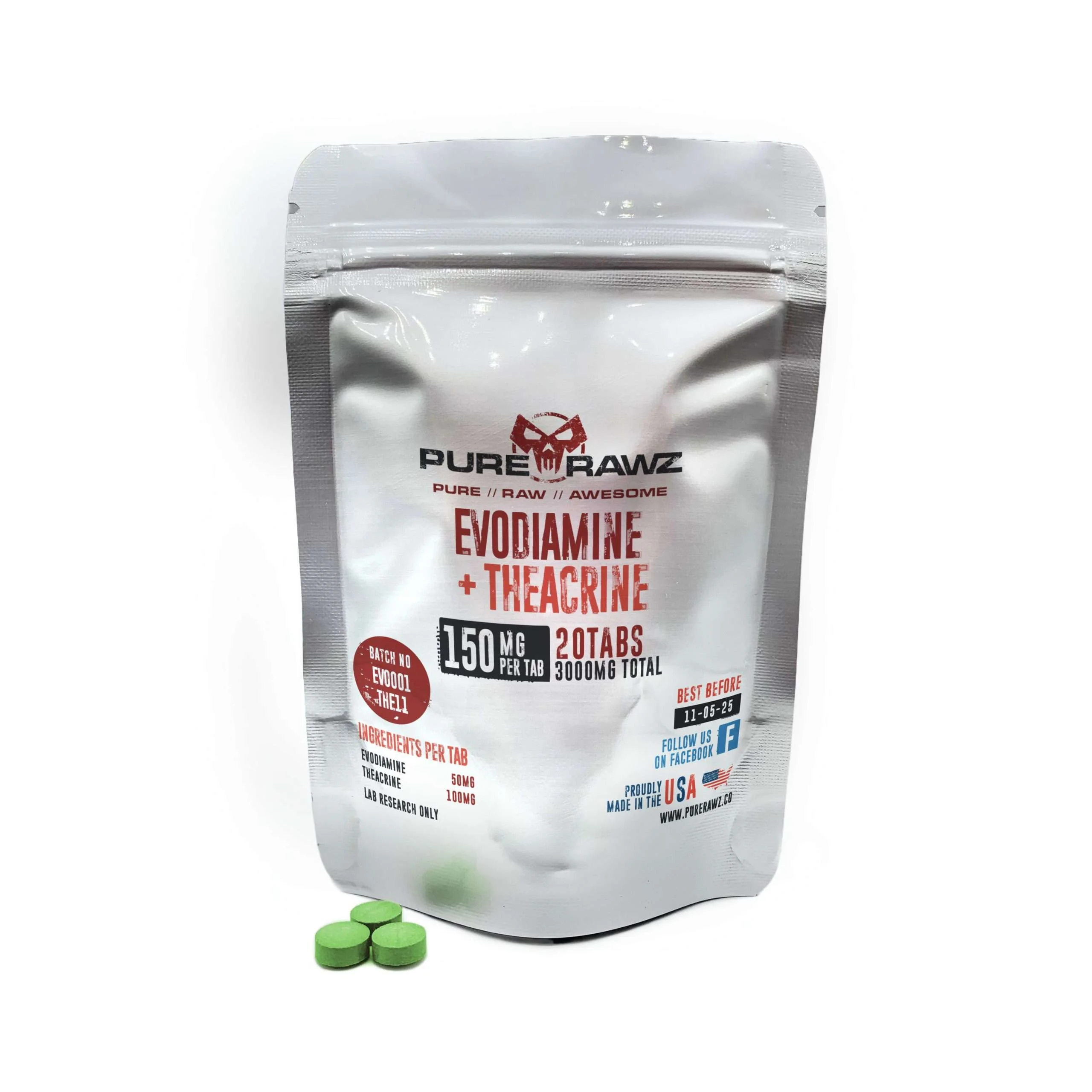
Evodiamine + Theacrine Tablets
Price range: $36.61 through $66.13
Earn 37 - 66 points upon purchasing this product.
✅ 99% Purity – Third-Party Tested
🚚 Free U.S. Shipping on Orders $100+
 Proudly Made in the USA
⚡ Fast & Reliable Shipping
🔒 Secure Checkout Guaranteed
Enjoy 24/7 customer support, 1st & 3rd party verified 99% purity, and free shipping on orders over $100!
Description
Overview of Evodiamine + Theacrine Tablets
Evodiamine is a quinazoline alkaloid derived from Evodia rutaecarpa. Theacrine (1,3,7,9-tetramethyluric acid) is a purine alkaloid from Camellia assamica var. kucha. Both compounds have been studied for their molecular interactions, including Theacrine's modulation of adenosine receptors and effects on cyclic nucleotide signaling pathways.
The combination of these two compounds may provide a synergistic effect that can enhance their mechanism. The table below shows the quantity of each compound in these tablets.
| Tablet Variant | Evodiamine per tablet | Theacrine per tablet | Total Tablets | Total Amount |
| Variant 1 | 50mg | 100mg | 20 | 3g |
| Variant 2 | 50mg | 100mg | 40 | 6g |
Evodiamine
Evodiamine, a significant alkaloid that affects lipid metabolism like capsaicin. Energy dissipation is increased by UCP1-mediated thermogenesis. Evodiamine activates the ERK/MAPK pathway to suppress adipocyte development, controlling lipid metabolism at the cellular level.
This compound is intended for research purposes and has not been approved by the FDA.
Chemical Properties of Evodiamine
| Property | Information |
| CAS Number | 518-17-2 |
| Molecular Formula | C19H17N3O |
| Molecular Mass | 303.4 g/mol |
| Synonyms | d-Evodiamine, Evodiamine, (+)-, C01825BVNL, (+)-Evodiamine |
| IUPAC Name | (1S)-21-methyl-3,13,21-triazapentacyclo[11.8.0.02,10.04,9.015,20]henicosa-2(10),4,6,8,15,17,19-heptaen-14-one |
Theacrine
Theacrine is a tetramethyluric acid compound structurally related to caffeine. It influences adenosine and dopamine signaling, resulting in combined stimulant-like and calming neurochemical activity. Published findings also describe antioxidant, anti-inflammatory/analgesic, anti-depressive, locomotor, and sedative/hypnotic properties.
This compound is intended exclusively for research applications and has not been approved by the FDA.
Chemical Properties of Theacrine
| Property | Information |
| CAS Number | 2309-49-1 |
| Molecular Formula | C9H12N4O3 |
| Molecular Mass | 224.22 g/mol |
| Synonyms | Tetramethyluric acid, theacrine, 1,3,7,9-Tetramethyluric acid, Temurin, Temorine |
| IUPAC Name | 1,3,7,9-tetramethylpurine-2,6,8-trione |
How does Evodiamine + Theacrine work?
Evodiamine Mechanism: Lipid Metabolism and Thermogenic Signaling
Evodiamine is a non-pungent vanilloid (TRPV1) receptor agonist that mostly affects circuits connected to lipids. Evodiamine activates TRPV1, which increases mitochondrial GDP binding in brown adipose tissue, boosts lipolytic activity, and changes thermogenic signaling. These receptor-mediated pathways synchronize cellular lipid metabolism and energy expenditure, creating a molecular basis for the investigation of lipid control and energy signaling at the cellular level.
Theacrine Mechanism: Neurochemical Modulation and Energy Signaling
When combined with Theacrine, Theacrine's activity on adenosine receptors and dopaminergic signaling contributes to increased neuro-locomotor activity and energy signaling without behavioral habituation. These central neurochemical effects complement evodiamine's peripheral modulation of thermogenesis and lipid metabolism, linking metabolic energy mobilization with neurochemical pathways that support overall energy levels. Theacrine is also not FDA-approved.
Research Findings on Evodiamine + Theacrine Tablets
Preclinical studies suggest evodiamine can affect fat-related cell processes that are relevant to metabolic research. In lab models, evodiamine was shown to activate cellular pathways like AMPK and influence adiponectin by increasing the active form of adiponectin in fat cells. This supports the idea that evodiamine might influence how adipocytes function at a molecular level, beyond simply increasing heat production from fat.
Research on theacrine has looked mainly at its central nervous system effects in animal models. This shows it can increase locomotor activity through adenosine and dopamine receptor pathways without developing tolerance like caffeine. In studies, theacrine enhanced activity and countered motor depression from adenosine receptor agonists. This indicates neurochemical modulation that could relate to perceived energy and alertness.
Why Choose Purerawz for Evodiamine + Theacrine Tablets?
Buy Evodiamine for laboratory research use from our online shop. At Purerawz, we provide high-quality reference materials. Each research compound comes with a Certificate of Analysis for verification of purity and concentration.
Note: Evodiamine + Theacrine Tablets is an investigational compound currently undergoing clinical evaluation and has not been established as safe or effective for any therapeutic use
Disclaimer
This information is for educational purposes only and not medical advice. Products are for research use only. Research must follow IRB or IACUC guidelines. Verify information independently before purchasing. By ordering, you agree to our Terms and Conditions. If you are not 100% satisfied with the product you received, please contact us at support@staging.purerawz.co
ATTENTION: All our products are for LABORATORY AND RESEARCH PURPOSES ONLY, not for veterinary or human use
Reference Links
Ziegenfuss, T. N., Habowski, S. M., Sandrock, J. E., Kedia, A. W., Kerksick, C. M., & Lopez, H. L. (2016). A two-part approach to examine the effects of theacrine (TeaCrine) supplementation on oxygen consumption, hemodynamic responses, and subjective measures of cognitive and psychometric parameters. Journal of Dietary Supplements, 13(2), 199-213. https://pubmed.ncbi.nlm.nih.gov/27164220/
Feduccia, A. A., Wang, Y., Simms, J. A., Li, R., & Yeomans, D. C. (2012). Locomotor activation by theacrine, a purine alkaloid structurally related to caffeine. Pharmacology Biochemistry and Behavior, 102(3), 485-493. https://pubmed.ncbi.nlm.nih.gov/26610558/
Li, Y., Wang, Y., Zhang, H., & Chen, L. (2013). Theacrine exhibits antioxidant and hepatoprotective activities in experimental models. Journal of Agricultural and Food Chemistry, 61(12), 3005-3012. https://pubmed.ncbi.nlm.nih.gov/28864241/
Kobayashi, Y., Nakano, Y., Kizaki, M., Hoshikuma, K., Yokoo, Y., Kamiya, T., & Mori, Y. (2001). Capsaicin-like anti-obese activities of evodiamine from fruits of Evodia rutaecarpa, a vanilloid receptor agonist. Planta Medica, 67(7), 628-633. https://pubmed.ncbi.nlm.nih.gov/11582540/
Pearce, L. V., Petukhov, P. A., Szabo, T., Das, S., & Premkumar, L. S. (2004). Molecular determinants of vanilloid receptor (TRPV1) activation by nonpungent vanilloid-like natural products. Organic & Biomolecular Chemistry, 2(18), 2684-2690. https://pubmed.ncbi.nlm.nih.gov/15305207/
Wang, T., Kusudo, T., Takeuchi, T., Yamashita, Y., Kontani, Y., Okamatsu, Y., Saito, M., Mori, N., & Yamashita, H. (2009). Evodiamine inhibits adipocyte differentiation through ERK/MAPK signaling and improves diet-induced obesity in animal models. Obesity, 17(6), 1072-1081. https://pubmed.ncbi.nlm.nih.gov/17884939/
Feduccia, A. A., Wang, Y., Simms, J. A., Yi, H. Y., Li, R., Bjeldanes, L., Ye, C., & Bartlett, S. E. (2012). Locomotor activation by theacrine, a purine alkaloid structurally similar to caffeine: involvement of adenosine and dopamine receptors. Pharmacology, Biochemistry, and Behavior, 102(2), 241-248. https://doi.org/10.1016/j.pbb.2012.04.014

Dr. Helma Wennemers
Dr. Helma Wennemers is a globally recognized chemist shaping modern peptide science and molecular design through highly original research in applied biosciences.
Her work explores how precise molecular architecture can be engineered to create new functional systems in chemistry and life sciences. Her contributions continue to redefine contemporary chemical research through creativity, depth, and structural innovation.
Please click here to access instructions on how to make a payment.
How to PayRelated products
-

GW 0742
Price range: $51.06 through $122.22 Select options This product has multiple variants. The options may be chosen on the product page -
Enclomiphene Citrate
Price range: $62.85 through $133.90 Select options This product has multiple variants. The options may be chosen on the product page -
Jackhammer Tablets (Mirodenafil + Amino Tadalafil + SR-9011)
$124.51 Select options This product has multiple variants. The options may be chosen on the product page -
7-Keto DHEA
Price range: $26.77 through $45.33 Select options This product has multiple variants. The options may be chosen on the product page


