
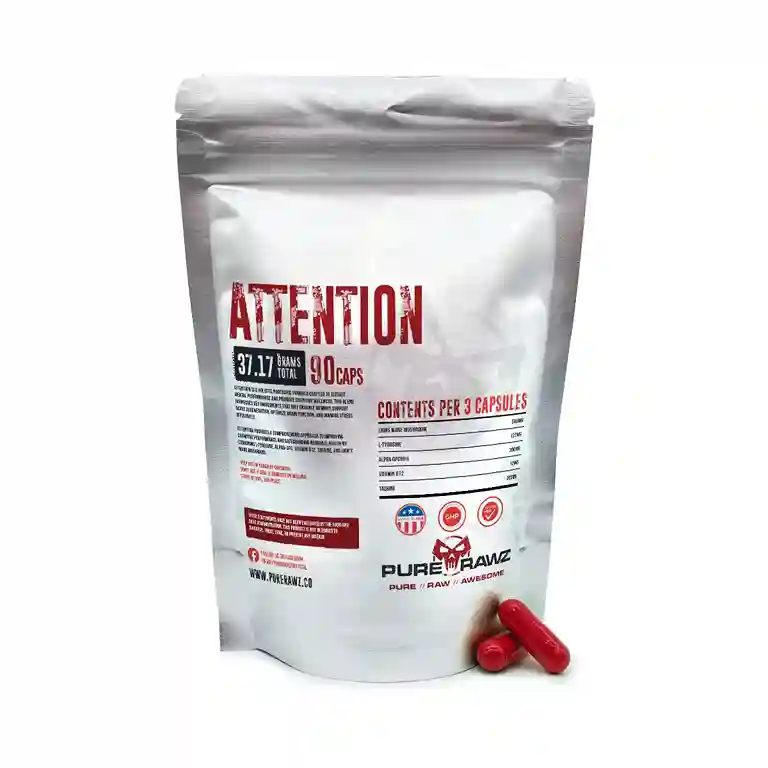
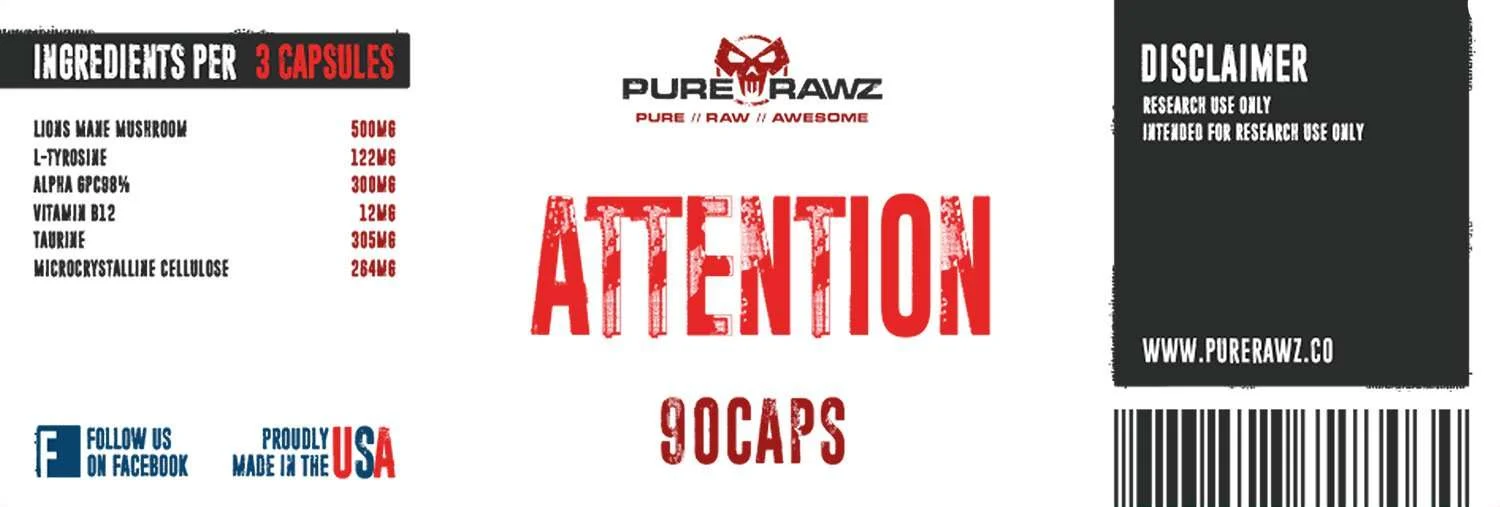
Attention Capsules
$32.49
Earn 32 points upon purchasing this product.
✅ 99% Purity – Third-Party Tested
🚚 Free U.S. Shipping on Orders $100+
 Proudly Made in the USA
⚡ Fast & Reliable Shipping
🔒 Secure Checkout Guaranteed
Enjoy 24/7 customer support, 1st & 3rd party verified 99% purity, and free shipping on orders over $100!
Description
Botanical Neuromodulatory Research Chemical
Product Information
Botanical Neuromodulatory Research Chemical is a laboratory formulation made from plant-derived extracts together with selected micronutrient components. It contains botanical molecules that are often studied for many years because many of them interact with proteins, enzymes, and signaling molecules found inside cells.
These molecular interactions are useful in experimental work that focuses on how phytochemical compounds may influence cellular communication systems under controlled laboratory conditions.
Botanical Neuromodulatory Research Chemical is supplied exclusively by PureRawz for scientific and laboratory research use only. The product is not intended for human consumption, veterinary use, or medical application.
| Property | Description | |
| Compound Name | A Botanical Neuromodulatory research chemical | |
| Chemical Type | Botanical and micronutrient research formulation | |
| Molecular Components | Plant-derived phytochemicals and micronutrients | |
| Chemical Class | Phytochemicals and biochemical regulatory compounds | |
| Storage Conditions | Store in a cool, dry environment away from light | |
| Laboratory Status | Research chemical formulation | |
| Regulatory Status | Not FDA-approved |
Working Mechanism
Many phytochemicals can interact with intracellular enzymes, signaling proteins, and regulatory molecules. Laboratory studies often focus on how these interactions affect signaling pathways that coordinate communication between cellular structures.
In current research, the emphasis is placed on molecular behavior and signaling activity inside cells. Investigations are designed to observe biochemical interactions rather than clinical or therapeutic outcomes.
Research Applications
- Researchers may first analyze plant molecules to determine chemical composition, structural features, purity, and stability. Techniques such as chromatography and spectrometry are commonly used to detect and characterize phytochemical components under controlled laboratory conditions.
- Another area of investigation involves cellular signaling pathways. Experiments sometimes explore how botanical compounds interact with signaling proteins, regulatory enzymes, or transcription-related mechanisms that participate in cellular communication.
- In certain neuroscience laboratory models, phytochemicals may also be examined for their relationship with cellular systems involved in neurotransmitter signaling and neural communication pathways.
Why Buy from PureRawz?
PureRawz supplies research-grade compounds intended to support laboratory investigation and experimental consistency.
Each batch of Botanical Neuromodulatory Research Chemical is subjected to independent laboratory testing. A Certificate of Analysis (COA) is provided to verify product identity, composition, and quality.
Get free shipping if orders qualify for over $100.
Reacher Disclaimer
This information is for educational purposes only and not medical advice. Products are for research use only. Research must follow IRB or IACUC guidelines. Verify information independently before purchasing. By placing an order, you agree to our Terms and Conditions. If you are not 100% satisfied with the product you received, please contact us at support@staging.purerawz.co
ATTENTION: All our products are for LABORATORY AND RESEARCH PURPOSES ONLY, not for veterinary or human use
References
Panche, A. N., Diwan, A. D., & Chandra, S. R. (2016). Flavonoids: An overview. Journal of Nutritional Science, 5, e47. https://doi.org/10.1017/jns.2016.41
Scalbert, A., Johnson, I. T., & Saltmarsh, M. (2005). Polyphenols: Antioxidants and beyond. The American Journal of Clinical Nutrition, 81(1), 215S 217S. https://doi.org/10.1093/ajcn/81.1.215S
Williamson, G. (2017). The role of polyphenols in modern nutrition. Nutrition Bulletin, 42(3), 226 235. https://doi.org/10.1111/nbu.12278
Lobo, V., Patil, A., Phatak, A., & Chandra, N. (2010). Free radicals, antioxidants and functional foods: Impact on human health. Pharmacognosy Reviews, 4(8), 118 126. https://doi.org/10.4103/0973-7847.70902

Dr. Helma Wennemers
Dr. Helma Wennemers is a globally recognized chemist shaping modern peptide science and molecular design through highly original research in applied biosciences.
Her work explores how precise molecular architecture can be engineered to create new functional systems in chemistry and life sciences. Her contributions continue to redefine contemporary chemical research through creativity, depth, and structural innovation.
Please click here to access instructions on how to make a payment.
How to PayRelated products
-

Estrokill
$76.31 Select options This product has multiple variants. The options may be chosen on the product page -
Cleanse
$20.27 Select options This product has multiple variants. The options may be chosen on the product page -
Elderberry Gummies
$17.20 Select options This product has multiple variants. The options may be chosen on the product page -
Slin
$30.59 Select options This product has multiple variants. The options may be chosen on the product page


