
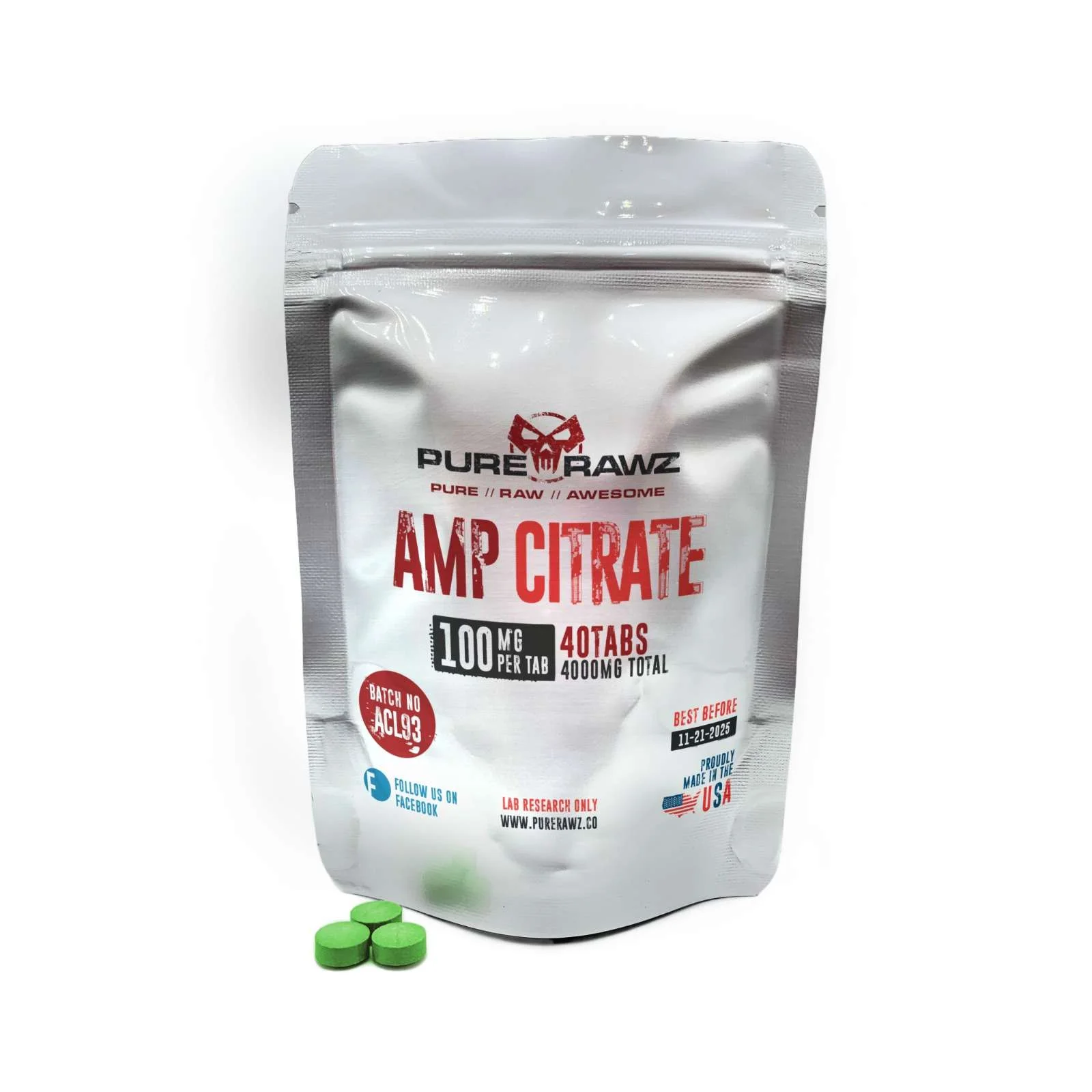
AMP Citrate
Price range: $33.88 through $131.16
Earn 34 - 131 points upon purchasing this product.
✅ 99% Purity – Third-Party Tested
🚚 Free U.S. Shipping on Orders $100+
 Proudly Made in the USA
⚡ Fast & Reliable Shipping
🔒 Secure Checkout Guaranteed
Enjoy 24/7 customer support, 1st & 3rd party verified 99% purity, and free shipping on orders over $100!
Description
Overview of AMP Citrate
AMP Citrate, also called 4-amino-2-methylpentane citrate or 1,3-dimethylbutylamine (DMBA), is a synthetic aliphatic amine used in experimental biochemical research. Its structure is similar to other substituted aliphatic amines studied for interactions with monoamine transporters in laboratory models.
Chemical and Molecular Properties
| AMP Citrate | |
| PubChem SID | PubChem Substance SID 355051408 |
| Molecular Formula (Salt Form) | Approximately C6H15N · C6H8O7 |
| Molecular Weight (Approx.) | ~293 g/mol (salt pair estimate) |
| Synonyms | AMP Citrate; 4-amino-2-methylpentane citrate; 4-amino-2-methylpentane citrate |
| IUPAC (Base Amine) | 4-amino-2-methylpentane |
| Labeling | Research Use Only (RUO) |
| Chemical Structure Depiction | 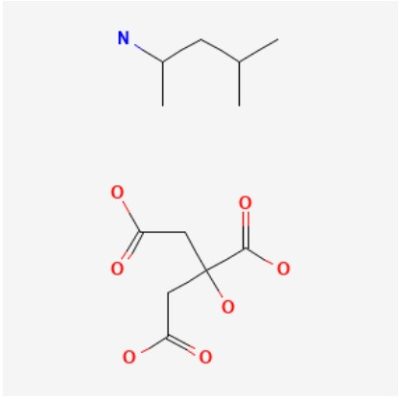 |
| Purity | ≥98% |
| Classification | Synthetic aliphatic amine salt; Laboratory research chemical |
| Storage Temperature | Store at −20 °C; protect from moisture and light |
| Solubility | Water-soluble; soluble in DMSO |
| Safety | Handle with laboratory PPE; avoid ingestion, inhalation, and skin contact; use only in controlled lab settings |
Mechanisms of AMP CITRATE
Monoamine Transporter Interaction
AMP Citrate is structurally related to substituted alyl amines that interact with monoamine transporters in experimental systems. In vitro assays examining transporter binding have been used to evaluate how substituted amines influence norepinephrine and dopamine transporter activity.
Structure - Activity Relationship Studies
Due to its structural similarity to other aliphatic amines, AMP Citrate is included in SAR investigations that examine how molecular substitutions influence transporter affinity, receptor interaction, and monoamine signaling pathway
AMP Citrate Research Applications
AMP Citrate is intended strictly for controlled experimental use, including:
- Neurochemical Pathway Research: Studying interactions with monoamine transporters (dopamine and norepinephrine).
- Structure-Activity Relationship Studies: Comparing AMP Citrate with similar compounds to see how structural changes affect transporter and receptor interactions.
- Analytical and Chemical Characterization: Using spectroscopy and chromatography to verify the compound and study chemical properties.
- Experimental Neuropharmacology Models: Investigating effects on catecholamine signaling in controlled cellular systems.
Why Choose PureRawz for AMP Citrate?
Buy AMP Citrate for laboratory research use from our online shop. At Purerawz, we provide high-quality reference materials. Each research compound comes with a Certificate of Analysis for verification of purity and concentration.
Note:
AMP Citrate is an investigational compound currently undergoing clinical evaluation and has not been established as safe or effective for any therapeutic use
Disclaimer
This information is for educational purposes only and not medical advice. Products are for research use only. Research must follow IRB or IACUC guidelines. Verify information independently before purchasing. By ordering, you agree to our Terms and Conditions. If you are not 100% satisfied with the product you received, please contact us at support@staging.purerawz.co
ATTENTION: All our products are for LABORATORY AND RESEARCH PURPOSES ONLY, not for veterinary or human use
Reference Links
PubChem Compound Summary for 4-amino-2-methylpentane citrate. National Center for Biotechnology Information. https://pubchem.ncbi.nlm.nih.gov/substance/355051408
Cozzi NV, Sievert MK, Shulgin AT, Jacob P, Ruoho AE. Inhibition of plasma membrane monoamine transporters by β-ketoamphetamines. European Journal of Pharmacology.
https://pubmed.ncbi.nlm.nih.gov/10528135/
Simmler LD, Rickli A, Hoener MC, Liechti ME. Monoamine transporter interaction profiles of psychoactive substances. Biochemical Pharmacology. https://pmc.ncbi.nlm.nih.gov/articles/PMC6165951/

Dr. Helma Wennemers
Dr. Helma Wennemers is a globally recognized chemist shaping modern peptide science and molecular design through highly original research in applied biosciences.
Her work explores how precise molecular architecture can be engineered to create new functional systems in chemistry and life sciences. Her contributions continue to redefine contemporary chemical research through creativity, depth, and structural innovation.
Please click here to access instructions on how to make a payment.
How to PayRelated products
-

Amino Tadalafil
Price range: $31.13 through $78.15 Select options This product has multiple variants. The options may be chosen on the product page -
7-Keto DHEA
Price range: $26.77 through $45.33 Select options This product has multiple variants. The options may be chosen on the product page -
Enclomiphene Citrate
Price range: $62.85 through $133.90 Select options This product has multiple variants. The options may be chosen on the product page -
6-OXO
Price range: $64.87 through $170.84 Select options This product has multiple variants. The options may be chosen on the product page


