
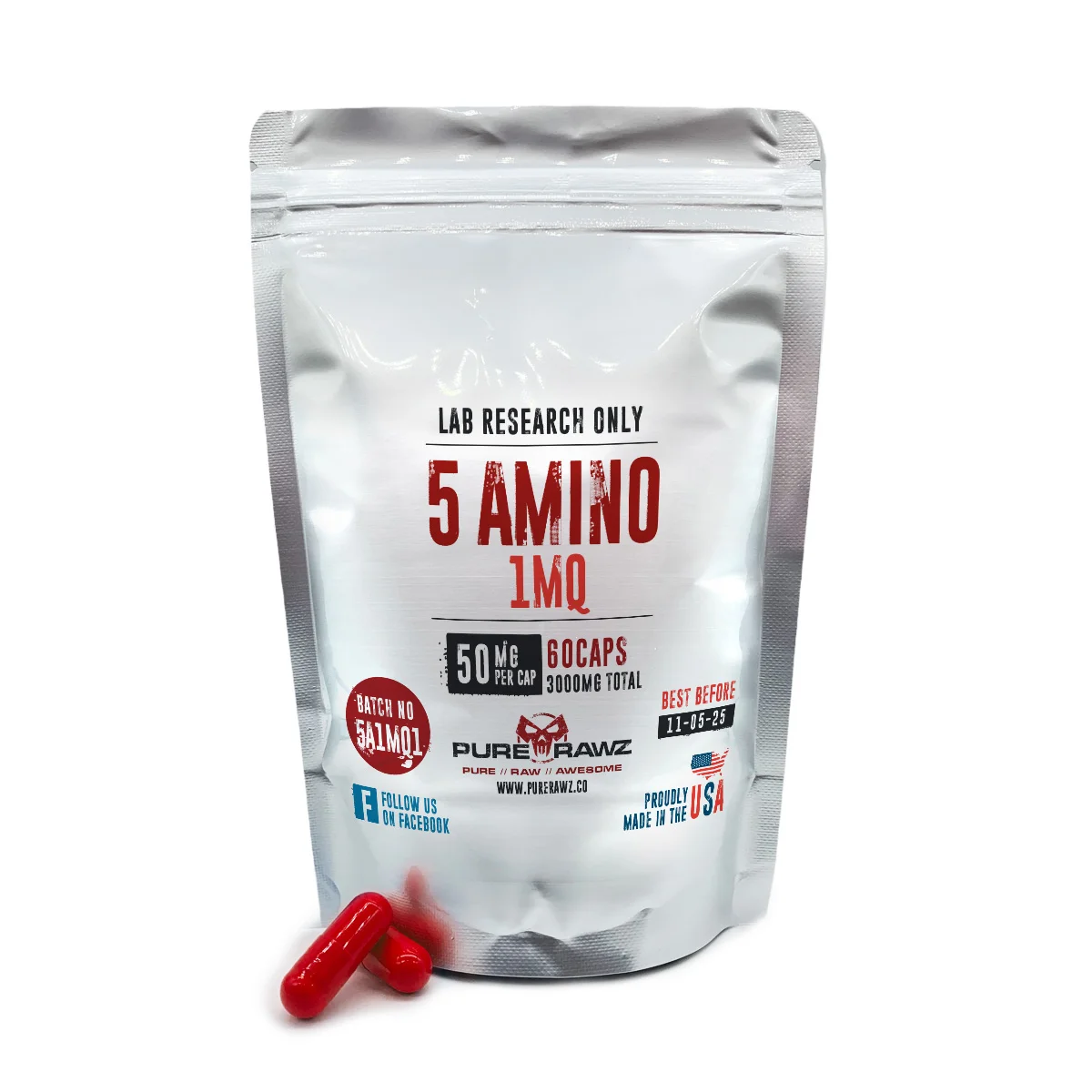
5 Amino 1MQ
$311.52
Earn 312 points upon purchasing this product.
✅ 99% Purity – Third-Party Tested
🚚 Free U.S. Shipping on Orders $100+
 Proudly Made in the USA
⚡ Fast & Reliable Shipping
🔒 Secure Checkout Guaranteed
Enjoy 24/7 customer support, 1st & 3rd party verified 99% purity, and free shipping on orders over $100!
Description
Overview
5-Amino-1MQ (5-Amino-1-methylquinolinium) is a small synthetic compound investigated in biochemical and metabolic research models. It is structurally derived from 1-methylquinolinium and is commonly examined in experimental studies exploring cellular metabolism, enzyme inhibition, and intracellular energy regulation pathways.
Within investigational research, 5-Amino-1MQ has been studied for its interaction with nicotinamide N-methyltransferase (NNMT), an enzyme involved in nicotinamide metabolism and methylation processes. NNMT plays a role in regulating intracellular levels of nicotinamide adenine dinucleotide (NAD+) and other metabolites associated with cellular energy pathways.
Chemical and Molecular Properties
| Property | Value |
| Compound Name | 5-Amino-1-methylquinolinium (5-Amino-1MQ) |
| CAS Number | 42464-96-0 |
| Molecular Formula | C10H11N2+ |
| Molecular Weight | 159.21 g/mol |
| IUPAC Name | 5-amino-1-methylquinolinium |
| Chemical Class | Quinoline derivative |
Working Mechanism
NNMT Enzyme Function
NNMT catalyzes the methylation of nicotinamide, transferring a methyl group from S-adenosyl-L-methionine (SAM) to nicotinamide to form 1-methylnicotinamide (MNA). This reaction participates in cellular pathways associated with NAD+ metabolism and methyl donor utilization.
Enzyme Inhibition Mechanism
In in vitro enzymatic assays, 5-Amino-1MQ interacts with NNMT and reduces its catalytic activity. The inhibition of NNMT can influence several intracellular processes within experimental systems:
- Altered nicotinamide metabolism through reduced methylation of nicotinamide.
- Changes in NAD+ pathway dynamics, since nicotinamide is a precursor involved in NAD+ biosynthesis.
- Modulation of methyl donor utilization, which may influence cellular methylation balance.
Cellular Pathway Implications in Experimental Models
Through NNMT inhibition, 5-Amino-1MQ may influence molecular pathways studied in laboratory environments, including:
- NAD+ dependent enzyme activity, such as sirtuin-related signaling systems
- mitochondrial metabolic processes associated with cellular energy production
- gene expression patterns related to metabolic regulation
These molecular interactions are commonly analyzed using biochemical enzyme assays, metabolic pathway analysis, and cellular gene expression studies in controlled research settings.
Research Applications in Laboratory Settings
NNMT Enzyme Inhibition Studies
5-Amino-1MQ is widely used in biochemical investigations of NNMT enzyme activity. Researchers utilize the compound in in vitro assays to evaluate:
- catalytic regulation of nicotinamide methylation
- substrate-enzyme interaction dynamics
- molecular mechanisms controlling NAD-related metabolic pathways
These studies contribute to understanding enzyme regulation within cellular metabolic networks.
Cellular Metabolism Research
Experimental models frequently use 5-Amino-1MQ to explore metabolic pathway regulation. Investigations often focus on:
- intracellular nicotinamide metabolism
- NAD+ biosynthesis and turnover
- mitochondrial metabolic signaling
Such experiments typically involve cell culture systems and metabolic profiling techniques.
Gene Expression and Metabolic Signaling Studies
In preclinical research models, NNMT inhibition by compounds such as 5-Amino-1MQ has been used to investigate transcriptional regulation of metabolic genes. Researchers may analyze:
- changes in metabolism-associated gene expression
- regulation of energy-related cellular signaling pathways
- interactions between methylation pathways and metabolic transcription factors
These experiments contribute to a broader understanding of metabolic regulatory networks within cellular systems.
Experimental Models of NAD+ Pathway Regulation
Because NNMT interacts with nicotinamide metabolism, 5-Amino-1MQ is also studied in experimental models evaluating NAD+-related pathways. Laboratory research may investigate:
- enzymatic pathways involved in NAD+ synthesis and recycling
- interactions between NAD-dependent enzymes and metabolic signaling networks
- cellular responses to altered nicotinamide availability
These investigations are typically conducted in controlled in vitro systems and molecular biology research platforms.
Why Choose Purerawz for 5-Amino-1MQ?
Buy 5-Amino-1MQ for laboratory research use from our online shop. At Purerawz, we provide high-quality reference materials. Each research compound comes with a Certificate of Analysis for verification of purity and concentration.
Disclaimer
This information is for educational purposes only and not medical advice. Products are for research use only. Research must follow IRB or IACUC guidelines. Verify information independently before purchasing. By ordering, you agree to our Terms and Conditions. If you are not 100% satisfied with the product you received, please contact us at support@staging.purerawz.co
Reference Links
- Tian, Y., Qin, H., Ding, M., Tang, L., & Zeng, F. (2023). Water soluble macrocyclic host for recognition of N-methylquinolinium salts in water. RSC Advances, 13(21), 14539-14542. https://doi.org/10.1039/d3ra02447d
- Baydoun, Z. A., Rao, M., & Khan, I. (2024). Endoplasmic reticular stress and pathogenesis of experimental colitis: Mechanism of action of 5-Amino salicylic acid. Medical Principles and Practice, 34(1), 1-9. https://doi.org/10.1159/000541791

Dr. Helma Wennemers
Dr. Helma Wennemers is a globally recognized chemist shaping modern peptide science and molecular design through highly original research in applied biosciences.
Her work explores how precise molecular architecture can be engineered to create new functional systems in chemistry and life sciences. Her contributions continue to redefine contemporary chemical research through creativity, depth, and structural innovation.
Please click here to access instructions on how to make a payment.
How to PayRelated products
-

1-Andro
Price range: $34.41 through $132.80 Select options This product has multiple variants. The options may be chosen on the product page -
AC-262
Price range: $38.44 through $152.06 Select options This product has multiple variants. The options may be chosen on the product page -
Beta-Ecdysterone Capsules (99% Purity)
Price range: $17.98 through $33.66 Select options This product has multiple variants. The options may be chosen on the product page -
BAM-15 + SLU-PP-332 Capsules
Price range: $43.48 through $173.96 Select options This product has multiple variants. The options may be chosen on the product page


