
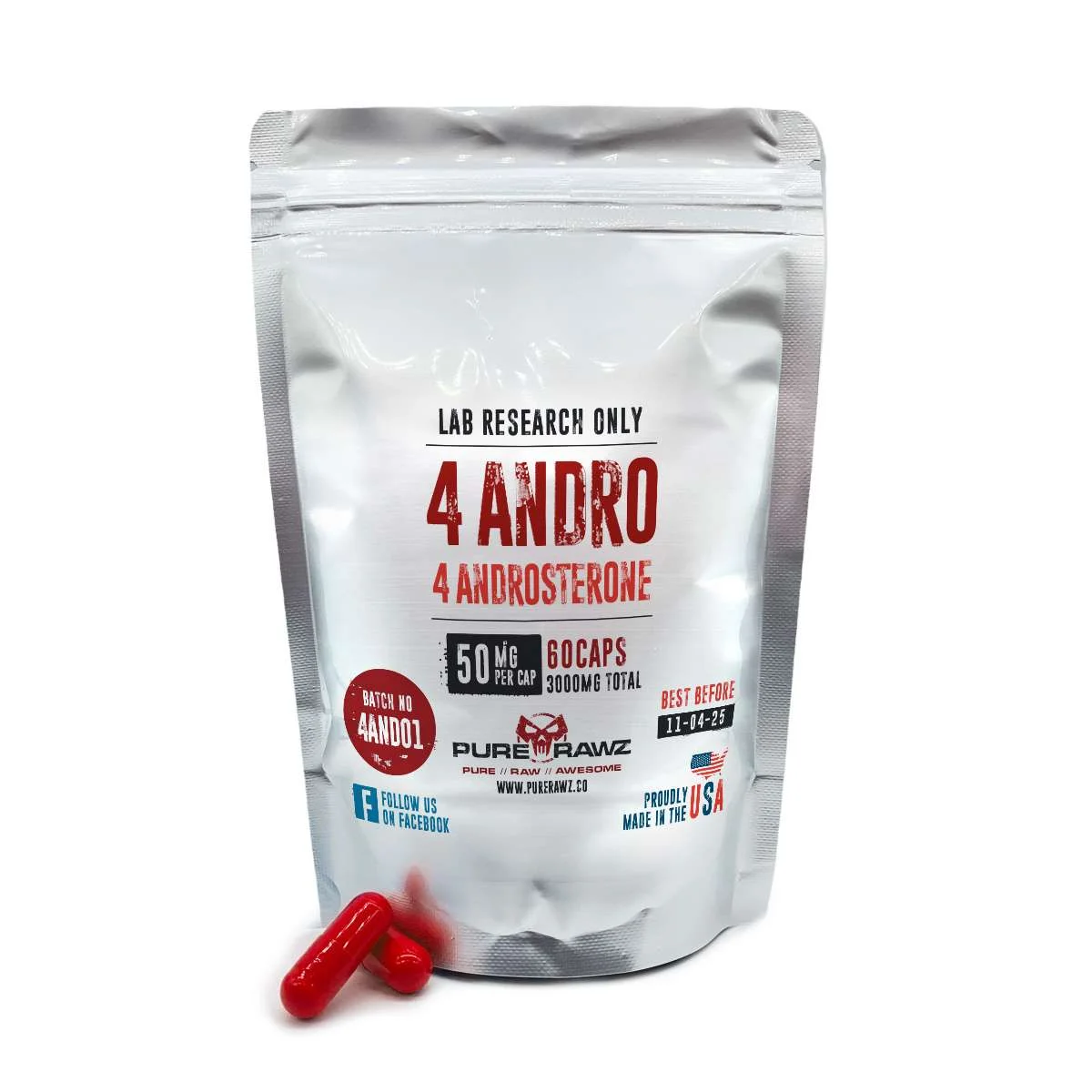
4-Andro
Price range: $36.13 through $126.81
Earn 36 - 127 points upon purchasing this product.
✅ 99% Purity – Third-Party Tested
🚚 Free U.S. Shipping on Orders $100+
 Proudly Made in the USA
⚡ Fast & Reliable Shipping
🔒 Secure Checkout Guaranteed
Enjoy 24/7 customer support, 1st & 3rd party verified 99% purity, and free shipping on orders over $100!
Description
4-Andro Overview
4-Androstenediol (4-Andro) is an androstenediol-type steroid precursor that is structurally related to dehydroepiandrosterone (DHEA). In research models, compounds from the androstenediol family are studied for how structural differences may influence androgen-related signaling pathways and receptor interactions.
In laboratory settings, 4-Androstenediol is investigated for its role in steroidogenic conversion pathways, particularly its potential enzymatic transformation into downstream steroid hormones such as testosterone. Research also explores how androgen-related steroid compounds may interact with biochemical pathways involved in hormone signaling and metabolism.
Chemical and Molecular Properties
| Property | Information |
| CAS Number | 1156-92-9 |
| Molecular Formula | C19H30O2 |
| Molecular Mass | 290.4 g/mol |
| Synonyms | 4-Androstenediol, Androst-4-ene-3beta,17beta-diol, G10EHA9I0D, 4-ANDENDIOL |
| IUPAC Name | (3S,8R,9S,10R,13S,14S,17S)-10,13-dimethyl-2,3,6,7,8,9,11,12,14,15,16,17-dodecahydro-1H-cyclopenta[a]phenanthrene-3,17-diol |
| Storage | 15-30°C (59-86°F) |
Mechanism of Action
Current research investigates the potential enzymatic conversion of 4-Androstenediol (4-Andro) into downstream steroid hormones under controlled experimental conditions.
Studies have evaluated:
- Conversion into testosterone through steroidogenic enzymes such as 3β-hydroxysteroid dehydrogenase and 17β-hydroxysteroid dehydrogenase
- Aromatization pathways in which testosterone-derived metabolites may form estradiol through aromatase activity
- Comparative pathway utilization when evaluated alongside related steroid precursors such as androstenedione
One controlled investigation reported temporary elevations in serum testosterone during short-term administration of androstenedione-related precursor compounds. These levels were observed to return to normal during extended observation periods. Additional studies have also examined the formation of aromatization-related metabolites during similar experimental research protocols.
Potential Research Applications
Published literature has examined DHEA and androstenediol-related compounds across multiple controlled experimental settings.
IGF-1 Signaling Pathways
Certain controlled studies have reported measurable variations in circulating insulin-like growth factor-1 (IGF-1) concentrations during monitored research protocols involving DHEA-related compounds.
Steroidogenic Conversion Dynamics
Investigations have assessed the enzymatic conversion potential of androstenediol-related compounds into downstream steroid hormones under laboratory conditions.
Muscle Physiology Markers
Some research protocols have evaluated musculoskeletal performance metrics alongside endocrine markers in defined study populations.
Neuroendocrine & Cortisol-Related Parameters
Exploratory research has examined associations between DHEA-related compounds and neuroendocrine markers.
Note: 4-Andro is not approved by the FDA for medical uses. It is available for investigational and research purposes only.
Where to Buy 4-Androstenediol?
PureRawz offers high-quality 4-Andro for laboratory and research applications. The compound is prepared under controlled production conditions to help ensure consistency for experimental studies.
All our products undergo strict quality control procedures. An independent third-party Certificate of Analysis (COA) is provided to confirm the compound's identity, purity, and overall quality for reliable research use.
Disclaimer
This information is for educational purposes only and not medical advice. Products are for research use only. Research must follow IRB or IACUC guidelines. Verify information independently before purchasing. By ordering, you agree to our Terms and Conditions. If you are not 100% satisfied with the product you received, please contact us at support@staging.purerawz.co
ATTENTION: All our products are for LABORATORY AND RESEARCH PURPOSES ONLY, not for veterinary or human use
References:
PubChem. (2026). 4-Androstenediol. Nih.gov; PubChem. https://pubchem.ncbi.nlm.nih.gov/compound/4-Androstenediol
Wolkowitz, O. M., Reus, V. I., Roberts, E., Manfredi, F., Chan, T., Raum, W. J., Ormiston, S., Johnson, R., Canick, J., Brizendine, L., & Weingartner, H. (1997). Dehydroepiandrosterone (DHEA) treatment of depression. Biological Psychiatry, 41(3), 311'318. https://doi.org/10.1016/s0006-3223(96)00043-1
Villareal, D. T., & Holloszy, J. O. (2004). Effect of DHEA on abdominal fat and insulin action in elderly women and men. JAMA, 292(18), 2243. https://doi.org/10.1001/jama.292.18.2243
Sripada, R. K., Marx, C. E., King, A. P., Rajaram, N., Garfinkel, S. N., Abelson, J. L., & Liberzon, I. (2013). DHEA enhances emotion regulation, neurocircuits, and modulates memory for emotional stimuli. Neuropsychopharmacology, 38(9), 1798'1807. https://doi.org/10.1038/npp.2013.79

Dr. Helma Wennemers
Dr. Helma Wennemers is a globally recognized chemist shaping modern peptide science and molecular design through highly original research in applied biosciences.
Her work explores how precise molecular architecture can be engineered to create new functional systems in chemistry and life sciences. Her contributions continue to redefine contemporary chemical research through creativity, depth, and structural innovation.
Please click here to access instructions on how to make a payment.
How to PayRelated products
-

EPI-Andro
Price range: $49.72 through $92.92 Select options This product has multiple variants. The options may be chosen on the product page -
Turkesterone
Price range: $37.71 through $45.33 Select options This product has multiple variants. The options may be chosen on the product page

