
🔥 WE HAVE THE BEST COMPOUNDS ON THE PLANET
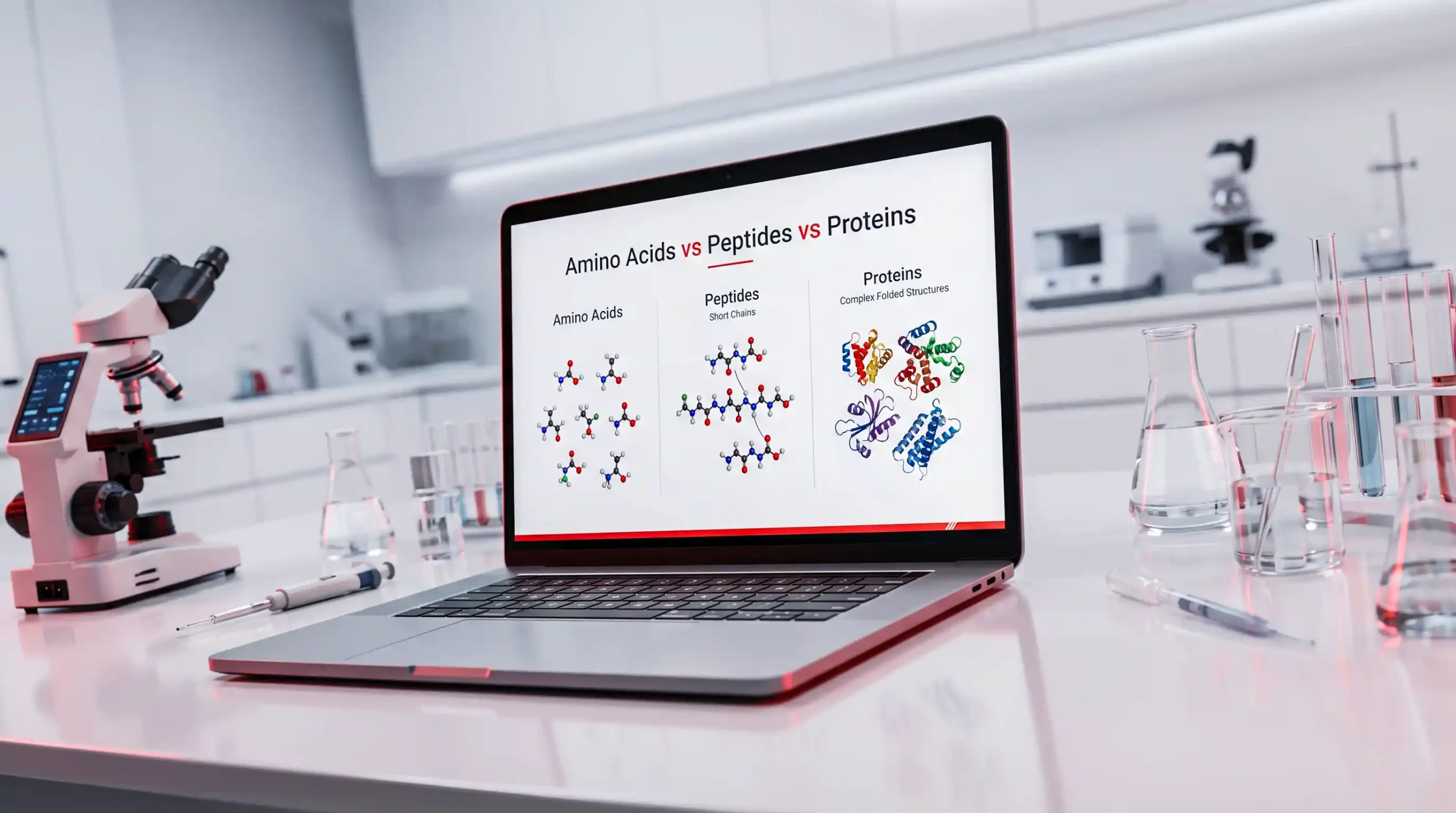
Peptides, proteins, and amino acids are the important molecular components of cellular research based systems. They play critical roles in structural organization, signaling pathways, and enzymatic activity across experimental models.
However, these three compounds are quite different from each other in terms of their molecular structure and properties. The primary difference between these compounds is that
In the following blog, you will learn more information regarding the differences between proteins, peptides, and amino acids.
Proteins are large, complex macromolecules. They are formed from one or more polypeptide chains folded into specific three-dimensional structures.
Researchers have observed that proteins perform critical cellular functions in investigational research subjects. From structural support, enzymatic catalysis, and molecular transport, proteins perform every function in regulating biochemical pathways.
In experimental and investigational models, proteins are central to studies of cellular organization and protein interactions. Their structural complexity and functional diversity make them key subjects in molecular biology, structural biology, and bioengineering research.
Peptides are short chains of amino acids connected by peptide bonds, typically comprising 2 to 50 residues. They act as signaling molecules, regulatory agents, and intermediates in protein synthesis.
In research settings, peptides are used in vitro to explore receptor-ligand interactions and cellular communication.
Their smaller size and simpler structure compared to proteins make them highly versatile tools for mechanistic studies in laboratory models.
Amino acids are the most fundamental molecular units in cellular biology. Each amino
acid consists of an amino group (–NH₂), a carboxyl group (–COOH), and a distinctive side chain that determines their chemical properties.
In investigational models, amino acids serve as the essential building blocks for the synthesis of peptides and proteins.
Their study provides insights into metabolic pathways, enzymatic mechanisms, and intracellular signaling processes in molecular and biochemical research.
| Feature | Amino Acids | Peptides | Proteins |
| Basic Definition | Small organic molecules; building blocks of proteins | Short chains of amino acids linked by peptide bonds | Large, complex molecules made of one or more long polypeptide chains |
| Structure Size | Single unit | 2–50 amino acids (usually) | More than 50 amino acids |
| Molecular Weight | Low | Moderate | High |
| Bonding | No peptide bonds within a single amino acid | Peptide bonds between amino acids | Extensive peptide bonds form long chains |
| Complexity | Simple | Intermediate | Highly complex (folded 3D structures) |
| Levels of Structure | No levels | The primary structure mainly | Primary, secondary, tertiary, and quaternary structures |
| Examples | Glycine, Alanine, Lysine | Insulin (short chains), Oxytocin | Hemoglobin, Collagen, Enzymes |
| Solubility | Highly soluble | Generally soluble | Variable (depends on structure) |
| Formation | Synthesized or obtained from the diet | Formed by linking amino acids | Formed by the folding of long peptide chains |
| Stability | Very stable | Less stable than proteins | Stability depends on structure |
Understanding the differences between amino acids, peptides, and proteins is essential for modern research. Amino acids are the building blocks, peptides act as short-chain regulators, and proteins are large, folded macromolecules with complex biological functions.
Their interrelated structures and functions form the backbone of cellular life and serve as a foundation for scientific discovery in molecular biology and biotechnology.

Dr. Helma Wennemers is a globally recognized chemist shaping modern peptide science and molecular design through highly original research in applied biosciences.
Her work explores how precise molecular architecture can be engineered to create new functional systems in chemistry and life sciences.Her contributions continue to redefine contemporary chemical research through creativity, depth, and structural innovation.
We are offering the following products on sale. Hurry up before the sale ends!
As part of our exclusive upscale promotion, you can add some of our top research compounds to your order at a special discounted rate.