
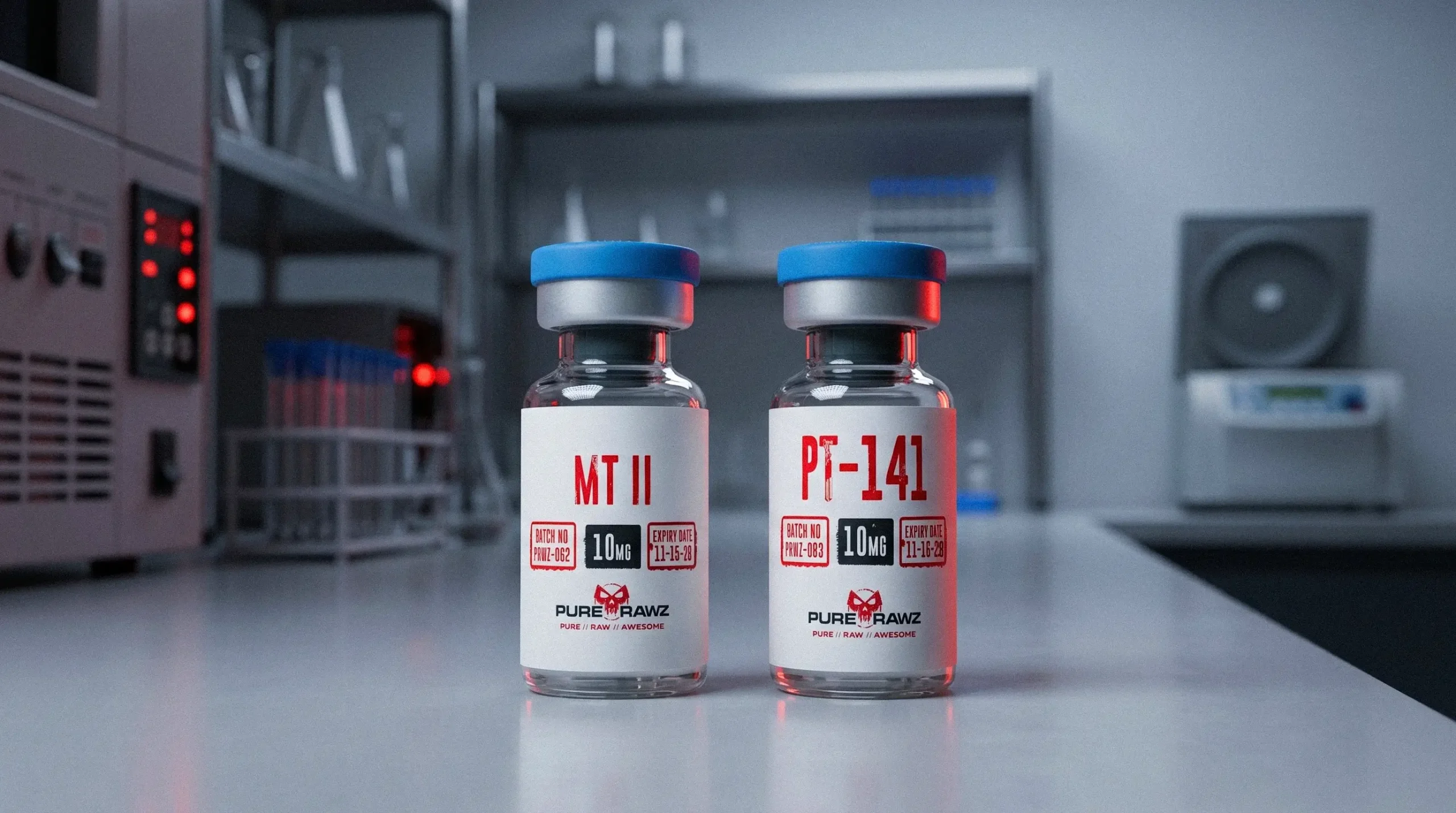
Melanotan II and PT-141 are both synthetic melanocortin peptides with different receptor selectivity and research focus.
Researchers have found that both peptides are derived from the same natural peptide precursor, alpha-melanocyte-stimulating hormone (α-MSH) [1]. However, their receptor binding profiles diverge sharply at the molecular level.
Disclaimer:
PT-141 (bremelanotide/Vyleesi) holds FDA approval as a prescription drug for one specific clinical indication. It requires a physician's prescription and is dispensed through licensed pharmacies only. It is not available for research, personal, or unsupervised use outside of authorized medical prescribing.
Melanotan II is not approved for human consumption, personal use, cosmetic use, or veterinary use in any form.
This content is for informational and educational purposes only and does not constitute medical advice, diagnosis, or treatment recommendations. Not for human or animal use.
Melanotan II activates four melanocortin receptor subtypes simultaneously, which include:
Melanotan II is being investigated for pigmentation, metabolic, and neuroendocrine research pathways in controlled laboratory settings [1].
PT-141 (bremelanotide), by contrast, was structurally re-engineered to concentrate activity almost exclusively at MC4R. Studies have suggested that PT-141 may eliminate pigmentation response.
This article breaks down exactly where Melanotan II and PT-141 diverge at the receptor level, and what the downstream signaling differences mean for preclinical research design.
Melanotan II (MT-II) is a non-selective melanocortin receptor agonist. That means it does not target one receptor, it engages four of them, each associated with a different research pathway.
MC1R
Studied in preclinical models for its role in melanocyte pigmentation pathways [2].
MC3R
Investigated for melanocortin-mediated interactions in adipocyte signaling and energy homeostasis models [2].
MC4R
Linked to neuroendocrine signaling and appetite-regulating mechanisms in preclinical research. The receptor both Melanotan II and PT-141 share, with significantly different selectivity profiles [2].
MC5R
Investigated for its role in exocrine gland function, including sebaceous and lacrimal gland activity in preclinical models [2].
PT-141 (bremelanotide) is a direct structural derivative of Melanotan II. Removing the C-terminal amide group from the peptide chain reduced MC1R activity and shifted the receptor profile toward central nervous system melanocortin pathways [4]. One structural change. Fundamentally different receptor selectivity.
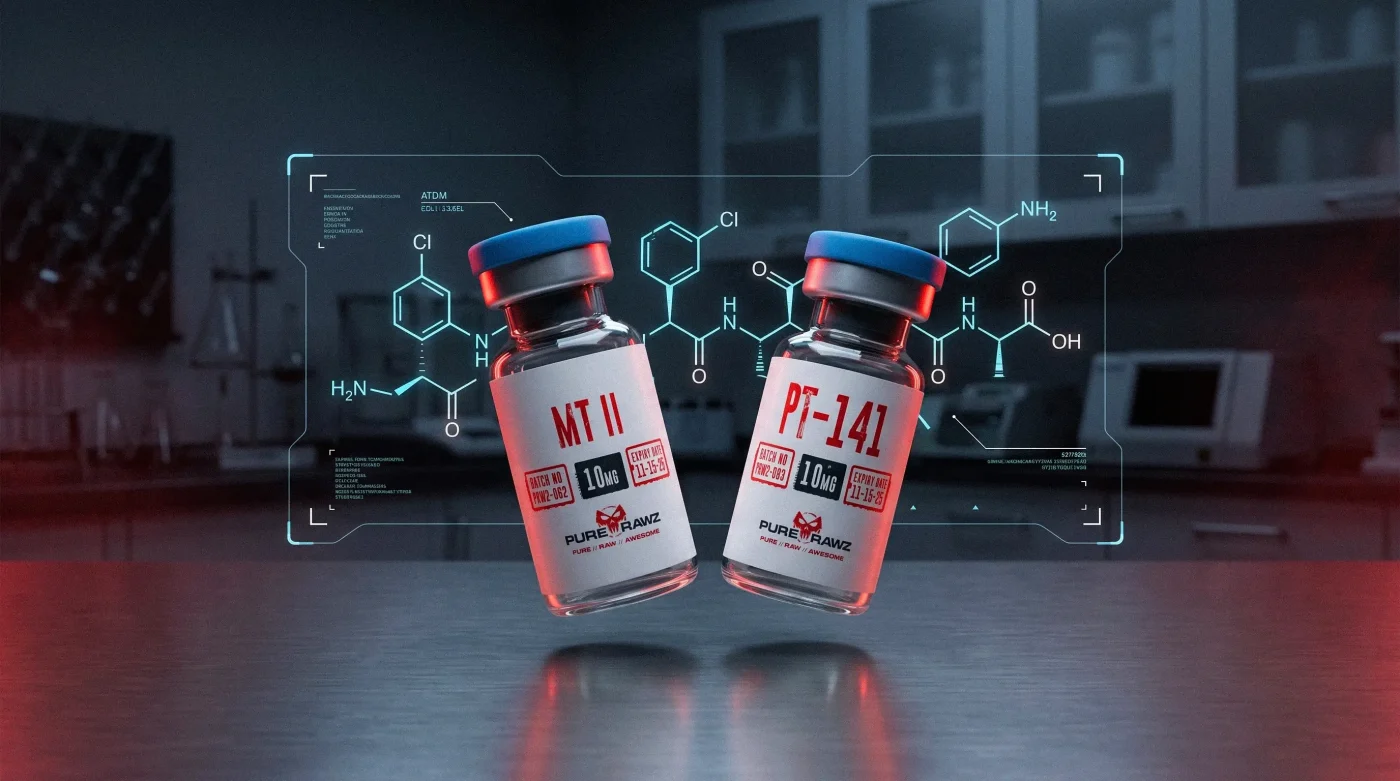
PT-141's investigational profile is primarily centered on MC4R and MC3R activation. Preclinical research models have associated melanocortin receptor signaling with downstream modulation involving dopaminergic pathways [5].
Experimental studies have also suggested potential involvement in oxytocin-associated neuronal signaling within central melanocortin pathway research. Research indicates PT-141 shows minimal MC1R activity [4].
Note: PT-141 holds FDA approval as a prescription drug for one specific clinical indication. [5] It is not available as an uncontrolled research chemical for general or personal use.
Melanotan II (MT-II) is a broad-spectrum melanocortin receptor agonist that interacts with MC1R, MC3R, MC4R, and MC5R. It shows strong MC1R activity linked to pigmentation research and melanocortin system signaling in preclinical models.
PT-141 is a more receptor-selective melanocortin analog, primarily associated with MC3R and MC4R activity. It has reduced MC1R interaction and a stronger focus on the central nervous system–based neuroendocrine pathway research.
Key difference: MT-II shows broad melanocortin receptor activation across multiple systems, while PT-141 demonstrates more targeted CNS-oriented receptor selectivity centered on MC3R/MC4R pathways.
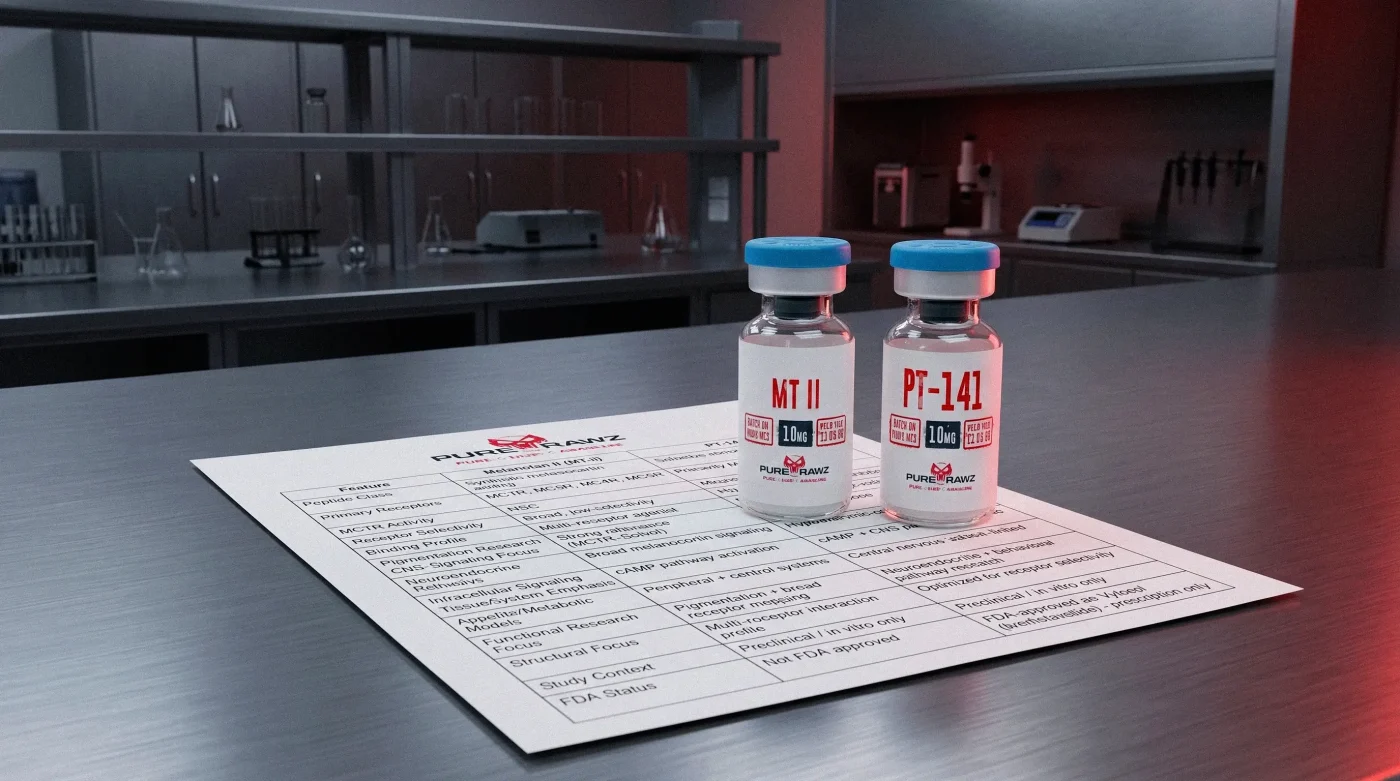
Note for researchers: The table below reflects investigational receptor profiles in preclinical research settings only. Neither compound is available for personal use in the United States.
| Feature | Melanotan II (MT-II) | PT-141 |
| Peptide Class | Synthetic melanocortin analog | Selective melanocortin analog |
| Primary Receptors | MC1R, MC3R, MC4R, MC5R | Primarily MC3R & MC4R |
| MC1R Activity | High | Minimal |
| Receptor Selectivity | Broad, low selectivity | Higher MC3R/MC4R selectivity |
| Binding Profile | Multi-receptor agonist | More targeted receptor interaction |
| Pigmentation Research | Strong relevance (MC1R-linked) | Limited relevance |
| CNS Signaling Focus | Moderate | Strong CNS-dominant focus |
| Neuroendocrine Pathways | Broad melanocortin signaling | Hypothalamic-centered signaling |
| Intracellular Signaling | cAMP pathway activation | cAMP + CNS pathway emphasis |
| Tissue/System Emphasis | Peripheral + central systems | Central nervous system–dominant |
| Appetite/Metabolic Models | Investigated | Investigated (more CNS-linked) |
| Functional Research Focus | Pigmentation + broad receptor mapping | Neuroendocrine + behavioral pathway research |
| Structural Focus | Multi-receptor interaction profile | Optimized for receptor selectivity |
| Study Context | Preclinical / in vitro only | Preclinical / in vitro only |
| FDA Status | Not FDA approved | FDA-approved as Vyleesi (bremelanotide) - prescription only |
Both Melanotan II and PT-141 engage MC4R for the central arousal pathway [3,5]. However, PT-141 does so with far greater selectivity. In preclinical research models, hypothalamic MC4R activation has been associated with a signaling chain involving oxytocin neurons.
It may also be linked with dopamine release, and downstream nitric oxide synthase activity in vascular tissue research contexts.
Research compliance note: All findings discussed reflect preclinical and early-phase data only. These compounds are not intended for personal, cosmetic, or recreational use.
Beyond receptor binding, the pharmacokinetic characteristics of Melanotan II and PT-141 differ in ways that matter for research protocol design.
Half-life: Melanotan II has an approximate plasma half-life of 1–2 hours in pharmacokinetic studies. PT-141 demonstrates a longer half-life of approximately 2.7 hours, reflecting its structural differences and altered metabolic processing rate.
Stability: The cyclic structure of Melanotan II confers greater resistance to enzymatic degradation than linear peptides. PT-141's modifications produce a distinct stability profile relevant to storage and handling considerations in research settings.
Melanotan II is the appropriate choice when the research objective requires engagement across MC1R, MC3R, MC4R, and MC5R simultaneously.
PT-141's selectivity makes it the right choice when the objective is specifically MC4R-mediated CNS signaling.
Melanotan II only! PT-141's dramatically reduced MC1R affinity makes it unsuitable for studies requiring active melanogenesis pathway engagement.
Melanotan II is studied for MC3R-focused investigational models. PT-141's limited MC3R engagement disqualifies it for this specific application.
Research-grade material with HPLC/MS verification and a Certificate of Analysis is the baseline standard for responsible investigational procurement regardless of compound choice.
The distinction between Melanotan II and PT-141 begins and ends at the receptor level. Both share the same molecular ancestor. Both engage the melanocortin system.
But one structural modification transformed a broad-spectrum investigational tool into a highly selective MC4R agonist and that difference has cascading consequences for every aspect of research design, from compound selection to data interpretation.
Melanotan II is the right tool when the research question spans the full melanocortin receptor family. PT-141 is the right tool when the objective requires isolating the MC4R/hypothalamic pathway without pigmentation variables.
Both compounds are for investigational and informational study only, not for human or animal consumption.
If you found this article while researching these compounds for personal health questions, particularly around sexual function or related concerns, the appropriate path is through a licensed healthcare provider.
PT-141 (bremelanotide/Vyleesi) is an FDA-approved prescription drug for one specific clinical indication in premenopausal adults. A physician can evaluate whether it is clinically appropriate for your situation.
Melanotan II holds no FDA approval for any indication. It is not legally available for human use in the United States outside of authorized research contexts.
This article provides research context only and does not constitute medical advice or a recommendation for personal use of either compound.
No. Both are synthetic analogs derived from alpha-MSH and both engage melanocortin receptors, but they are structurally distinct compounds with fundamentally different receptor affinity profiles. Melanotan II binds MC1R, MC3R, MC4R, and MC5R. PT-141 was structurally modified to concentrate activity at MC4R with minimal MC1R engagement.
PT-141 demonstrates high selectivity for MC4R, with reduced activity at MC3R, and minimal engagement at MC1R and MC5R. Melanotan II engages all four subtypes with meaningful affinity.
Pigmentation in research models is driven by the MC1R → cAMP → tyrosinase → eumelanin chain. Melanotan II binds MC1R with high affinity, activating this cascade. PT-141 was engineered with the C-terminal amide group removed, which reduces its MC1R affinity by approximately 1,000-fold. Without meaningful MC1R engagement, the melanogenesis pathway is not triggered, and no pigmentation effect is observed in PT-141 research.
Pro-opiomelanocortin (POMC) is a large precursor protein produced in the pituitary gland and hypothalamus. When specific enzymes cleave it, one of the resulting peptides is alpha-MSH. Both Melanotan II and PT-141 are synthetic analogs of α-MSH engineered to mimic its receptor binding.
