
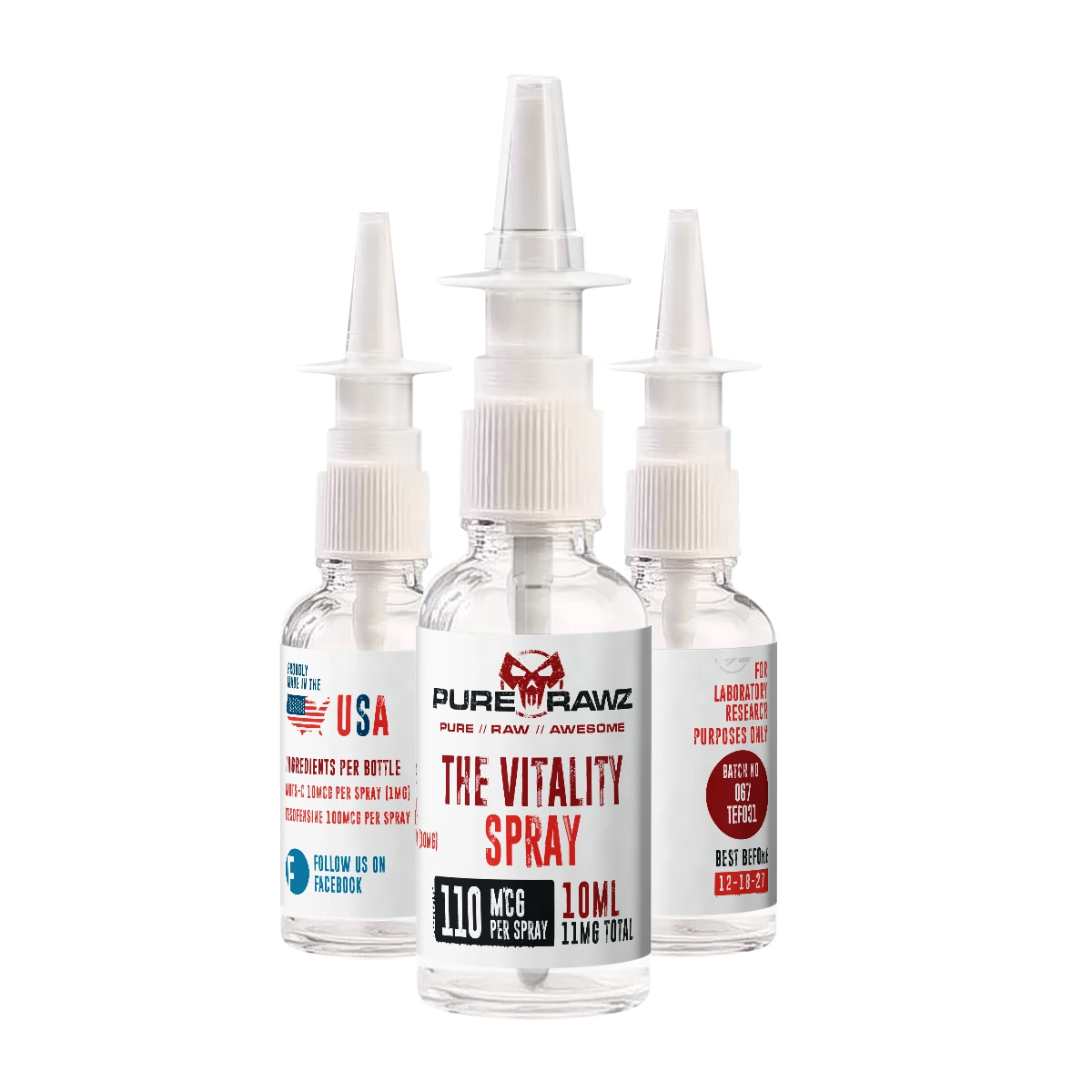
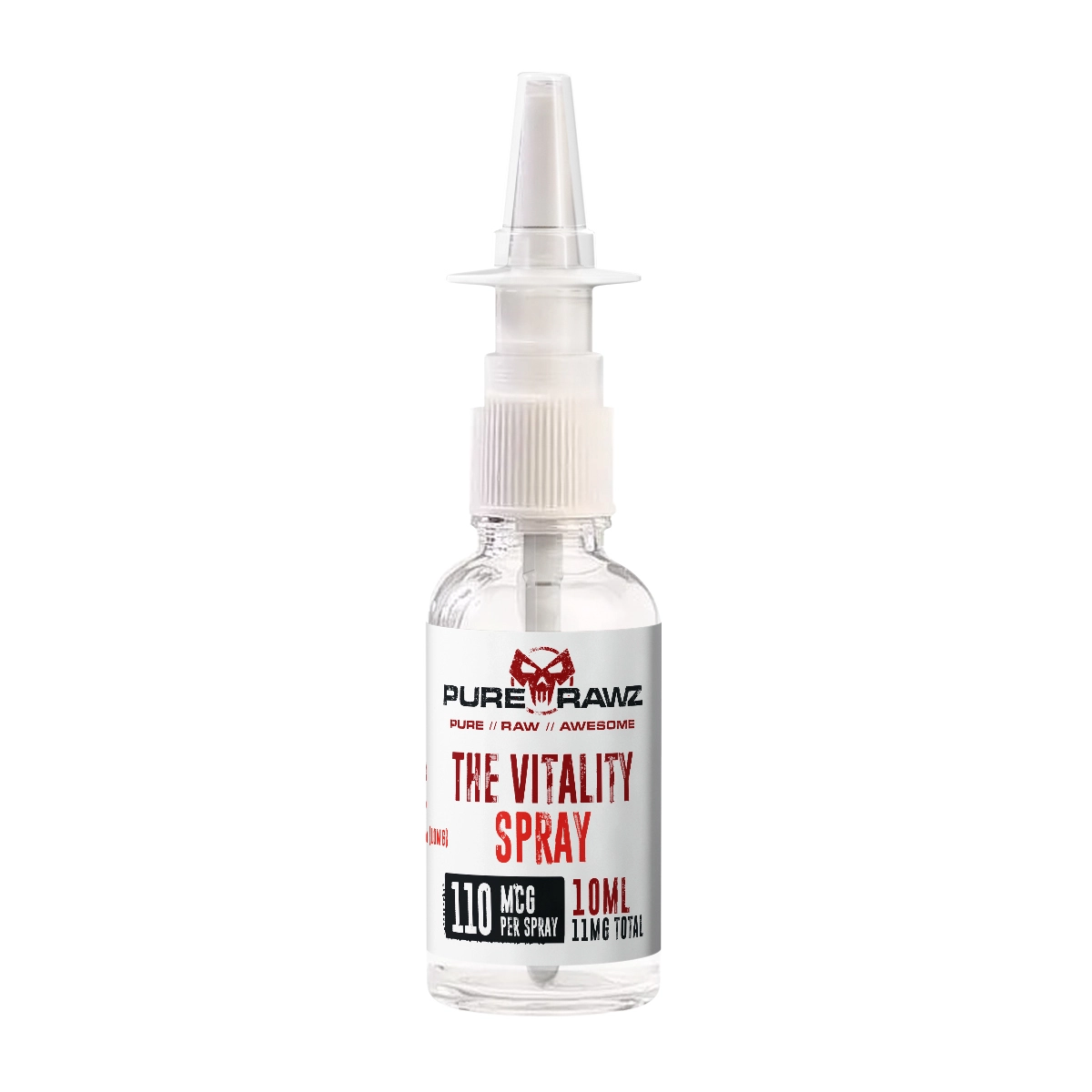
Vitality Spray
$158.48
Earn 158 points upon purchasing this product.
✅ 99% Purity – Third-Party Tested
🚚 Free U.S. Shipping on Orders $100+
 Proudly Made in the USA
⚡ Fast & Reliable Shipping
🔒 Secure Checkout Guaranteed
Enjoy 24/7 customer support, 1st & 3rd party verified 99% purity, and free shipping on orders over $100!
Description
Overview of MOTS-c + Tesofensine Nasal Spray
Vitality Spray is an investigational formulation containing MOTS-c and Tesofensine, delivered as a 10 mL nasal spray. MOTS-c is a mitochondrial-derived peptide identified in experimental models as a regulator of intracellular metabolic signaling and energy-related pathways. Tesofensine is a synthetic monoamine reuptake inhibitor that interacts with dopamine, norepinephrine, and serotonin transporter systems in preclinical studies.
It is important to note that this product is intended strictly for laboratory-based investigation.
MOTS-c
MOTS-c is a mitochondria-encoded peptide composed of 16 amino acids. It is structurally classified as a short peptide involved in intracellular signaling processes related to energy regulation.
| MOTS-c | |
| CAS Number | 1627580-64-6 |
| Molar Mass | 2174.6 g/mol |
| Chemical Formula | C101H152N28O22S2 |
| IUPAC Name | (4S)-4-[[(2S)-5-amino-2-[[(2S)-2-[[(2S)-2-[[(2S)-2-amino-4-methylsulfanylbutanoyl]amino]-5-carbamimidamidopentanoyl]amino]-3-(1H-indol-3-yl)propanoyl]amino]-5-oxopentanoyl]amino]-5-[[(2S)-1-[[2-[[(2S)-1-[[(2S,3S)-1-[[(2S)-1-[[(2S)-1-[(2S)-2-[[(2S)-1-[[(2S)-6-amino-1-[[(2S)-1-[[(1S)-4-carbamimidamido-1-carboxybutyl]amino]-4-methyl-1-oxopentan-2-yl]amino]-1-oxohexan-2-yl]amino]-5-carbamimidamido-1-oxopentan-2-yl]carbamoyl]pyrrolidin-1-yl]-3-(4-hydroxyphenyl)-1-oxopropan-2-yl]amino]-1-oxo-3-phenylpropan-2-yl]amino]-3-methyl-1-oxopentan-2-yl]amino]-3-(4-hydroxyphenyl)-1-oxopropan-2-yl]amino]-2-oxoethyl]amino]-4-methylsulfanyl-1-oxobutan-2-yl]amino]-5-oxopentanoic acid |
Tesofensine
Tesofensine is a synthetic small molecule belonging to the class of monoamine reuptake inhibitors. It is structurally designed to modulate transporter-mediated neurotransmitter dynamics in experimental systems
| Tesofensine | |
| CAS Number | 195875-84-4 |
| Molar Mass | 328.3 g/mol |
| Chemical Formula | C17H23Cl2NO |
| IUPAC Name | (1R,2R,3S,5S)-3-(3,4-dichlorophenyl)-2-(ethoxymethyl)-8-methyl-8-azabicyclo[3.2.1]octane |
How does Vitality Spray work?
MOTS-c Mechanism: Cellular Energy Signaling and Metabolic Regulation
MOTS-c has shown that it can translocate to the nucleus under metabolic stress and participate in the regulation of gene expression linked to metabolic adaptation.
MOTS-c interacts with folate and one-carbon metabolic pathways, contributing to the regulation of intracellular metabolic intermediates and nucleotide synthesis. These interactions have been associated with modulation of the AMP/ATP ratio, a key indicator of cellular energy status.
An increased AMP/ATP ratio is associated with the activation of AMP-activated protein kinase (AMPK), a central regulator of energy homeostasis. AMPK activation has been shown to regulate downstream processes such as mitochondrial biogenesis, glucose metabolism, and lipid oxidation in experimental models.
Tesofensine Mechanism Monoamine Transport Regulation
Tesofensine is a triple monoamine reuptake inhibitor that interacts with transporter proteins located on presynaptic neuron membranes. It has been shown to inhibit the reuptake of dopamine, serotonin, and norepinephrine, leading to increased extracellular monoamine concentrations in experimental and clinical studies.
This elevation in monoamine signaling can influence postsynaptic receptor activity and intracellular signaling pathways, including cyclic AMP (cAMP)-related cascades. These pathways are involved in the regulation of neural activity, reward signaling, and energy balance.
Tesofensine has been studied in clinical and experimental research for its effects on neural signaling related to feeding behavior and energy balance, mediated through central monoaminergic pathways.
Combined Investigational Perspective
The combination of MOTS-c and Tesofensine allows researchers to study interactions between mitochondrial-derived metabolic signaling and monoaminergic transporter activity under controlled experimental conditions.
Research Applications of Vitality Spray
Vitality Spray is intended solely for laboratory research and may be used for:
- Investigation of mitochondrial-derived signaling pathways
- Study of AMPK-related metabolic regulation in cellular models
- Evaluation of monoamine transporter function and neurotransmitter dynamics
- Analysis of intracellular signaling pathways associated with energy metabolism
- Examination of interactions between metabolic and monoaminergic systems in experimental settings
Why Choose Purerawz for Vitality Spray?
Buy Vitality Spray for laboratory research use from our online shop. At Purerawz, we provide high-quality reference materials. Each research compound comes with a Certificate of Analysis for verification of purity and concentration.
Note:
Vitality Spray is an investigational compound currently undergoing clinical evaluation and has not been established as safe or effective for any therapeutic use
Disclaimer
This information is for educational purposes only and not medical advice. Products are for research use only. Research must follow IRB or IACUC guidelines. Verify information independently before purchasing. By ordering, you agree to our Terms and Conditions. If you are not 100% satisfied with the product you received, please contact us at support@staging.purerawz.co
ATTENTION: All our products are for LABORATORY AND RESEARCH PURPOSES ONLY, not for veterinary or human use
Reference Links
Lee, C., Zeng, J., Drew, B. G., Sallam, T., Martin-Montalvo, A., Wan, J., Kim, S. J., Mehta, H., Hevener, A. L., de Cabo, R., & Cohen, P. (2015). The mitochondrial-derived peptide MOTS-c promotes metabolic homeostasis and reduces obesity and insulin resistance. Cell Metabolism, 21(3), 443–454. https://pubmed.ncbi.nlm.nih.gov/25738459/
Hardie, D. G., Ross, F. A., & Hawley, S. A. (2012). AMPK: a nutrient and energy sensor that maintains energy homeostasis. Nature Reviews Molecular Cell Biology, 13(4), 251–262. https://pubmed.ncbi.nlm.nih.gov/22436748/
Heal, D. J., Gosden, J., & Smith, S. L. (2013). What is the prognosis for new centrally acting anti-obesity drugs? Neuropharmacology, 63(1), 132–146. https://pubmed.ncbi.nlm.nih.gov/22313529/
Tesofensine. PubChem Compound Summary. https://pubchem.ncbi.nlm.nih.gov/compound/Tesofensine
MOTS-c. PubChem Compound Summary. https://pubchem.ncbi.nlm.nih.gov/compound/146675088
Astrup, A., Madsbad, S., Breum, L., Jensen, T. J., Kroustrup, J. P., & Larsen, T. M. (2008). Effect of tesofensine on bodyweight loss, body composition, and quality of life in obese patients: a randomized, double-blind, placebo-controlled trial. The Lancet, 372(9653), 1906–1913. https://pubmed.ncbi.nlm.nih.gov/18950853/
Kim, K. H., Son, J. M., Benayoun, B. A., & Lee, C. (2018). The mitochondrial-encoded peptide MOTS-c translocates to the nucleus to regulate nuclear gene expression in response to metabolic stress. Cell Metabolism, 28(3), 516–524.e7. https://pubmed.ncbi.nlm.nih.gov/29983246/

Dr. Helma Wennemers
Dr. Helma Wennemers is a globally recognized chemist shaping modern peptide science and molecular design through highly original research in applied biosciences.
Her work explores how precise molecular architecture can be engineered to create new functional systems in chemistry and life sciences. Her contributions continue to redefine contemporary chemical research through creativity, depth, and structural innovation.
Please click here to access instructions on how to make a payment.
How to PayRelated products
-

TB-500
Price range: $45.33 through $315.36 Select options This product has multiple variants. The options may be chosen on the product page -
Emideltide
Price range: $49.90 through $90.09 Select options This product has multiple variants. The options may be chosen on the product page -
ACTH (4-7) Pro-Gly-Pro
Price range: $34.98 through $128.54 Select options This product has multiple variants. The options may be chosen on the product page -
N-Acetyl Epithalon Amidate
Price range: $171.57 through $419.51 Select options This product has multiple variants. The options may be chosen on the product page


