
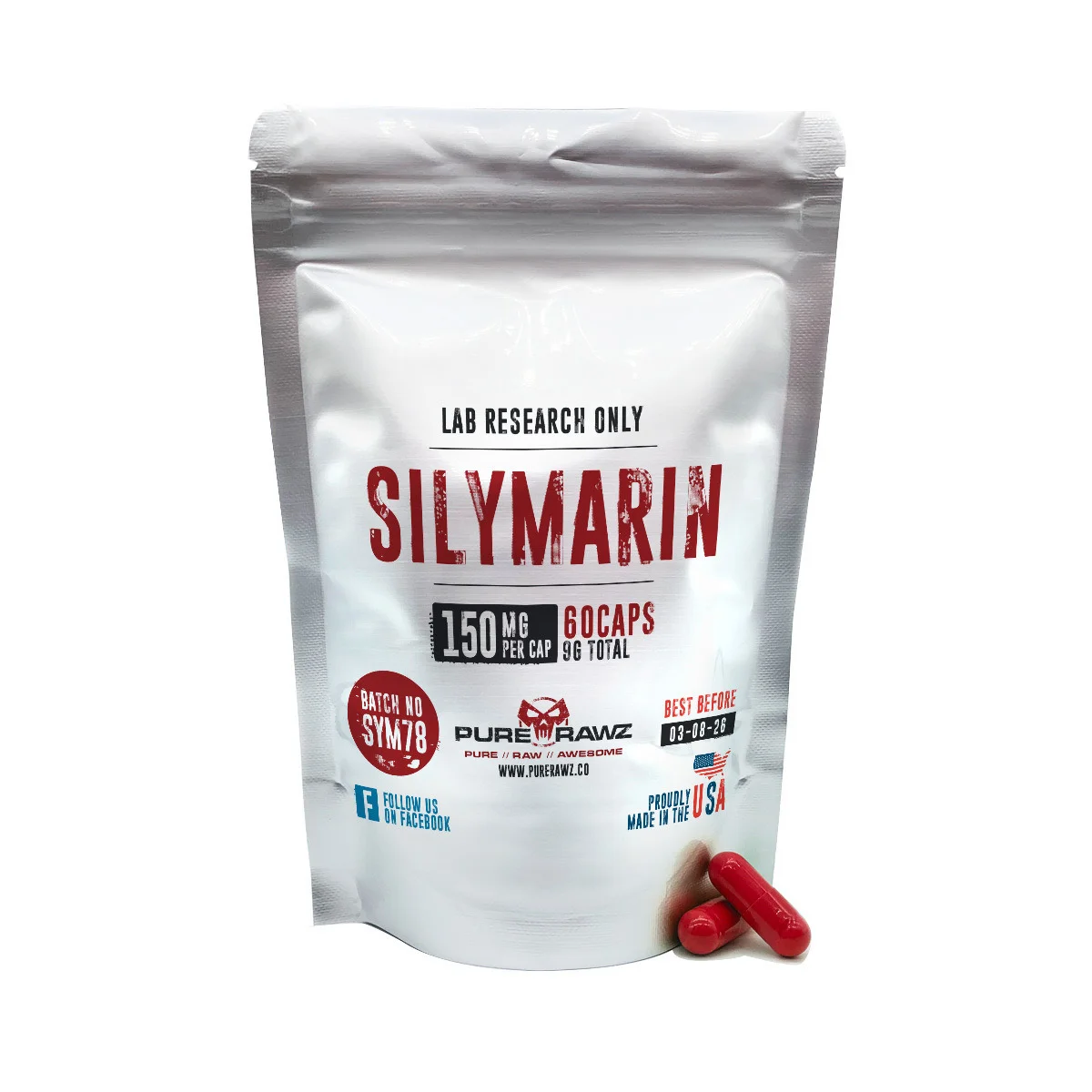
Silymarin (Milk Thistle)
$11.45
Earn 11 points upon purchasing this product.
✅ 99% Purity – Third-Party Tested
🚚 Free U.S. Shipping on Orders $100+
 Proudly Made in the USA
⚡ Fast & Reliable Shipping
🔒 Secure Checkout Guaranteed
Enjoy 24/7 customer support, 1st & 3rd party verified 99% purity, and free shipping on orders over $100!
Description
Silymarin (Milk Thistle) Overview
Silymarin (Milk Thistle) is a laboratory formulation composed of flavonolignan compounds. These are extracted from the seeds of Silybum marianum and widely studied in research environments.
Silymarin is examined for its potential antioxidant, hepatoprotective, and molecular signaling properties. Laboratory studies focus on its role in cellular oxidative stress pathways and enzyme regulation.
Silymarin is frequently used in experimental models to investigate liver-related biochemical processes and protein interaction pathways. It is also studied for intracellular antioxidant responses within controlled research settings.
Silymarin is supplied strictly for laboratory and research use. It is not intended for human consumption, therapeutic use, or diagnostic applications. This product is not approved by the FDA.
Chemical and Molecular Properties
| Property | Description |
| Compound Name | Silymarin (Milk Thistle) |
| Key Component | Flavonolignans (Silybin, Silychristin, Silydianin) |
| Chemical Type | Plant-derived polyphenolic research chemical formulation |
| Molecular Components | Silybin (C25H22O10), Silychristin (C25H22O10), Silydianin (C25H22O10) |
| Chemical Class | Flavonolignans / Botanical extracts |
| Lab Safety Required | Handle as a laboratory chemical reagent and follow standard laboratory safety protocols |
| Storage Conditions | Store in a cool, dry environment away from direct light |
| Status | Not for human or animal consumption |
| Regulatory Status | Not FDA-Approved |
Working Mechanism of Silymarin (Milk Thistle)
Antioxidant and Cellular Protection Research
Silymarin is extensively investigated in laboratory research for its antioxidant activity and its ability to interact with cellular oxidative stress pathways. Experimental studies focus on:
- free radical scavenging
- protection of cellular membranes
- modulation of intracellular redox balance
These studies allow researchers to observe molecular events related to oxidative stress reduction in controlled experimental systems.
Enzyme and Protein Interaction Analysis
Silymarin's flavonolignan compounds are studied for their ability to interact with enzyme systems and protein signaling networks. Laboratory investigations may explore:
- enzyme activity modulation
- protein interaction pathways
- intracellular signaling related to cytoprotection
These analyses help researchers understand biochemical regulatory mechanisms at a molecular level.
Molecular Signaling and Hepatic Biochemistry
Laboratory studies examine Silymarin's influence on cellular signaling pathways, particularly those related to hepatocyte function and stress response. Researchers may analyze:
- intracellular protective signaling mechanisms
- regulation of detoxification-related enzymes
- flavonolignan-mediated transcriptional activity
These studies contribute to a deeper understanding of plant-derived molecular signaling in controlled biochemical research.
Multi-Compound Biochemical Interaction Analysis
Silymarin contains multiple flavonolignan components (Silybin, Silychristin, Silydianin) which enable the study of combined biochemical effects in laboratory models. Investigational studies may explore:
- antioxidant signaling pathways
- enzyme regulatory mechanisms
- molecular interactions among flavonolignan compounds
Such research allows scientists to evaluate complex biochemical interactions within experimental cellular systems.
Research Applications
In laboratory and experimental environments, Silymarin (Milk Thistle) may be utilized for:
- Antioxidant pathway studies
- Enzyme modulation research
- Cellular protective mechanism investigations
- Molecular signaling pathway analysis
- Biochemical pathway modeling in controlled laboratory systems
These applications are conducted strictly within scientific and experimental research settings.
Buy Silymarin (Milk Thistle) from Purerawz for Research Use
Research organizations and laboratory professionals can obtain Silymarin (Milk Thistle) through our online platform for investigational laboratory research applications.
At Purerawz, this formulation is provided exclusively as a research chemical preparation intended for scientific evaluation and controlled experimental analysis. Each batch is independently tested and supplied with Certificates of Analysis (COA) to support transparency, quality assurance, and reliability in laboratory research environments.
Regulatory Status and Disclaimer
Silymarin (Milk Thistle) is supplied exclusively as a research chemical for laboratory investigation.
This product:
- Is not FDA approved
- Is not intended for human or veterinary use
- Should only be handled by qualified research professionals
- Must be used solely in controlled laboratory environments
Note: Any use outside of legitimate research settings is not recommended.
References
https://pubchem.ncbi.nlm.nih.gov/compound/Silymarin
https://pubmed.ncbi.nlm.nih.gov/20564545
https://www.ncbi.nlm.nih.gov/pmc/articles/PMC6277331
https://pubmed.ncbi.nlm.nih.gov/27809307

Dr. Helma Wennemers
Dr. Helma Wennemers is a globally recognized chemist shaping modern peptide science and molecular design through highly original research in applied biosciences.
Her work explores how precise molecular architecture can be engineered to create new functional systems in chemistry and life sciences. Her contributions continue to redefine contemporary chemical research through creativity, depth, and structural innovation.
Please click here to access instructions on how to make a payment.
How to PayRelated products
-

RAD 140 (Testolone)
Price range: $35.50 through $184.72 Select options This product has multiple variants. The options may be chosen on the product page -
Enclomiphene Citrate
Price range: $62.85 through $133.90 Select options This product has multiple variants. The options may be chosen on the product page -
Arimistane
Price range: $67.96 through $234.28 Select options This product has multiple variants. The options may be chosen on the product page -
Coleus Forskohlii 20%
$21.85 Select options This product has multiple variants. The options may be chosen on the product page


