
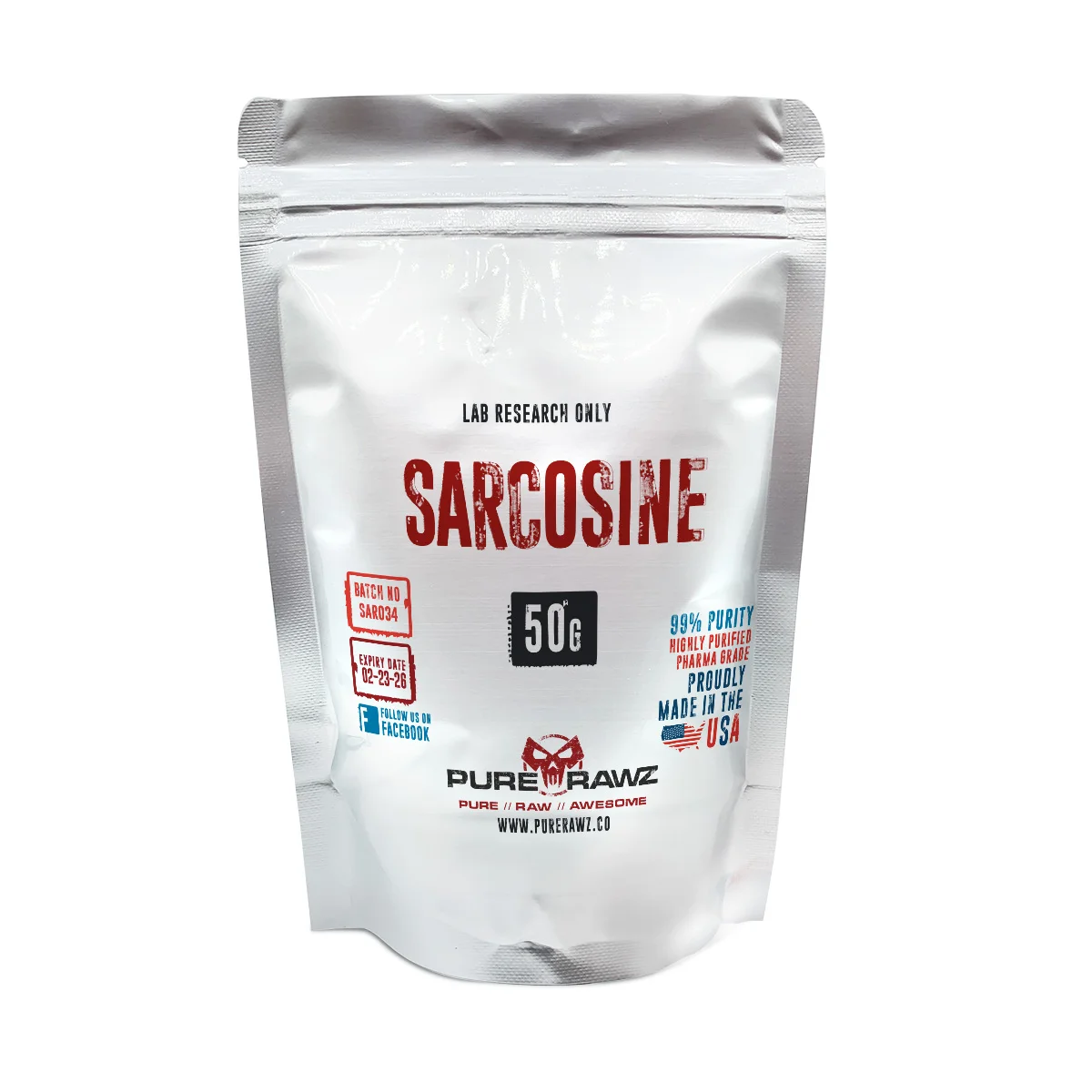
Sarcosine
$13.10
Earn 13 points upon purchasing this product.
✅ 99% Purity – Third-Party Tested
🚚 Free U.S. Shipping on Orders $100+
 Proudly Made in the USA
⚡ Fast & Reliable Shipping
🔒 Secure Checkout Guaranteed
Enjoy 24/7 customer support, 1st & 3rd party verified 99% purity, and free shipping on orders over $100!
Description
Overview
Sarcosine, also known as N-methylglycine, is a naturally occurring amino acid derivative and metabolic intermediate associated with glycine metabolism. It is classified as a methylated glycine analogue and participates in biochemical pathways linked to one-carbon metabolism and amino acid interconversion.
In biological systems, sarcosine occurs as a metabolic intermediate in the conversion pathway between choline and glycine, where it is generated and subsequently metabolized through enzymatic reactions involving sarcosine dehydrogenase. In laboratory settings, the compound may also be synthesized through chemical reactions involving methylamine and chloroacetic acid, producing a stable amino acid derivative suitable for research applications.
Chemical and Molecular Properties
| Property | Verified Data |
| Compound Name | Sarcosine |
| Chemical Name | N-Methylglycine |
| CAS Number | 107-97-1 |
| Molecular Formula | C3H7NO2 |
| Molecular Weight | 89.09 g/mol |
| PubChem CID | 115 |
| IUPAC Name | N-methylglycine |
| Chemical Classification | Amino acid derivative / glycine metabolite |
Working Mechanism
In investigational neurochemical research, sarcosine has been studied for its interaction with glycine transporter type-1 (GlyT1) systems. GlyT1 is responsible for regulating extracellular glycine concentrations by facilitating glycine reuptake into cells.
In in vitro experimental systems, sarcosine has been observed to interact with this transporter mechanism, leading researchers to study its role as a GlyT1 transport inhibitor. Inhibition of this transporter in research models may increase extracellular glycine availability in synaptic environments.
Elevated extracellular glycine levels are investigated because glycine functions as a co-agonist at the glycine modulatory site of N-methyl-D-aspartate (NMDA) receptors, a class of glutamatergic receptors involved in synaptic signaling and neuronal communication.
Through modulation of glycine transport systems, sarcosine has been examined in laboratory models for its potential influence on:
- NMDA receptor–associated signaling pathways
- Synaptic glycine concentration dynamics
- Glutamatergic neurotransmission regulation
- Amino acid transporter activity in neural systems
Additionally, sarcosine may serve as a direct ligand for the NMDA receptor glycine-binding site in certain experimental conditions, making it useful in mechanistic research focused on receptor activation and neurotransmitter signaling dynamics.
Research Applications of the Product in Laboratory Settings
Glycine Transporter Research
Sarcosine is frequently used in in vitro transporter studies examining the regulation of glycine transporter-1 (GlyT1) activity. These experiments investigate how transporter inhibition alters extracellular glycine concentrations and downstream receptor signaling.
NMDA Receptor Signaling Studies
Because glycine functions as a co-agonist for NMDA receptors, sarcosine is used in experimental neurochemical models to study NMDA receptor activation, receptor modulation, and synaptic signaling mechanisms.
Neurotransmitter Pathway Research
In cell culture and experimental neurobiology systems, sarcosine is investigated for its role in regulating neurotransmitter-related signaling pathways associated with glutamatergic transmission and synaptic communication.
Metabolic Pathway Investigations
Sarcosine is also studied in biochemical research models exploring one-carbon metabolism, amino acid interconversion pathways, and enzymatic processes involving glycine derivatives.
Molecular Biomarker Research
In some cellular and biochemical research investigations, sarcosine levels have been examined as part of metabolic profiling studies aimed at identifying potential metabolic markers associated with cellular metabolic changes.
Why Choose Purerawz for Sarcosine?
Buy Sarcosine for laboratory research use from our online shop. At Purerawz, we provide high-quality reference materials. Each research compound comes with a Certificate of Analysis for verification of purity and concentration.
Disclaimer
This information is for educational purposes only and not medical advice. Products are for research use only. Research must follow IRB or IACUC guidelines. Verify information independently before purchasing. By ordering, you agree to our Terms and Conditions. If you are not 100% satisfied with the product you received, please contact us at support@staging.purerawz.co
Reference Links
- Zhang, H. X., Lyons-Warren, A., & Thio, L. L. (2009). The glycine transport inhibitor sarcosine is an inhibitory glycine receptor agonist.Neuropharmacology, 57(5–6), 551–555. https://doi.org/10.1016/j.neuropharm.2009.07.019
- Shan, G., Bian, Y., Ren, S., Hu, Z., Pan, B., Zeng, D., Zheng, Z., Fan, H., Bi, G., Yao, G., & Zhan, C. (2025). Sarcosine sensitizes lung adenocarcinoma to chemotherapy by dual activation of ferroptosis via PDK4/PDHA1 signaling and NMDAR-mediated iron export. Experimental Hematology and Oncology,14(1), 60. https://doi.org/10.1186/s40164-025-00657-0

Dr. Helma Wennemers
Dr. Helma Wennemers is a globally recognized chemist shaping modern peptide science and molecular design through highly original research in applied biosciences.
Her work explores how precise molecular architecture can be engineered to create new functional systems in chemistry and life sciences. Her contributions continue to redefine contemporary chemical research through creativity, depth, and structural innovation.
Please click here to access instructions on how to make a payment.
How to PayRelated products
-

Vincamine
Price range: $15.83 through $49.18 Select options This product has multiple variants. The options may be chosen on the product page -
Agomelatine
$61.76 Select options This product has multiple variants. The options may be chosen on the product page -
Fonturacetam Phenylpiracetam Hydrazide 98%
Price range: $25.68 through $71.05 Select options This product has multiple variants. The options may be chosen on the product page -
Compound 7P
$62.85 Select options This product has multiple variants. The options may be chosen on the product page


