
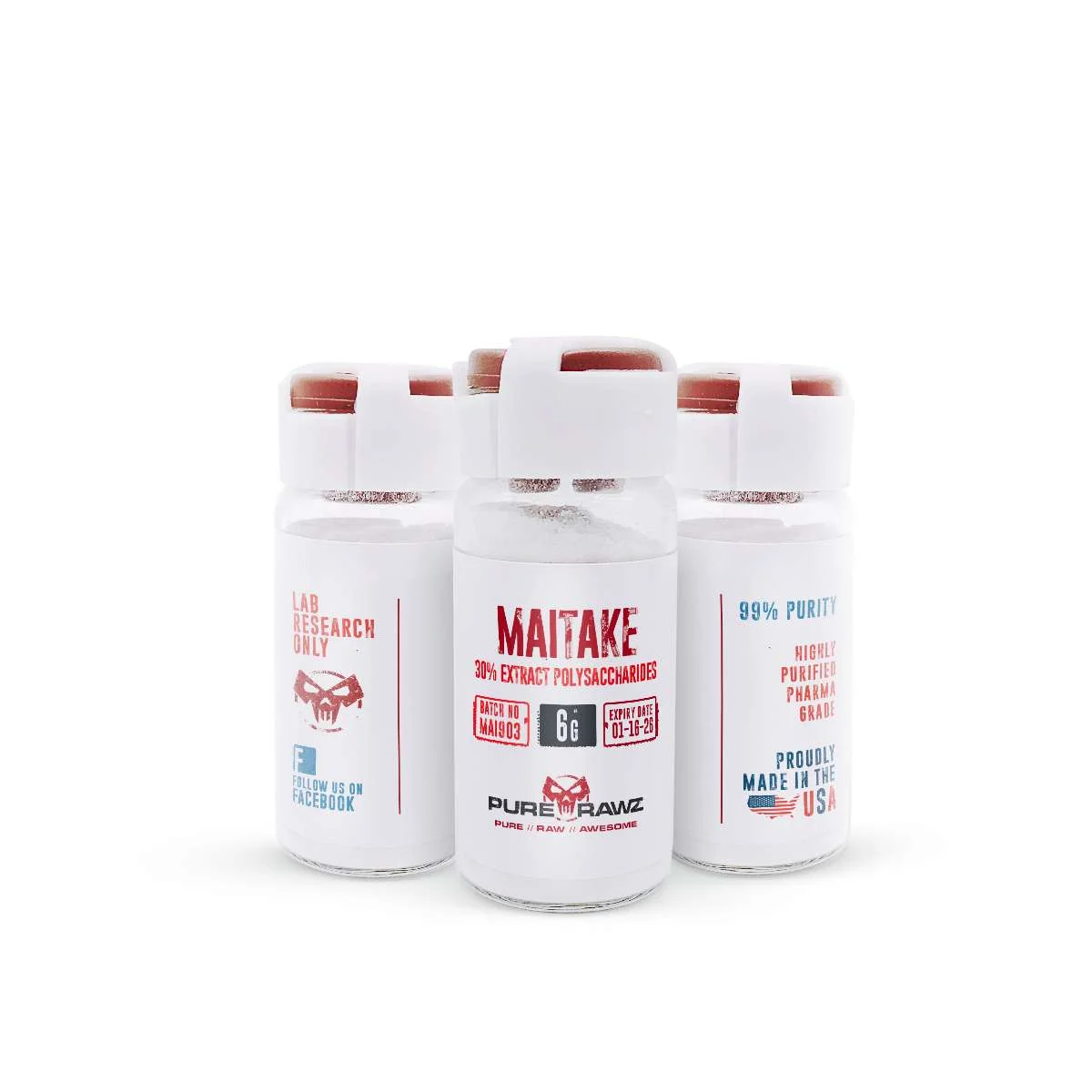
Maitake Powder 30% Extract POLYSACCHARIDES
Price range: $13.66 through $50.26
Earn 14 - 50 points upon purchasing this product.
✅ 99% Purity – Third-Party Tested
🚚 Free U.S. Shipping on Orders $100+
 Proudly Made in the USA
⚡ Fast & Reliable Shipping
🔒 Secure Checkout Guaranteed
Enjoy 24/7 customer support, 1st & 3rd party verified 99% purity, and free shipping on orders over $100!
Description
Overview of Maitake 30% Extract Polysaccharides
Maitake extract is a research-grade mushroom extract derived from Grifola frondosa. It contains polysaccharides, including beta-glucans, along with ergosterol and other metabolites. This extract is intended for laboratory research. It is used to study molecular interactions, signaling pathways, and cellular activity.
Chemical and Molecular Properties
| Maitake 30% Extract Polysaccharides | |
| PubChem CID | Not available (extract is a complex mixture of polysaccharides) |
| Molecular Formula | Not applicable (polysaccharide mixture; β–glucan and α–glucan) |
| Molecular Weight | Variable; typically high–molecular–weight β-glucans (100 kDa – >1 MDa) depending on extraction method |
| Source | Grifola frondosa fruiting body and mycelium |
| Major Constituents | Major Constituents
β-glucans (β–1,3 / β–1,6 polysaccharides), minor α-glucans, proteins, ergosterol, and other fungal metabolites |
| CAS | Not applicable (natural extract, not a single chemical) |
| Labeling | Research Use Only (RUO); not for human or animal use |
| Classification | Natural fungal extract (polysaccharide-rich mushroom extract) |
| Storage Temperature | Lyophilized: –20°C or colder |
| Solubility | Partially soluble in water; limited solubility in organic solvents |
| Safety | Handle with gloves, lab coat, and eye protection; use fume hood if dust/aerosol is possible; not for ingestion or animal/human use |
Various Mechanisms of Maitake 30% Extract Polysaccharides
Polysaccharide Activity
- Beta-glucans interact with receptors on cultured immune-related cells. This interaction triggers intracellular signaling.
- Activation of cytokine-related pathways has been observed. These observations were made in isolated cell assays.
Structural Influence
- Variations in β–glucan linkages (β–1,3 vs. β–1,6) affect receptor binding. These variations also influence downstream signaling in vitro.
Cellular Interactions
- Maitake polysaccharides and mycelial extracts have been tested for mitogenic activity. These tests were conducted in isolated cells.
- They influence cellular pathways related to proliferation. They also affect signaling in laboratory models.
Complementary Compounds
- Ergosterol and other metabolites contribute to molecular interactions in cell-based assays.
Research Applications of Maitake 30% Extract Polysaccharides
- In vitro studies of polysaccharide-mediated signaling pathways
- Cellular assays for receptor binding and cytokine modulation
- Mitogenic activity in isolated immune and other cell types
- Comparative studies of β-glucan structural variations
Why Choose Purerawz for Maitake 30% Extract Polysaccharides?
Buy Maitake 30% Extract POLYSACCHARIDES for laboratory research use from our online shop. At Purerawz, we provide high-quality reference materials. Each research compound comes with a Certificate of Analysis for verification of purity and concentration.
Note:
Maitake 30% Extract POLYSACCHARIDES is an investigational compound currently undergoing clinical evaluation and has not been established as safe or effective for any therapeutic use
Disclaimer
This information is for educational purposes only and not medical advice. Products are for research use only. Research must follow IRB or IACUC guidelines. Verify information independently before purchasing. By ordering, you agree to our Terms and Conditions. If you are not 100% satisfied with the product you received, please contact us at support@staging.purerawz.co
ATTENTION: All our products are for LABORATORY AND RESEARCH PURPOSES ONLY, not for veterinary or human use
Reference Links
Sun, N., Zhao, Y., & Yin, M. (2023). Extraction, purification, structure and bioactivities of Polysaccharides from Grifola frondosa (maitake): a review. Journal of Food Measurement & Characterization, 17(6), 6200–6213. https://doi.org/10.1007/s11694-023-02133-x
Deng, G., Lin, H., Seidman, A., Fornier, M., D’Andrea, G., Wesa, K., Yeung, S., Cunningham-Rundles, S., Vickers, A. J., & Cassileth, B. (2009). A phase I/II trial of a polysaccharide extract from Grifola frondosa (Maitake mushroom) in breast cancer patients: immunological effects. Journal of Cancer Research and Clinical Oncology, 135(9), 1215–1221. https://doi.org/10.1007/s00432-009-0562-z Cited for mechanistic research context only; does not imply human therapeutic use.
Kodama, N., Kakuno, T., & Nanba, H. (2003). Stimulation of the natural immune system in normal mice by polysaccharide from maitake mushrooms. Mycoscience, 44(3), 257–261. https://doi.org/10.1007/s10267-003-0099-y

Dr. Helma Wennemers
Dr. Helma Wennemers is a globally recognized chemist shaping modern peptide science and molecular design through highly original research in applied biosciences.
Her work explores how precise molecular architecture can be engineered to create new functional systems in chemistry and life sciences. Her contributions continue to redefine contemporary chemical research through creativity, depth, and structural innovation.
Please click here to access instructions on how to make a payment.
How to PayRelated products
-

Reishi Extract 30% Powder
Price range: $19.11 through $50.26 Select options This product has multiple variants. The options may be chosen on the product page -
Kava Extract 70% Kavalactones
Price range: $19.66 through $47.52 Select options This product has multiple variants. The options may be chosen on the product page -
Coleus Forskohlii 20%
$21.85 Select options This product has multiple variants. The options may be chosen on the product page -
Orlistat
Price range: $66.68 through $103.83 Select options This product has multiple variants. The options may be chosen on the product page


