
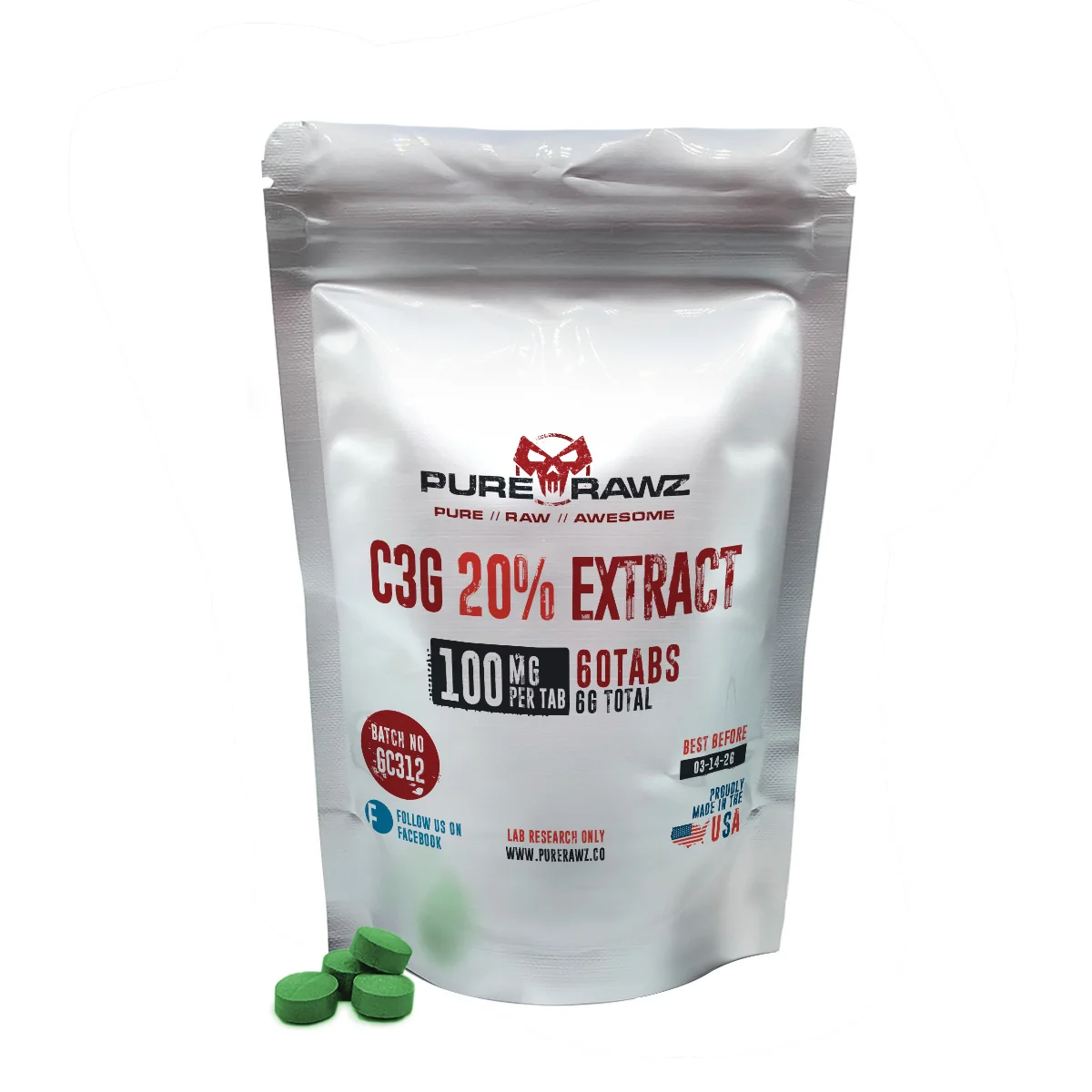
C3G (Cyanidin 3 Glucoside)
Price range: $51.90 through $127.32
Earn 52 - 127 points upon purchasing this product.
✅ 99% Purity – Third-Party Tested
🚚 Free U.S. Shipping on Orders $100+
 Proudly Made in the USA
⚡ Fast & Reliable Shipping
🔒 Secure Checkout Guaranteed
Enjoy 24/7 customer support, 1st & 3rd party verified 99% purity, and free shipping on orders over $100!
Description
Overview of C3G
C3G (Cyanidin-3-Glucoside) is a naturally occurring anthocyanin pigment. It belongs to the flavonoid class. C3G is formed when cyanidin attaches to a glucose molecule at the 3-position. It is water-soluble and exhibits color changes in response to pH variations.
Chemical Properties
| C3G | |
| PubChem CID | 197081 |
| Molecular Formula | C21H21ClO11 |
| Molecular Weight | 484.8 g/mol |
| Source | Naturally occurring anthocyanin pigment in plants (e.g., berries, black rice, purple corn) |
| Major Constituents | Cyanidin-3-O-glucoside, Chloride form |
| CAS | 7084-24-4 |
| Labeling | For research use only; laboratory applications; not for human or veterinary use |
| Chemical Structure Depiction | 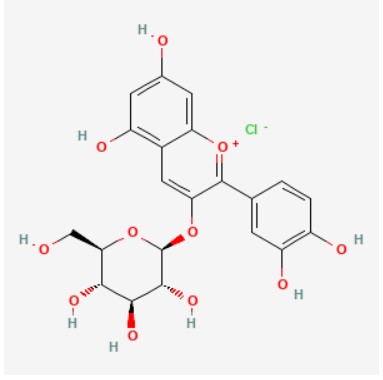 |
| Purity | Typically ≥ 95% (verify with manufacturer certificate of analysis) |
| Classification | Flavonoid, Anthocyanin, Glycoside |
| Storage Temperature | 2–8 °C, protected from light and moisture |
| Solubility | Water–soluble; color changes with pH variations |
| Safety | Handle using standard laboratory safety procedures; use personal protective equipment (PPE); avoid ingestion and contact with skin or eyes |
Various Mechanisms of C3G
Free Radical Interaction
C3G has electron-donating properties. These properties allow it to interact with reactive oxygen species (ROS) in chemical and cellular model systems.
Signal Pathway Modulation
C3G can interact with NF-κB signaling components. It also influences associated molecular pathways under controlled experimental conditions.
Enzymatic and Kinase Interactions
C3G affects AMP-activated protein kinase (AMPK) phosphorylation. This modulation influences downstream molecular events related to cellular energy metabolism in vitro.
Research Applications
C3G is utilized in laboratory research to investigate its biochemical and molecular interactions. It is applied in studies of reactive oxygen species (ROS) modulation and redox chemistry. Researchers also examine signal transduction pathways, including NF-κB and kinase activity (e.g., AMPK). C3G is used in spectroscopic and analytical chemistry studies that leverage its water solubility and pH-dependent color changes. Additionally, it supports structure–function analyses of anthocyanins, glycoside linkages, and flavonoid stability, with all applications strictly limited to research use and not implying effects on living subjects.
Why Choose Purerawz for C3G?
Buy C3G for laboratory research use from our online shop. At Purerawz, we provide high-quality reference materials. Each research compound comes with a Certificate of Analysis for verification of purity and concentration.
Note:
C3G is an investigational compound currently undergoing clinical evaluation and has not been established as safe or effective for any therapeutic use
Disclaimer
This information is for educational purposes only and not medical advice. Products are for research use only. Research must follow IRB or IACUC guidelines. Verify information independently before purchasing. By ordering, you agree to our Terms and Conditions. If you are not 100% satisfied with the product you received, please contact us at support@staging.purerawz.co
ATTENTION: All our products are for LABORATORY AND RESEARCH PURPOSES ONLY, not for veterinary or human use
Reference Links
PubChem. (n.d.). Cyanidin 3-O-glucoside (CID 197081). PubChem Compound Database. U.S. National Library of Medicine. https://pubchem.ncbi.nlm.nih.gov/compound/197081
Ohba, Y. (2001). Requirement for C3G-dependent Rap1 activation for cell adhesion and embryogenesis. The EMBO Journal, 20(13), 3333–3341.https://doi.org/10.1093/emboj/20.13.3333
Donadelli, R., Pulieri, P., Piras, R., Iatropoulos, P., Valoti, E., Benigni, A., Remuzzi, G., & Noris, M. (2018). Unraveling the molecular mechanisms underlying complement dysregulation by nephritic factors in C3G and IC-MPGN. Frontiers in Immunology, 9, 2329. https://doi.org/10.3389/fimmu.2018.02329

Dr. Helma Wennemers
Dr. Helma Wennemers is a globally recognized chemist shaping modern peptide science and molecular design through highly original research in applied biosciences.
Her work explores how precise molecular architecture can be engineered to create new functional systems in chemistry and life sciences. Her contributions continue to redefine contemporary chemical research through creativity, depth, and structural innovation.
Please click here to access instructions on how to make a payment.
How to PayRelated products
-

CDP Choline (Citicoline)
$28.41 Select options This product has multiple variants. The options may be chosen on the product page -
Fonturacetam Phenylpiracetam Hydrazide 98%
Price range: $25.68 through $71.05 Select options This product has multiple variants. The options may be chosen on the product page -
Vincamine
Price range: $15.83 through $49.18 Select options This product has multiple variants. The options may be chosen on the product page -
Pramiracetam
Price range: $8.59 through $18.91 Select options This product has multiple variants. The options may be chosen on the product page


