
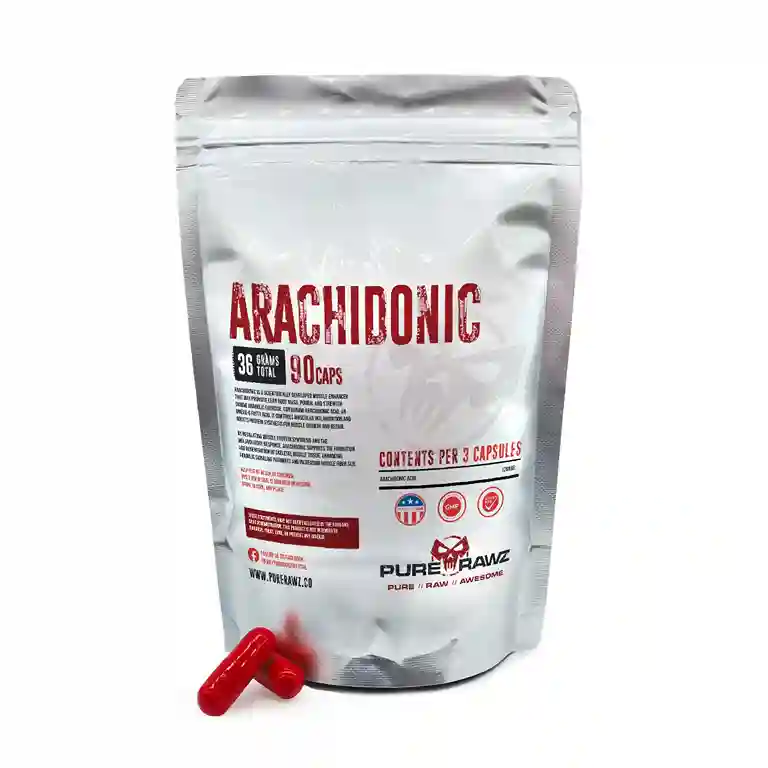
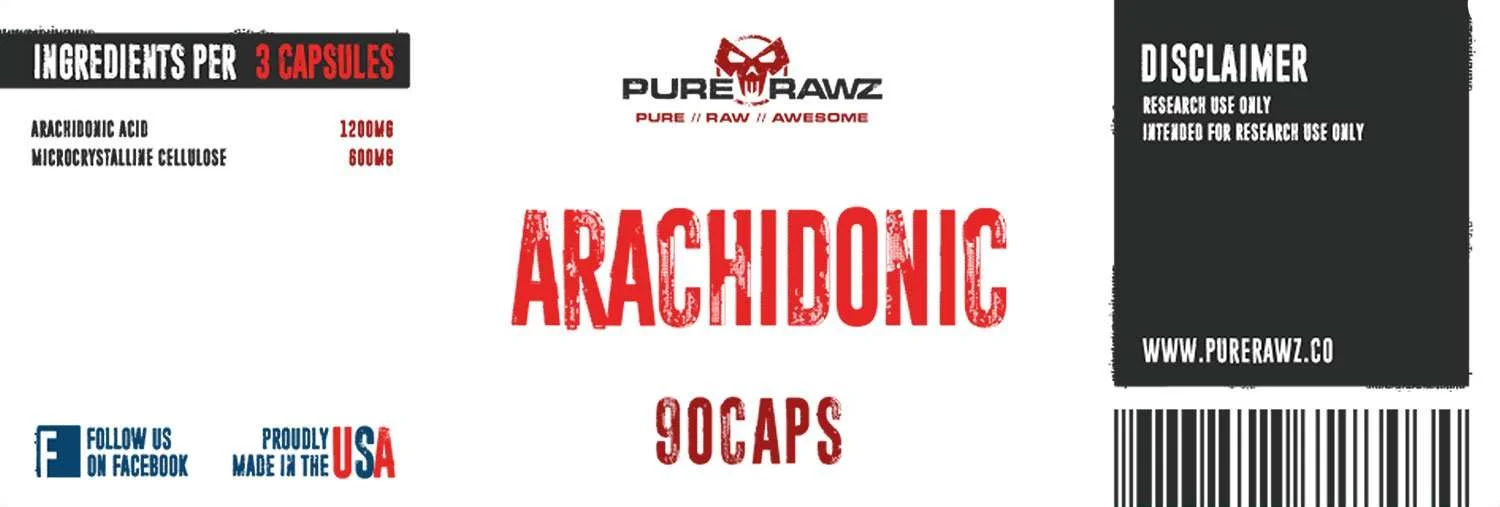
Arachidonic
$33.66
Earn 34 points upon purchasing this product.
✅ 99% Purity – Third-Party Tested
🚚 Free U.S. Shipping on Orders $100+
 Proudly Made in the USA
⚡ Fast & Reliable Shipping
🔒 Secure Checkout Guaranteed
Enjoy 24/7 customer support, 1st & 3rd party verified 99% purity, and free shipping on orders over $100!
Description
Arachidonic Acid
Product Overview
Arachidonic Acid Capsules contain arachidonic acid (ARA), an omega-6 polyunsaturated fatty acid. In biological systems, ARA can be found in membrane phospholipids. When released from cell membranes, ARA may serve as a precursor for several biologically active molecules, including prostaglandins and leukotrienes, which participate in cellular signaling related to immune responses and tissue regulation.
PureRawz supplies Arachidonic Acid capsules strictly for laboratory and scientific research purposes.
| Property | Value |
| Compound Name | Arachidonic Acid |
| Molecular Formula | C20H32O2 |
| Molecular Weight | 304.5 g/mol |
| Carbon Structure | 20-carbon fatty acid with four double bonds |
| Synonyms |
|
| CIUPAC Name | (5Z,8Z,11Z,14Z)-icosa-5,8,11,14-tetraenoic acid |
Research Applications of Arachidonic Acid
- Because of its role in cellular signaling systems and lipid mediator pathways, arachidonic acid has been carefully studied in biochemical and physiological studies.
- It can be used in the analysis of cell signaling pathways, lipid metabolism, and membrane composition.
- ARA serves as a precursor molecule for eicosanoids, including prostaglandins, thromboxanes, and leukotrienes.
- There are experimental models that investigate how lipid mediators influence skeletal muscle cell signaling and tissue responses.
- ARA is present in neuronal membrane phospholipids and is sometimes studied in brain lipid metabolism and neural signaling processes.
- Arachidonic acid is often used in analyzing membrane composition, lipid metabolism, and cell signaling mechanisms.
Working Mechanism
Phospholipids in the cell membrane store arachidonic acid. When cells acquire certain biochemical signals, enzymes like phospholipase A2 may release ARA.
Eicosanoid Formation
Arachidonic acid can be broken down by several enzyme processes after it is released:
- Cyclooxygenase (COX) pathway – are produced by the cyclooxygenase (COX) pathway.
- Lipoxygenase (LOX) pathway – are produced by the lipoxygenase (LOX) pathway.
These lipid mediators function as signaling molecules in many cellular processes studied in laboratory environments.
Eicosanoid molecules derived from arachidonic acid are involved in communication between cells during immune responses, inflammatory signaling, and tissue regulation.
Because of these roles, arachidonic acid is commonly used in experimental research examining biochemical signaling pathways.
Why Buy Arachidonic Acid Capsules at PureRawz
PureRawz is one of the best suppliers of top-quality Arachidonic Acid. They supply this research compound through only third-party analytical testing. Along with the other research-grade materials. All products are clearly labeled, and packaging is safely packed.
ATTENTION: All our products are for LABORATORY AND RESEARCH PURPOSES ONLY, not for veterinary or human use.
Disclaimer
All experimental work should follow appropriate institutional research standards, including oversight by IRB or IACUC where applicable. Researchers are responsible for ensuring compliance with all regulations governing laboratory chemicals and research materials. Reach out to support@staging.purerawz.co for more information.
Reference
Calder, P. C. (2015). Functional roles of fatty acids and their effects on human health. Journal of Parenteral and Enteral Nutrition, 39(1), 18S 32S.
Dennis, E. A., & Norris, P. C. (2015). Eicosanoid storm in infection and inflammation. Nature Reviews Immunology, 15(8), 511 523.
Funk, C. D. (2001). Prostaglandins and leukotrienes: Advances in eicosanoid biology. Science, 294(5548), 1871 1875.
Spector, A. A., & Kim, H. Y. (2015). Discovery of essential fatty acids. Journal of Lipid Research, 56(1), 11 21.

Dr. Helma Wennemers
Dr. Helma Wennemers is a globally recognized chemist shaping modern peptide science and molecular design through highly original research in applied biosciences.
Her work explores how precise molecular architecture can be engineered to create new functional systems in chemistry and life sciences. Her contributions continue to redefine contemporary chemical research through creativity, depth, and structural innovation.
Please click here to access instructions on how to make a payment.
How to PayRelated products
-

ZEN Capsules
$32.90 Select options This product has multiple variants. The options may be chosen on the product page -
Collagen Complex
$18.35 Select options This product has multiple variants. The options may be chosen on the product page -
Pre-Workout
$44.37 Select options This product has multiple variants. The options may be chosen on the product page -
Post-Lift
$44.75 Select options This product has multiple variants. The options may be chosen on the product page


